From the free course AP Calculus AB on Lykke
1.7 Selecting Procedures for Determining Limits
Key concepts: Selecting an appropriate procedure for determining a limit · Using equivalent expressions to determine limits · Rearranging expressions into equivalent forms before evaluating a limit · Identifying when a theorem or test is appropriate for a limit · Using mathematical characteristics or properties of functions when selecting a procedure
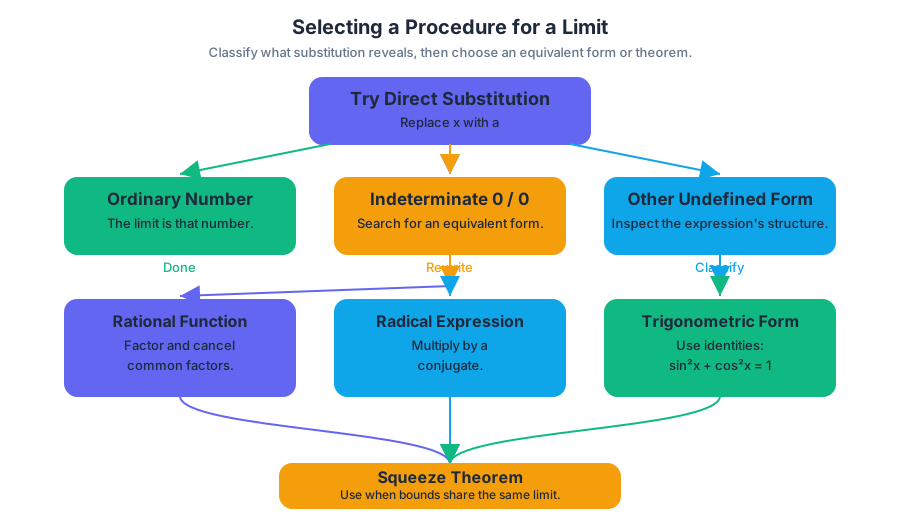
A decision path for limits: try direct substitution, and if it gives 0/0 choose the rewrite that fits the expression, such as factoring, a conjugate, or a trigonometric identity.
1.7 Selecting Procedures for Determining Limits
A limit is often easiest to determine not by calculating harder, but by recognizing what kind of expression is in front of you and choosing a procedure that preserves its behavior.
Enduring Understanding LIM-1: Reasoning with definitions, theorems, and properties can be used to justify claims about limits.
Learning Objective LIM-1.E: Determine the limits of functions using equivalent expressions for the function or the Squeeze Theorem.
Essential Knowledge LIM-1.E.1: It may be necessary or helpful to rearrange expressions into equivalent forms before evaluating limits.
Choosing the procedure
The AP skill emphasized here is 1.C — Identify an appropriate mathematical rule or procedure based on the classification of a given expression. The important decision is not simply “Can I substitute?” but “What does the expression become when I substitute, and what structure does that reveal?”
Use this decision path:
- Try direct substitution. If replacing $x$ with $a$ produces an ordinary real number, that number is the limit.
- If substitution produces $\frac{0}{0}$, the expression is indeterminate, not equal to zero. Search for an equivalent form.
- For rational functions, factor and cancel a common factor when appropriate.
- For radicals, multiply by a conjugate such as $\sqrt{x+c}+d$ or $\sqrt{x+c}-d$.
- For trigonometric expressions, rewrite using identities such as $\sin^2 x+\cos^2 x=1$ or $\tan x=\frac{\sin x}{\cos x}$.
- If the function is trapped between two simpler functions with the same limit, use the Squeeze Theorem.
Equivalent expressions reveal hidden behavior
Two expressions are equivalent on a relevant domain when they produce the same output wherever both are defined. They may look different algebraically, yet have identical limiting behavior near the point of interest. This allows a complicated expression to be replaced by a simpler one before evaluating its limit.
Worked example: a removable algebraic obstruction
Suppose the concentration of a chemical sensor is modeled near $t=3$ by
$$ C(t)=\frac{t^2-9}{t-3}. $$
Direct substitution gives
$$ C(3)=\frac{0}{0}, $$
which tells us only that the original formula cannot be evaluated by substitution. Factor the numerator:
$$ t^2-9=(t-3)(t+3). $$
For $t\ne3$,
$$ C(t)=\frac{(t-3)(t+3)}{t-3}=t+3. $$
Therefore,
$$ \lim_{t\to3}C(t)=\lim_{t\to3}(t+3)=6. $$
The cancellation does not claim that $C(3)$ exists under the original formula. It says that values of $C(t)$ near $t=3$ follow the simpler rule $t+3$, so the limit is $6$.
Radical expressions
For
$$ \lim_{x\to0}\frac{\sqrt{x+4}-2}{x}, $$
substitution again produces $\frac{0}{0}$. Multiply by the conjugate:
$$ \frac{\sqrt{x+4}-2}{x} \cdot \frac{\sqrt{x+4}+2}{\sqrt{x+4}+2}
\frac{x}{x(\sqrt{x+4}+2)}
\frac{1}{\sqrt{x+4}+2}. $$
Thus,
$$ \lim_{x\to0}\frac{\sqrt{x+4}-2}{x}
\frac{1}{4}. $$
Misconception check — “$\frac{0}{0}=0$.” The form $\frac{0}{0}$ is not an answer. It signals that the expression must be classified and transformed, or that another theorem may be needed.
Retrieval check
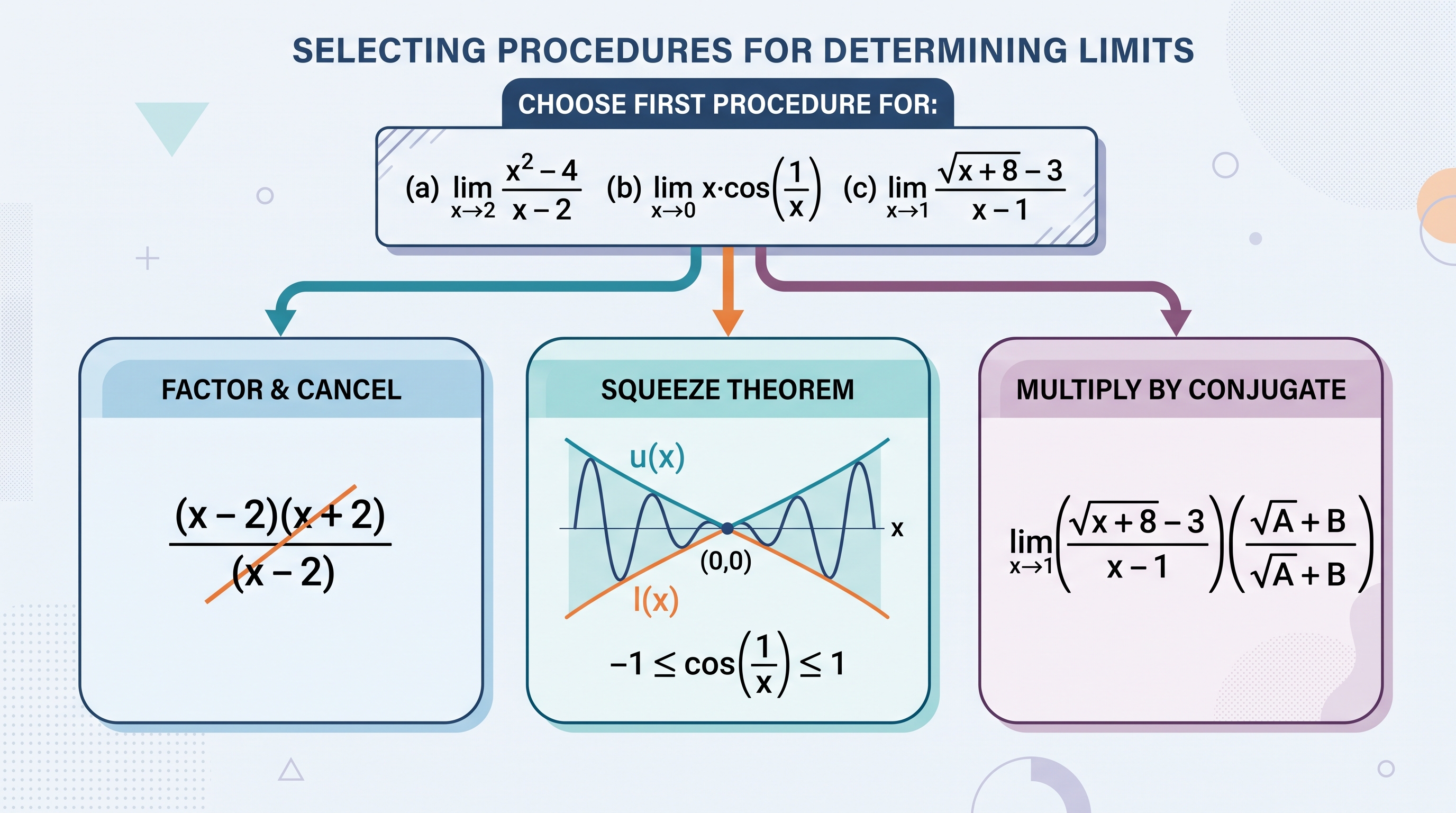
For each expression, name the best first procedure:
(a) $\displaystyle \lim_{x\to2}\frac{x^2-4}{x-2}$;
(b) $\displaystyle \lim_{x\to0}x\cos(1/x)$;
(c) $\displaystyle \lim_{x\to1}\frac{\sqrt{x+8}-3}{x-1}$.
Answers: (a) factor and cancel; (b) use the Squeeze Theorem because $-1\le\cos(1/x)\le1$; (c) multiply by the conjugate. In each case, the procedure follows from the expression’s mathematical characteristics.
Source Materials
- Learn More (.pdf)
- AP Calculus AB and BC Course and Exam Description
- AP Calculus AB Course Overview
- AP Calculus Course at a Glance
- AP Calculus AB and BC Course at a Glance Poster
- Adopt AP Calculus AB
- AP Calculus AB
- AP Calculus AB
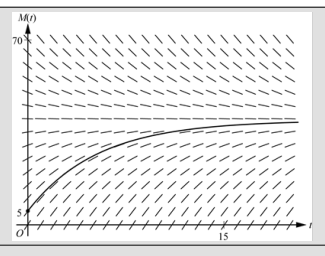
- 0 1 35 40 5 4 4 t dM dt = = − =
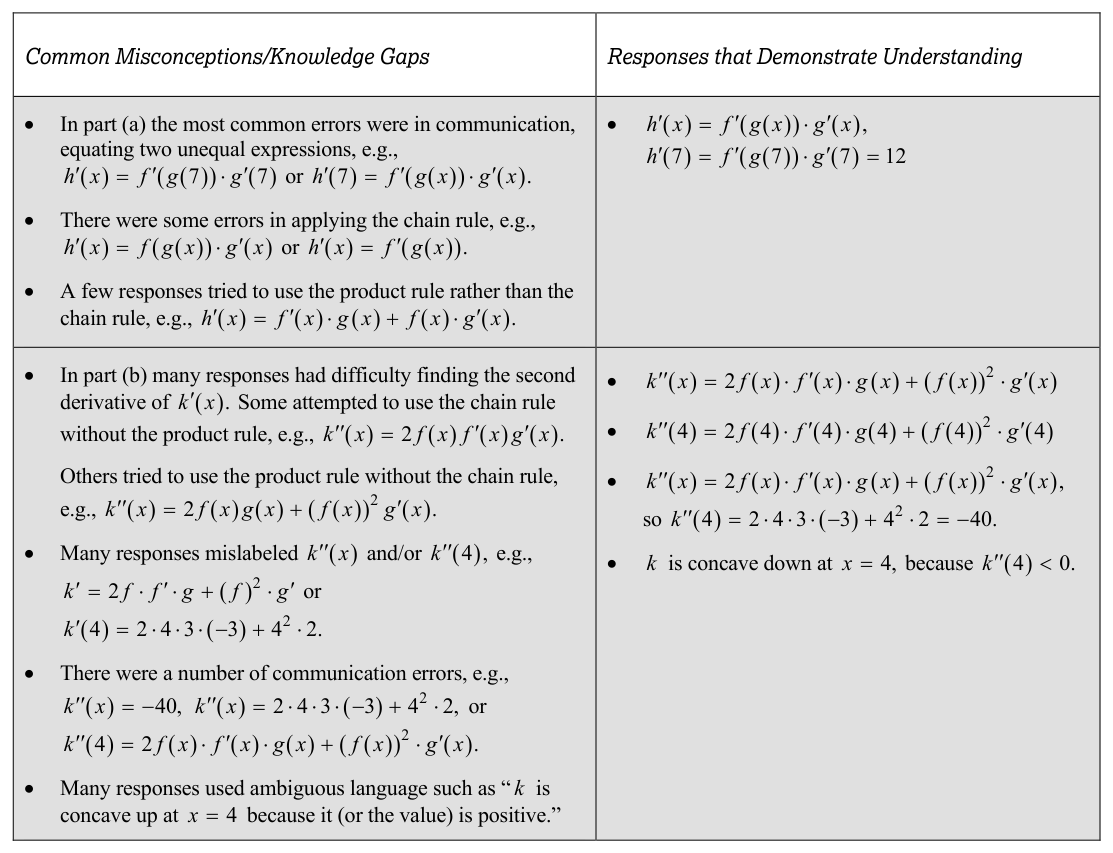
- Figure — Chief Reader Report (p. 19)
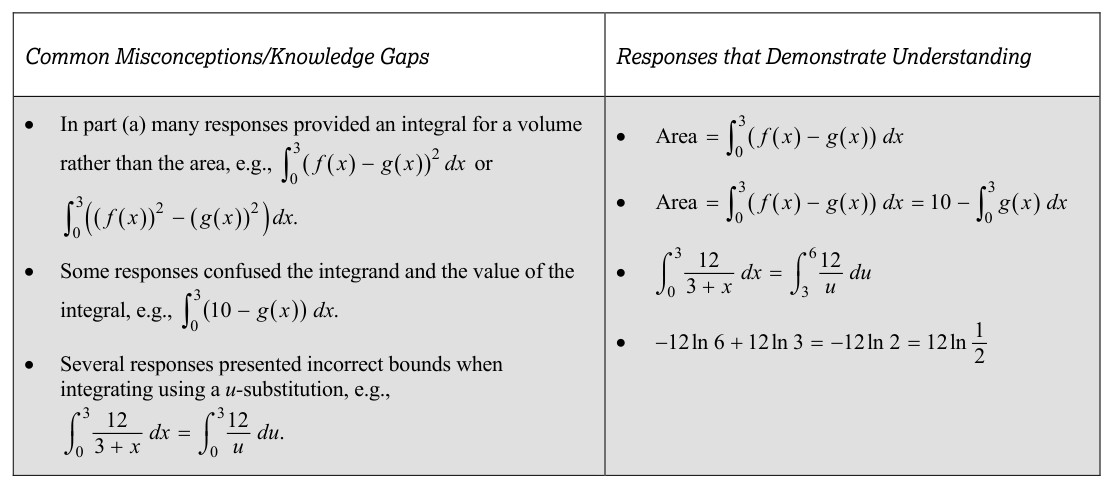
- Figure — Chief Reader Report (p. 31)
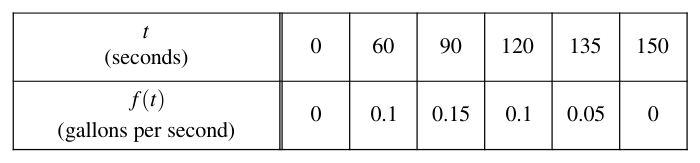
- 1. A customer at a gas station is pumping gasoline into a gas tank. The rate of flow of gasoline is modeled by a