From the free course AP Calculus AB on Lykke
2.1 Defining Average and Instantaneous Rates of Change at a Point
Key concepts: Average rate of change over an interval · Instantaneous rate of change at a point · Defining the derivative using a limit · Modeling dynamic change · The relationship between average rates of change and instantaneous rates of change · Limits as foundational tools for understanding derivatives · Continuity and its connection to limits
How the average rate of change over an interval (a secant slope) becomes the instantaneous rate at a single point (a tangent slope) by taking a limit of difference quotients.
2.1 Defining Average and Instantaneous Rates of Change at a Point
A car can travel $60$ miles in one hour, but that statement does not tell you its speed at exactly $t=23$ minutes. Average rate of change describes what happens across an interval; instantaneous rate of change describes what happens at one input value. Calculus connects them by shrinking the interval until its width approaches zero.
From a secant line to a tangent line
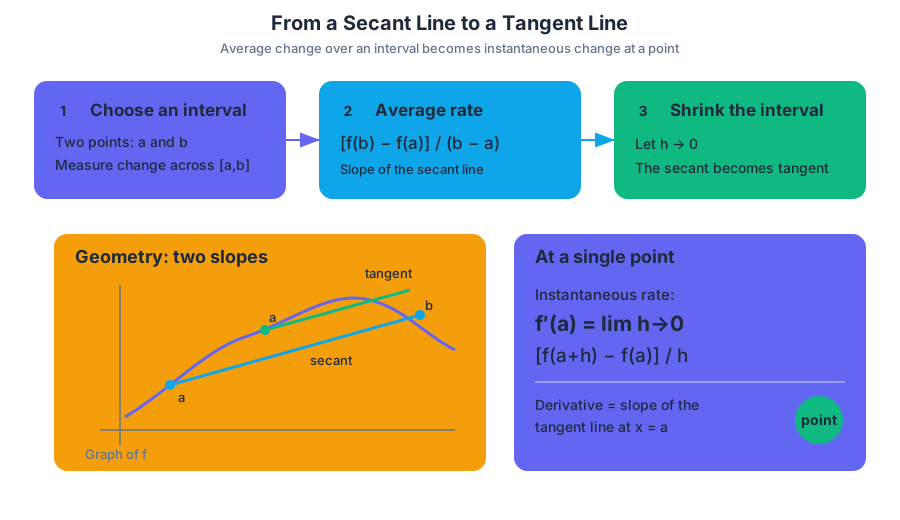
For a function $f$, the average rate of change over the closed interval $[a,b]$ is
$$ \frac{f(b)-f(a)}{b-a}. $$
Geometrically, this is the slope of the secant line, the line joining the two points $(a,f(a))$ and $(b,f(b))$ on the graph.
Suppose a runner’s position is modeled by $s(t)=t^2+2t$, where $s$ is measured in meters and $t$ in seconds. Over $[1,3]$,
$$ \frac{s(3)-s(1)}{3-1}
\frac{(3^2+2\cdot3)-(1^2+2\cdot1)}{2}
\frac{15-3}{2}
$$
The runner’s average velocity is therefore $6\ \text{m/s}$ during that two-second interval.
To estimate the runner’s velocity at exactly $t=1$, use an interval whose other endpoint approaches $1$. With $h$ representing the interval width, the average rate from $t=a$ to $t=a+h$ is
$$ \frac{f(a+h)-f(a)}{h}. $$
As $h\to0$, the secant line approaches the tangent line, the line that captures the graph’s direction at a single point. Its slope is the instantaneous rate of change.
The derivative at a point
The derivative at a point is the limit of average rates of change as the interval shrinks to zero. At $x=a$,
$$ f'(a)=\lim_{h\to0}\frac{f(a+h)-f(a)}{h}, $$
provided this limit exists. An equivalent form is
$$ f'(a)=\lim_{x\to a}\frac{f(x)-f(a)}{x-a}, $$
also provided the limit exists.
Key idea: A derivative is not an average over a tiny interval. It is the limiting value of those averages.
For $s(t)=t^2+2t$, find the instantaneous velocity at $t=1$:
$$ s'(1)=\lim_{h\to0}\frac{s(1+h)-s(1)}{h}. $$
Compute the numerator:
$$ s(1+h)=(1+h)^2+2(1+h)=3+4h+h^2, $$
so
$$ \frac{s(1+h)-s(1)}{h}
\frac{(3+4h+h^2)-3}{h}
4+h. $$
Therefore,
$$ s'(1)=\lim_{h\to0}(4+h)=4. $$
The runner’s instantaneous velocity at $t=1$ is $4\ \text{m/s}$. Notice that substituting $h=0$ into the original difference quotient would produce $0/0$; the algebraic simplification must occur before evaluating the limit.
AP skills and reasoning processes
Topic 2.1 develops Skill 2.B: Identify mathematical information from graphical, numerical, analytical, and/or verbal representations. A response might read a graph to identify a secant slope, use a table to form a difference quotient, or attach correct units to a rate.
Retrieval check
A tank contains $V(t)$ liters after $t$ minutes. Write the average rate of change on $[2,5]$, then the instantaneous rate at $t=2$ using the limit definition. What units should each rate have?
$$ \frac{V(5)-V(2)}{5-2}, \qquad V'(2)=\lim_{h\to0}\frac{V(2+h)-V(2)}{h}. $$
Both rates have units of liters per minute, but the first describes an interval and the second describes one instant.
Source Materials
- Learn More (.pdf)
- AP Calculus AB and BC Course and Exam Description
- AP Calculus AB Course Overview
- AP Calculus Course at a Glance
- AP Calculus AB and BC Course at a Glance Poster
- Adopt AP Calculus AB
- AP Calculus AB
- AP Calculus AB
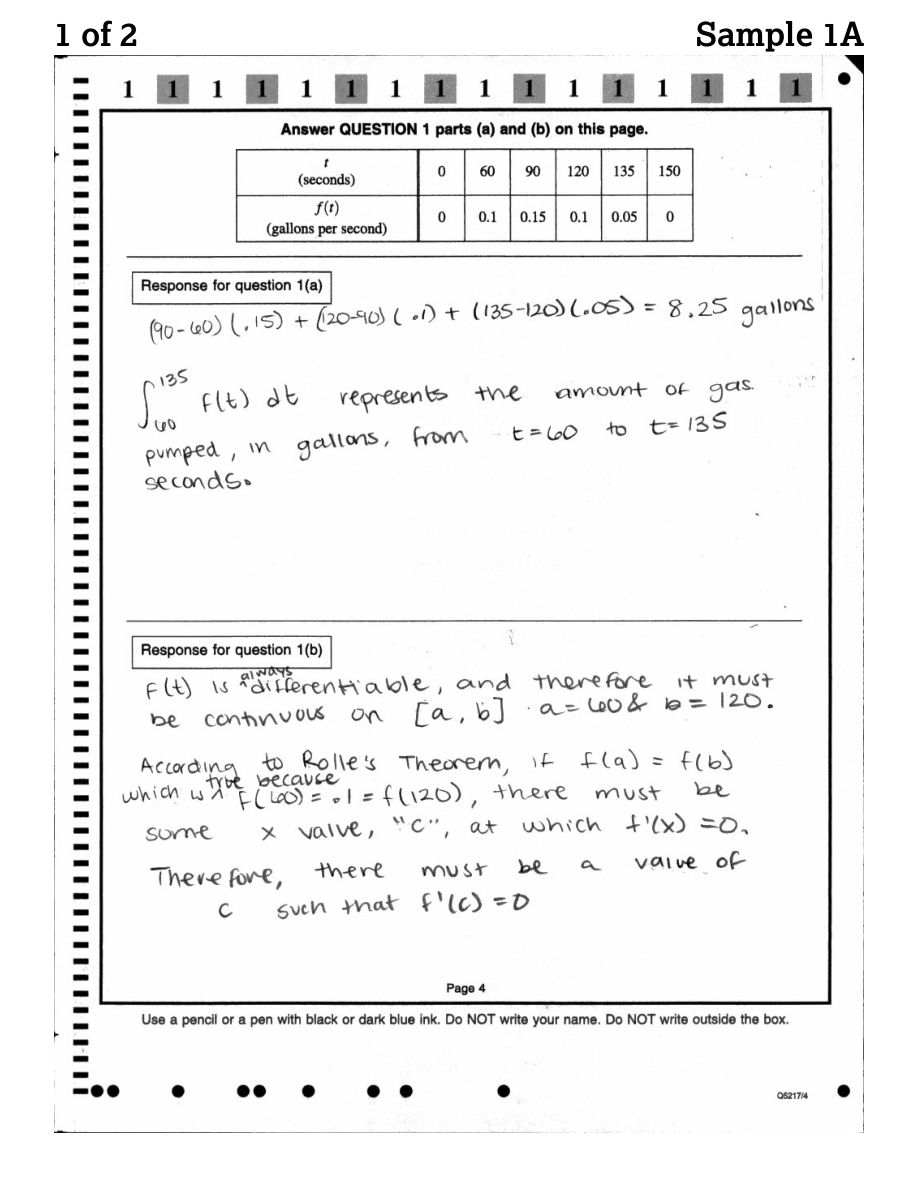
- Figure — Sample Responses Q1 (p. 5)
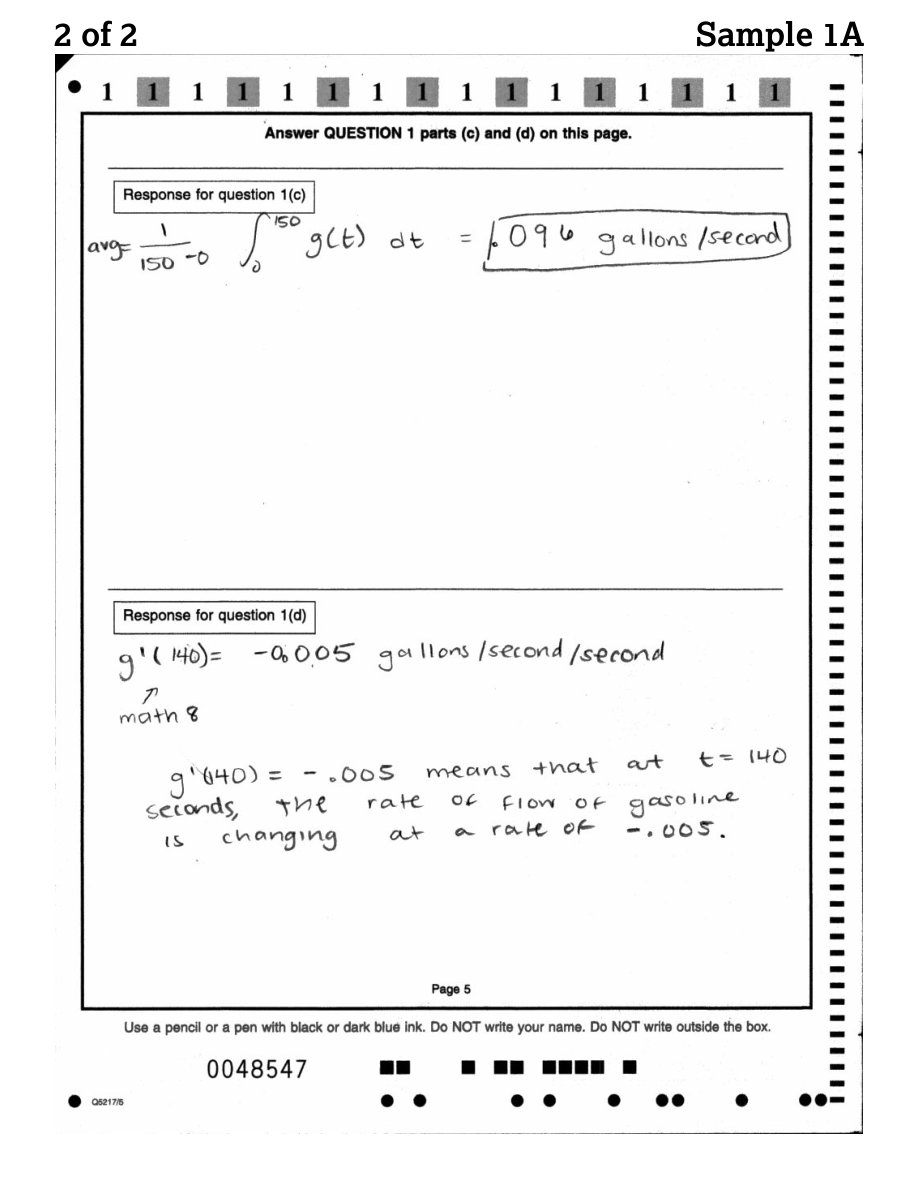
- Figure — Sample Responses Q1 (p. 6)
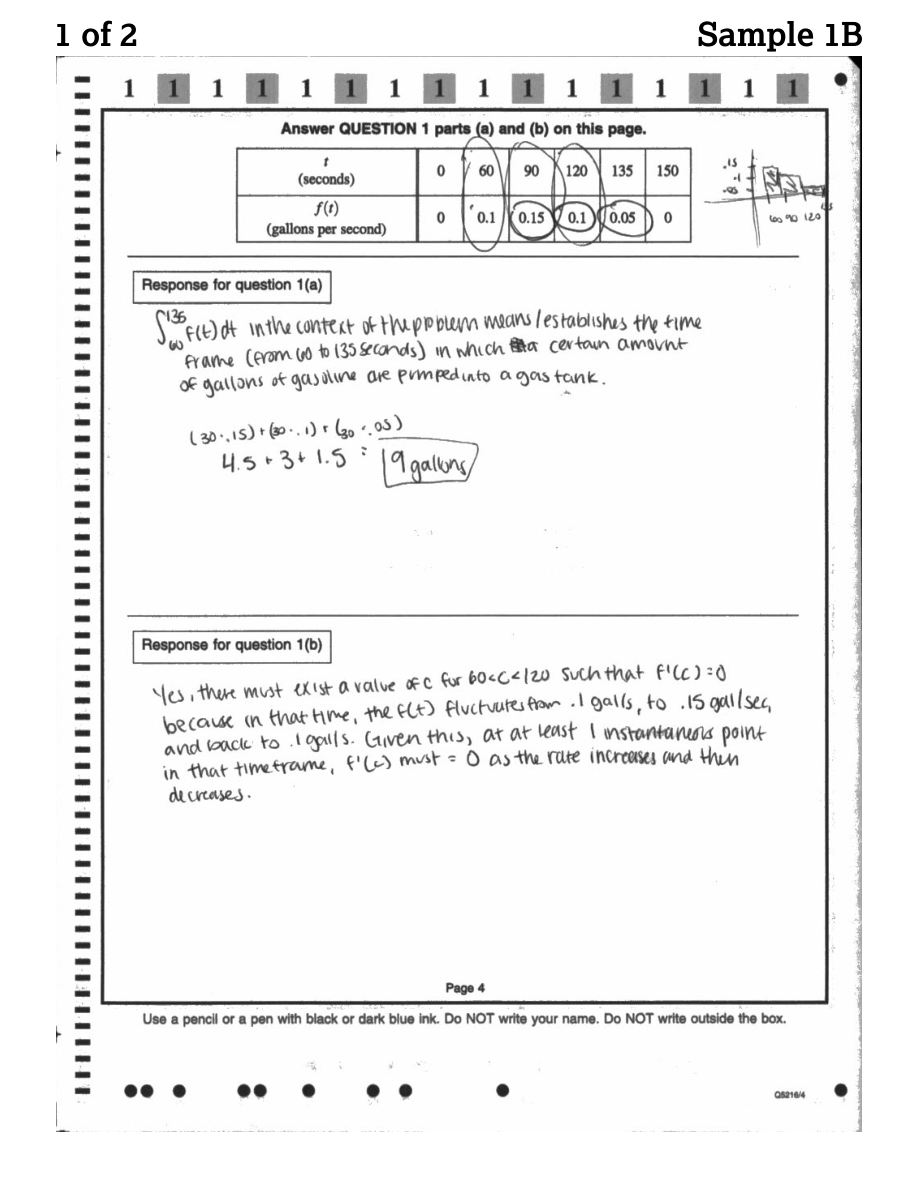
- Figure — Sample Responses Q1 (p. 7)
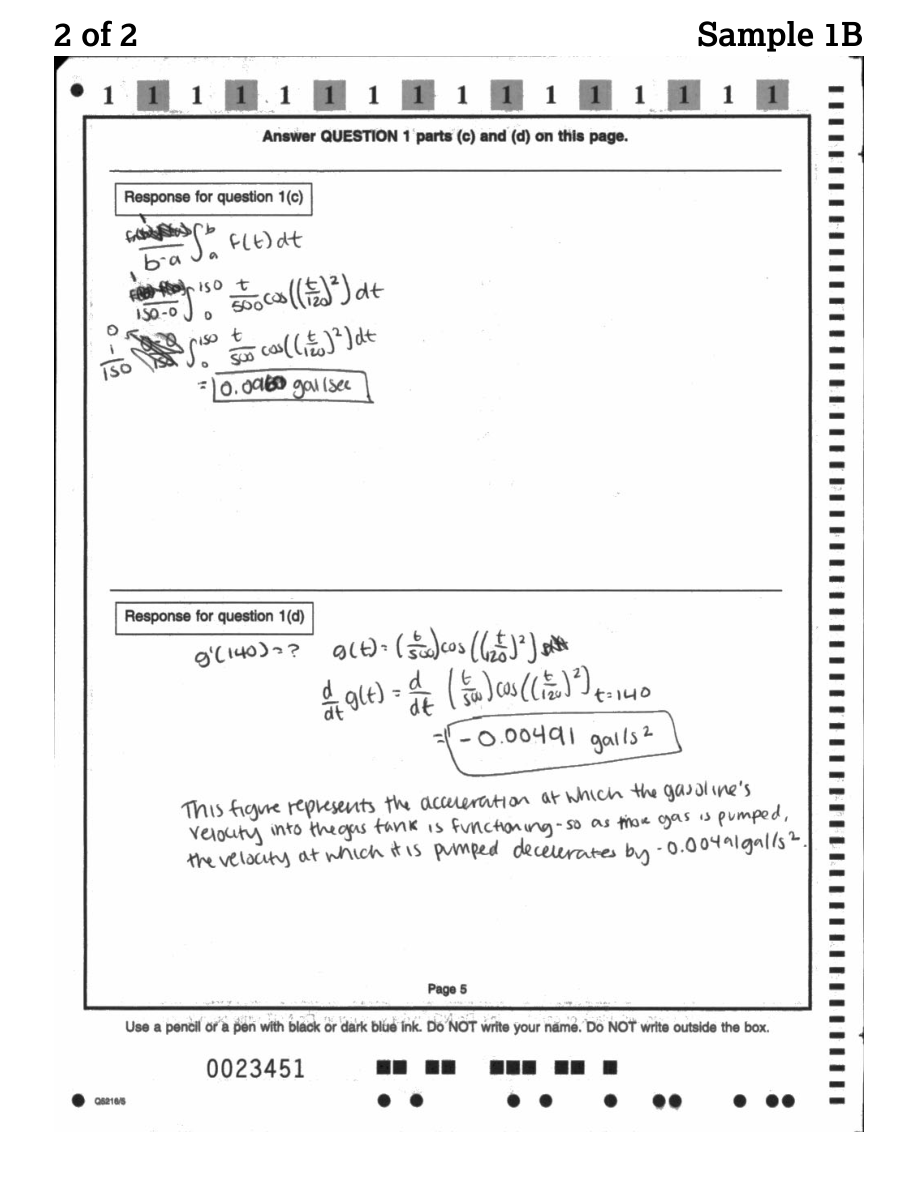
- Figure — Sample Responses Q1 (p. 8)