From the free course AP Calculus AB on Lykke
3.5 Selecting Procedures for Calculating Derivatives
Key concepts: Selecting an appropriate differentiation procedure · Differentiation rules for composite functions · The chain rule · Applying derivative rules with and without technology · Checking derivative answers and notation · Explaining and justifying the choice of a derivative procedure · Recognizing and correcting differentiation errors
How to classify an expression as a power, sum, product, quotient or composition so the right derivative rule is chosen, with the chain rule worked layer by layer and checked with technology.
3.5 Selecting Procedures for Calculating Derivatives
A derivative problem is often decided before any algebra begins: the expression’s structure tells you which rule belongs. A function such as $y=(x^2+1)^3$ is not merely a power; it is a composite function, an outer power applied to an inner quadratic.
Choosing the procedure
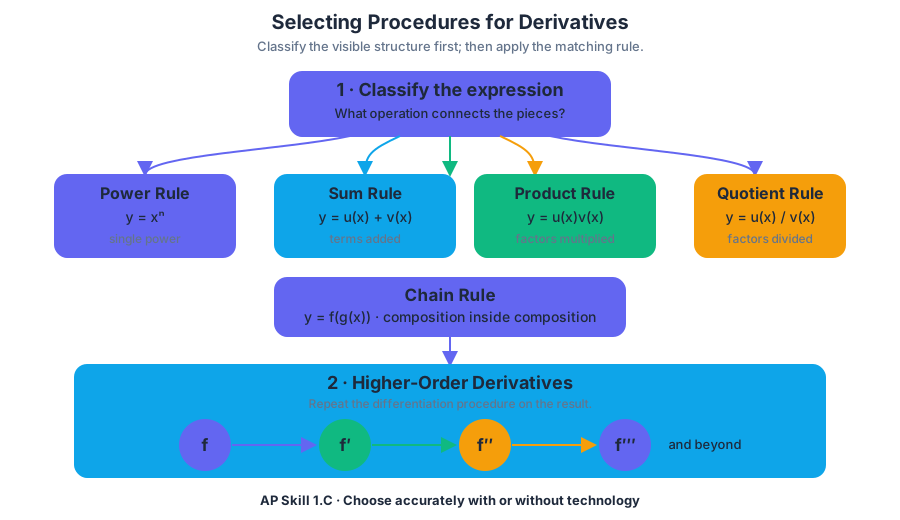
Selecting an appropriate differentiation procedure means classifying the expression before differentiating it. Ask what operation connects the visible pieces:
| Expression structure | Appropriate procedure |
|---|---|
| $y=x^n$ | Power Rule |
| $y=u(x)+v(x)$ | Sum Rule |
| $y=c,u(x)$ | Constant Multiple Rule |
| $y=u(x)v(x)$ | Product Rule |
| $y=\dfrac{u(x)}{v(x)}$ | Quotient Rule |
| $y=f(g(x))$ | Chain Rule |
The relevant AP skill is 1.C Identify an appropriate mathematical rule or procedure based on the classification of a given expression. Topic 3.5 is specifically intended to develop this selection skill, while also requiring accurate application of derivative procedures with and without technology.
The chain rule: differentiate each layer
The chain rule differentiates a composite function by multiplying the derivative of the outer function by the derivative of the inner function. In symbols, if $y=f(g(x))$, then
$$ \frac{dy}{dx}=f'(g(x))\cdot g'(x). $$
A useful visual is a two-stage machine:
$$ x \longrightarrow g(x) \longrightarrow f(g(x)). $$
Differentiate by moving backward through the machine:
$$ \text{outer derivative}\times\text{inner derivative}. $$
Worked example. Let
$$ y=(x^2+1)^3. $$
The inner function is $u=x^2+1$, and the outer function is $u^3$. Differentiate the outer layer while keeping the inner expression intact, then multiply by the derivative of the inner layer:
$$ \frac{dy}{dx}=3(x^2+1)^2(2x) =6x(x^2+1)^2. $$
The same structure applies to trigonometric, exponential, and logarithmic compositions. For example,
$$ y=\sin(4x^2) $$
has outer function $\sin u$ and inner function $u=4x^2$, so
$$ \frac{dy}{dx}=\cos(4x^2)\cdot 8x =8x\cos(4x^2). $$
A technology check
A graphing calculator or computer algebra system can check a derivative, but it does not replace the mathematical procedure or notation. Enter the function $y=(x^2+1)^3$ and request its symbolic derivative. A CAS may return
$$ 3(x^2+1)^2(2x), $$
while handwritten work may give
$$ 6x(x^2+1)^2. $$
These expressions are equivalent because $3(2x)=6x$. To verify numerically, evaluate both at $x=1$:
$$ 3(1^2+1)^2(2)=24, \qquad 6(1)(1^2+1)^2=24. $$
A graphing calculator can also approximate the slope of $y=(x^2+1)^3$ near $x=1$; the result should be close to $24$. Check three things: the function was entered correctly, the derivative uses the correct variable, and the output is algebraically equivalent—not merely visually similar.
Misconception check — “Differentiate only the outside.” Writing
$$ \frac{d}{dx}(x^2+1)^3=3(x^2+1)^2 $$
stops after the outer derivative. The missing factor, $2x$, is the derivative of the inside. Without it, the chain is broken.
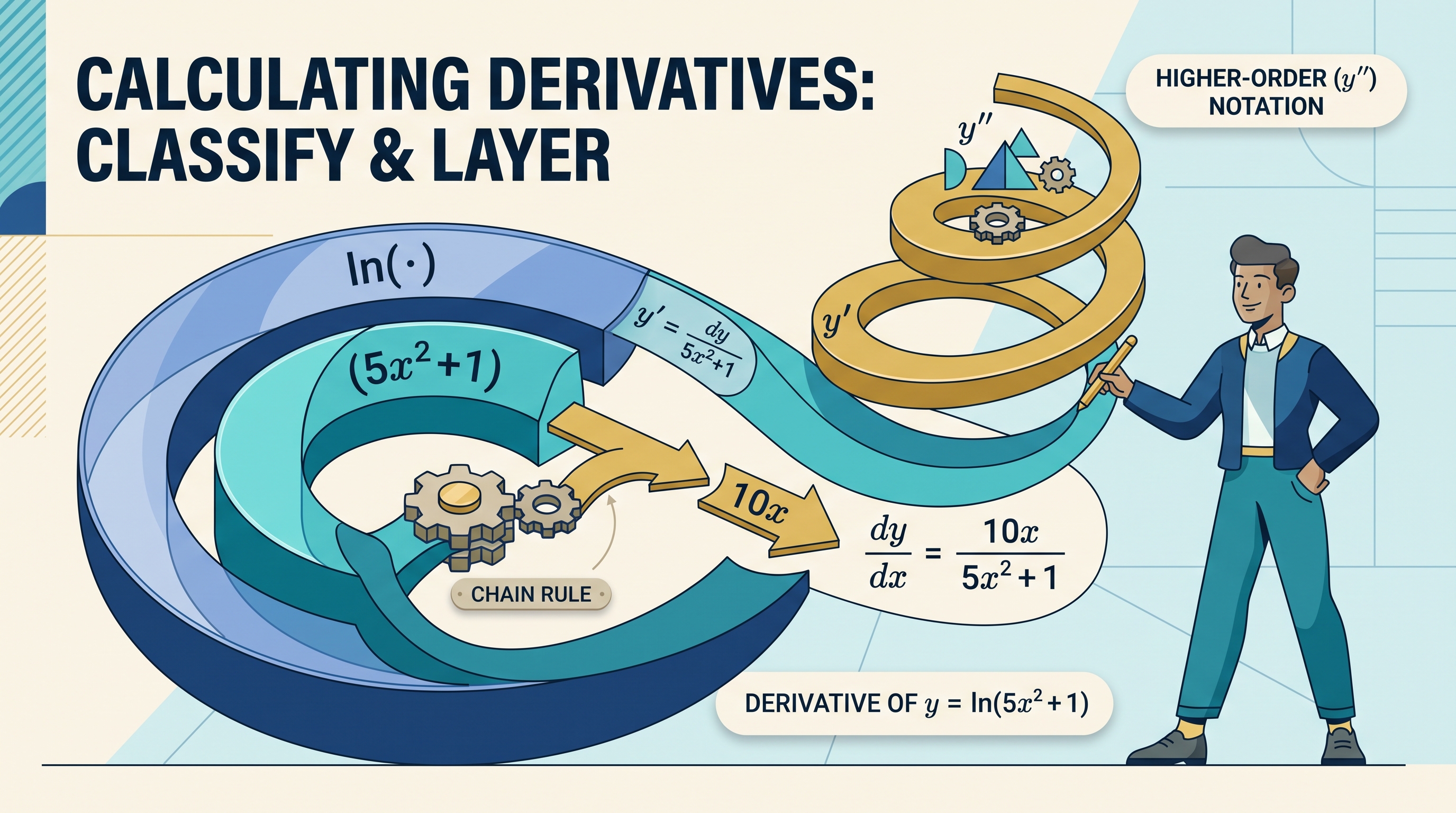
Classifying first matters just as much in Topic 3.6, where a derivative such as $y'$ is differentiated again to give the second derivative, written $y''$.
Retrieval check
For $y=\ln(5x^2+1)$, identify the procedure and calculate $\dfrac{dy}{dx}$. Then state why a factor of $10x$ must appear. Finally, if $y'=10x/(5x^2+1)$, write $y''$ using $y''$ notation. The essential habit is: classify first, differentiate layer by layer, and check both the mathematics and the notation.
Source Materials
- Learn More (.pdf)
- AP Calculus AB and BC Course and Exam Description
- AP Calculus AB Course Overview
- AP Calculus Course at a Glance
- AP Calculus AB and BC Course at a Glance Poster
- Adopt AP Calculus AB
- AP Calculus AB
- AP Calculus AB
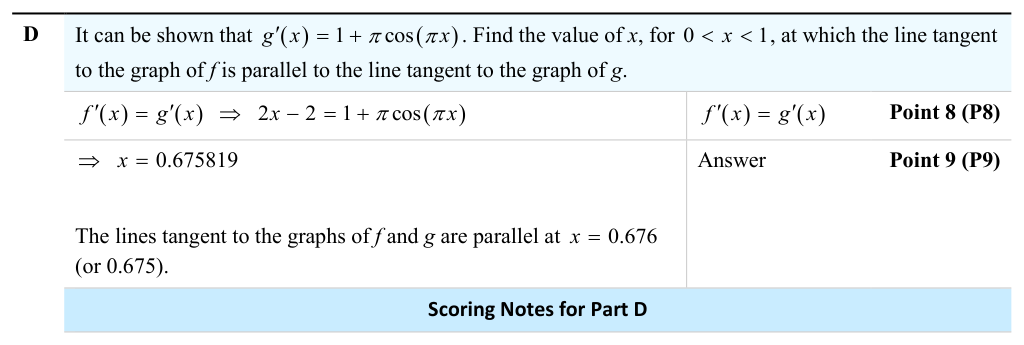
- • P8 is earned for a general statement, such as f ′(x) = g′( ) x , or for any correct equation formed by
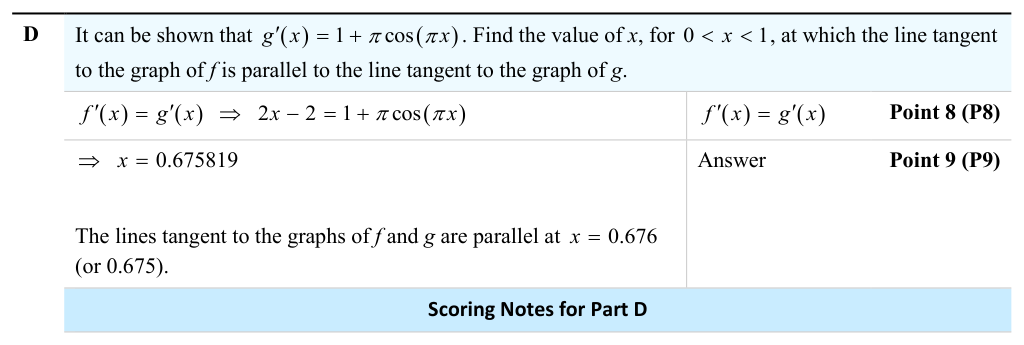
- • P8 is earned for a general statement, such as f ′(x) = g′( ) x , or for any correct equation formed by