From the free course AP Calculus AB on Lykke
1.5 Determining Limits Using Algebraic Properties of Limits
Key concepts: Algebraic properties of limits · Limit theorems · Limits of sums, products, quotients, and composite functions · Connecting graphical, numerical, and algebraic representations of limits · Evaluating limits across multiple representations · Determining limits of analytically expressed functions · Using algebra rather than technology to determine limits · Skill 1.E: applying algebraic properties of limits
The limit laws for sums, differences, products, quotients, constant multiples and composites, used to build a limit from limits that are already known.
1.5 Determining Limits Using Algebraic Properties of Limits
When two quantities approach predictable values, their sum, difference, product, or quotient usually approaches the corresponding combination of those values. The limit laws turn that idea into a reliable calculation procedure—and algebraic manipulation rescues problems where direct substitution produces an indeterminate form.
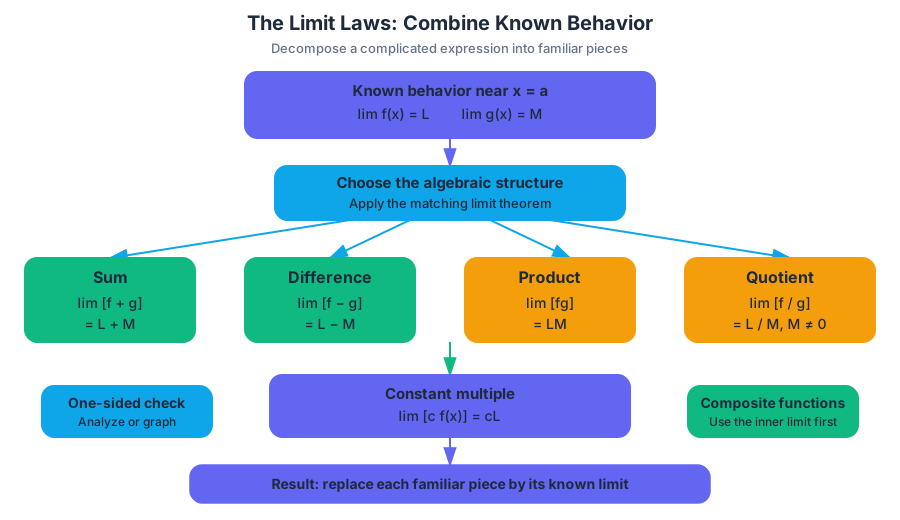
The limit laws: combine known behavior
The enduring understanding LIM-1, “Reasoning with definitions, theorems, and properties can be used to justify claims about limits,” is applied here through learning objective LIM-1.D, “Determine the limits of functions using limit theorems.” Essential knowledge LIM-1.D.1 recognizes that one-sided limits can be determined analytically or graphically, while LIM-1.D.2 states that limits of sums, differences, products, quotients, and composite functions can be found using limit theorems.
Suppose $\lim_{x\to a}f(x)=L$ and $\lim_{x\to a}g(x)=M$. Then the basic algebraic properties of limits are
$$ \lim_{x\to a}[f(x)+g(x)]=L+M, $$
$$ \lim_{x\to a}[f(x)-g(x)]=L-M, $$
$$ \lim_{x\to a}[f(x)g(x)]=LM, $$
and, provided $M\ne 0$,
$$ \lim_{x\to a}\frac{f(x)}{g(x)}=\frac{L}{M}. $$
A constant multiple behaves as expected:
$$ \lim_{x\to a}[cf(x)]=cL. $$
These rules allow a complicated expression to be decomposed into familiar pieces.
Worked example: a rate assembled from several effects
A sensor models the combined signal near time $t=2$ by
$$ S(t)=t^3+4\sin t-\frac{6}{t+1}. $$
Because polynomials, sine, and rational functions have limits found by direct substitution at $t=2$, apply the limit laws term by term:
$$ \begin{aligned} \lim_{t\to2}S(t) &=\lim_{t\to2}t^3+4\lim_{t\to2}\sin t -6\lim_{t\to2}\frac{1}{t+1}\ &=2^3+4\sin(2)-\frac{6}{3}\ &=6+4\sin(2). \end{aligned} $$
The limit exists even though the expression contains several different operations. The important move is not “substitute everywhere automatically,” but identify the structure and apply a theorem legally.
Composite functions: the outside function must behave well
A composite function applies one function to the output of another, such as $F(x)=\sqrt{5x+4}$. If $\lim_{x\to a}g(x)=M$ and the outer function $f$ is continuous at $M$, then
$$ \lim_{x\to a}f(g(x))=f(M). $$
For example,
$$ \lim_{x\to1}\sqrt{5x+4} =\sqrt{5(1)+4}=3. $$
The condition matters: if the outer function has a break at the approaching value, direct substitution may not be justified.
Multiple representations and an important cancellation
Limit reasoning may combine a graph, a table, a symbolic formula, and verbal information. For example, suppose a graph shows $\lim_{x\to2}f(x)=5$, a table indicates $\lim_{x\to2}g(x)=-1$, and $h(x)=f(x)g(x)$. Then the product law gives
$$ \lim_{x\to2}h(x)=5(-1)=-5. $$
The representations are different descriptions of the same local behavior; the algebraic theorem connects them.
A subtle exception prevents an incorrect “reverse” conclusion. The limit of $f+g$ can exist even when the individual limits do not. Let
$$ f(x)=\sin\left(\frac{1}{x-a}\right), \qquad g(x)=-\sin\left(\frac{1}{x-a}\right). $$
Neither limit exists as $x\to a$, because each function oscillates indefinitely. Yet
$$ f(x)+g(x)=0 $$
for every $x\ne a$, so
$$ \lim_{x\to a}[f(x)+g(x)]=0. $$
The limit laws tell us how to combine existing limits; they do not say that existence of a combined limit requires existence of every separate limit.
AP skill alignment: Topic 1.5 develops Skill 1.E: Apply appropriate mathematical rules or procedures, with and without technology. Topic 1.6 develops Skill 1.C: Identify an appropriate mathematical rule or procedure based on the classification of a given expression. Supporting work also uses Skill 2.B: Identify mathematical information from graphical, numerical, analytical, and/or verbal representations when data from different representations must be connected.
Retrieval check
Suppose $\lim_{x\to3}f(x)=2$ and $\lim_{x\to3}g(x)=-5$. Evaluate $\lim_{x\to3}[f(x)g(x)+4f(x)]$ and name each law you use. The product, constant-multiple and sum laws give $2(-5)+4(2)=-2$.