From the free course AP Calculus AB on Lykke
2.9 The Quotient Rule
Key concepts: Quotient rule for differentiable functions · Calculating derivatives of quotients · Learning objective FUN-3.B · Essential knowledge FUN-3.B.2
The quotient rule for differentiating a ratio of two functions, a worked example with a rational function, and why differentiating the numerator and denominator separately fails.
2.9 The Quotient Rule
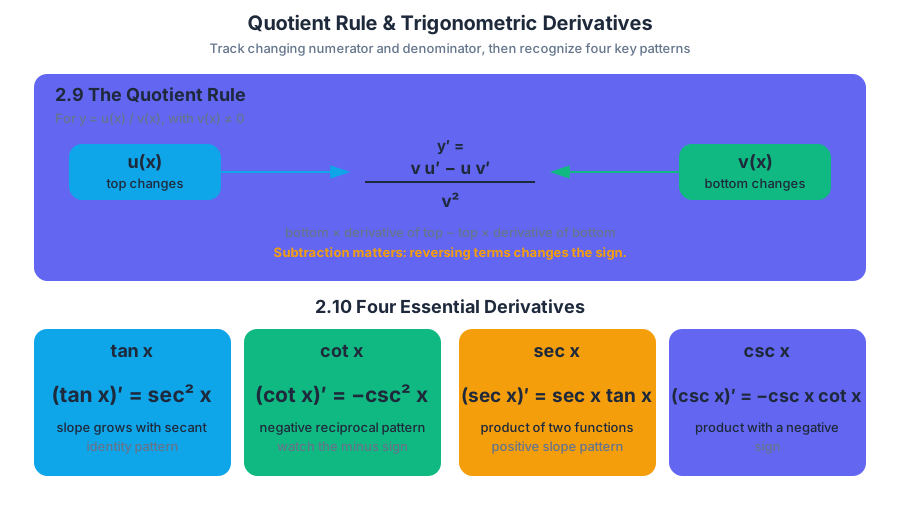
A quotient can change because both its numerator and denominator change. The quotient rule tracks those two effects without requiring the fraction to be expanded or rewritten first.
If $y=\dfrac{u(x)}{v(x)}$, where $u$ and $v$ are differentiable and $v(x)\neq 0$, then $$y'=\frac{v(x)u'(x)-u(x)v'(x)}{[v(x)]^2}.$$
The pattern is often remembered as “bottom times derivative of top, minus top times derivative of bottom, all over bottom squared.” The subtraction matters: reversing the two numerator terms changes the sign of the derivative.
The quotient rule in action
Suppose a sensor reports an efficiency ratio $$E(x)=\frac{3x^2+1}{x-2},$$ where $x$ represents an operating setting. The quotient rule is appropriate because both the numerator and denominator depend on $x$.
Let $$u(x)=3x^2+1,\qquad v(x)=x-2.$$ Then $$u'(x)=6x,\qquad v'(x)=1.$$ Substitute into the rule: $$ E'(x)=\frac{(x-2)(6x)-(3x^2+1)(1)}{(x-2)^2}. $$ Simplifying the numerator gives $$ E'(x)=\frac{6x^2-12x-3x^2-1}{(x-2)^2} =\frac{3x^2-12x-1}{(x-2)^2}. $$ The derivative is undefined at $x=2$, exactly where the original ratio is also undefined.
This example satisfies FUN-3.B: Calculate derivatives of products and quotients of differentiable functions and uses FUN-3.B.2: Derivatives of quotients of differentiable functions can be found using the quotient rule. The AP skill most directly involved is Skill 1.D: Identify an appropriate mathematical procedure, given information about a function or a function’s derivative. Here, recognizing a quotient leads directly to the quotient rule.
Products and quotients together
The examples in the rest of this page borrow two results from Topic 2.10: $\frac{d}{dx}[\tan(x)]=\sec^2(x)$ and $\frac{d}{dx}[\sec(x)]=\sec(x)\tan(x)$.
A function may require more than one rule. For $$F(x)=x^2\sec(x),$$ use the product rule: $$ F'(x)=2x\sec(x)+x^2\sec(x)\tan(x). $$ For $$G(x)=\frac{\tan(x)}{x^2+1},$$ use the quotient rule: $$ G'(x)=\frac{(x^2+1)\sec^2(x)-\tan(x)(2x)}{(x^2+1)^2}. $$
A common misconception is “differentiate the top and bottom separately”: $$ \left(\frac{u}{v}\right)'\neq\frac{u'}{v'}. $$ The quotient rule contains the cross-products $vu'$ and $uv'$, because changing either part affects the entire ratio.
Retrieval check
For $$H(x)=\frac{\sec(x)}{x+1},$$ identify the rule and write $H'(x)$ without expanding. Then state which identity would allow a derivation of $\sec'(x)$ from earlier derivative rules. The answers are
$$ H'(x)=\frac{(x+1)\sec(x)\tan(x)-\sec(x)}{(x+1)^2}, $$ and $$ \sec(x)=\frac{1}{\cos(x)}. $$