From the free course AP Calculus AB on Lykke
AP Practice 3
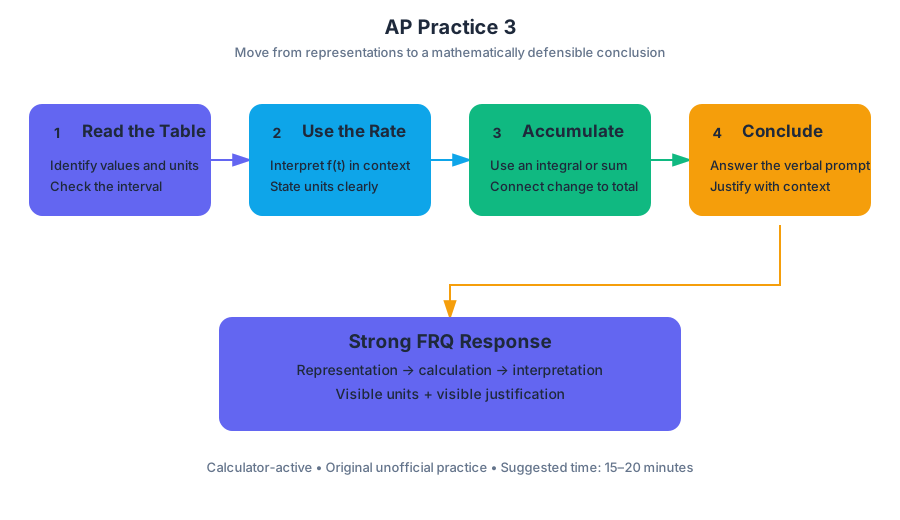
A graphing-calculator free-response question can ask you to move among a table, a rate function, an accumulation function, and a verbal conclusion—all while keeping units and justification visible.
AP Practice 3
A graphing-calculator free-response question can ask you to move among a table, a rate function, an accumulation function, and a verbal conclusion—all while keeping units and justification visible. The strongest response is not merely a collection of correct numbers: it shows a mathematically defensible chain from representation to conclusion.
Task type: calculator-active free-response question
Status: original and unofficial practice
Suggested time: $15$–$20$ minutes
The situation: water entering a reservoir
Water flows into a reservoir at a rate modeled by
$$ R(t)=\frac{180t}{t^2+9} $$
where $t$ is measured in hours and $R(t)$ is measured in liters per hour. At time $t=0$, the reservoir contains $420$ liters of water. A small outlet removes water at a constant rate of $8$ liters per hour.
Let $V(t)$ represent the volume of water in the reservoir, in liters, at time $t$.
(a) Write an expression involving an integral that gives the volume of water in the reservoir at time $t$.
(b) Find the rate at which the volume is changing at time $t=6$. Interpret your answer, including units.
(c) Determine the time $t$ in the interval $0\le t\le 10$ at which the volume is increasing most rapidly. Justify your answer.
(d) Find the average volume of water in the reservoir over the interval $0\le t\le 10$.
(e) A safety sensor activates whenever the volume reaches $600$ liters. Determine whether the sensor activates during the first $10$ hours. Justify your answer.
Part (a): Build the accumulation model
The net rate of change of volume is inflow minus outflow:
$$ V'(t)=R(t)-8=\frac{180t}{t^2+9}-8. $$
Starting with $420$ liters and accumulating the net change from $0$ to $t$ gives
$$ \boxed{V(t)=420+\int_0^t\left(\frac{180x}{x^2+9}-8\right),dx}. $$
The variable of integration is written as $x$ rather than $t$ because $t$ is the endpoint being evaluated. This distinction prevents the expression from confusing the input time with the temporary accumulation variable.
Rewardable reasoning: The response identifies the initial amount and adds the integral of the net rate. Writing only $\int_0^t R(x),dx$ omits the outlet and does not model the reservoir.
Part (b): Interpret a derivative in context
Evaluate the net rate at $t=6$:
$$ V'(6)=\frac{180(6)}{6^2+9}-8 =\frac{1080}{45}-8 =24-8 =16. $$
Therefore,
$$ \boxed{V'(6)=16\text{ liters per hour}}. $$
At time $t=6$ hours, the volume of water is increasing at an instantaneous rate of $16$ liters per hour.
Interpretation rule: A derivative in context must include what is changing, how quickly it is changing, and the appropriate units.
Part (c): Find when the volume increases most rapidly
Because $V'(t)$ is the rate at which volume changes, the volume increases most rapidly when $V'(t)$ is largest. Use the calculator to maximize
$$ V'(t)=\frac{180t}{t^2+9}-8 $$
on $0\le t\le 10$.
The maximum occurs at
$$ t=3. $$
Indeed, the variable part $\dfrac{180t}{t^2+9}$ reaches its maximum when $t=3$, giving
$$ V'(3)=\frac{180(3)}{3^2+9}-8 =\frac{540}{18}-8 =22. $$
Thus,
$$ \boxed{t=3\text{ hours}}. $$
A justification must connect the quantity being optimized to the question: maximizing $V(t)$ would find when the reservoir is fullest, not when it is filling fastest. A calculator-produced time without identifying the function being maximized is weaker mathematical communication.
Part (d): Average value of the volume
The average value of $V$ on $[0,10]$ is
$$ \frac{1}{10-0}\int_0^{10}V(t),dt =\frac{1}{10}\int_0^{10} \left[ 420+\int_0^t\left(\frac{180x}{x^2+9}-8\right),dx \right]dt. $$
Using a graphing calculator,
$$ \boxed{\frac{1}{10}\int_0^{10}V(t),dt\approx 676.1\text{ liters}}. $$
The average volume is not $V(5)$. The value $V(5)$ describes the reservoir at the midpoint in time; the average value accounts for the entire volume curve over the interval.
Part (e): Does the sensor activate?
To decide whether the volume reaches $600$ liters, examine the maximum value of $V(t)$ on $[0,10]$. Critical points occur where
$$ V'(t)=0. $$
Solving numerically gives
$$ t\approx 0.46 \quad\text{and}\quad t\approx 19.54. $$
Only $t\approx0.46$ lies in the interval $[0,10]$. Evaluate $V$ at the endpoints and the interior critical point:
$$ V(0)=420, $$
$$ V(0.46)\approx 424.8, $$
$$ V(10)\approx 735.9. $$
The largest volume during the first $10$ hours is approximately $735.9$ liters, which exceeds $600$ liters. Therefore,
$$ \boxed{\text{The safety sensor does activate during the first }10\text{ hours}.} $$
The conclusion is supported by an extreme-value check rather than by testing one convenient time. Since $V(10)>600$, the sensor definitely activates by $t=10$; continuity of $V$ guarantees that the volume must pass through $600$ on the way from below to above that value.
What an examiner rewards
| Mathematical Practice | Evidence in this response |
|---|---|
| Mathematical Practice 1: Implementing Mathematical Processes | Forms the net rate, writes accumulation and average-value integrals, and uses numerical procedures appropriately. |
| Mathematical Practice 2: Connecting Representations | Connects the verbal reservoir model to $V'(t)$, $V(t)$, integrals, and calculator-based numerical values. |
| Mathematical Practice 3: Justification | Explains why maximizing $V'(t)$ answers part (c) and why endpoint/critical-point analysis answers part (e). |
| Mathematical Practice 4: Communication and Notation | Uses defined variables, correct integral notation, contextual conclusions, and units. |
A response that reports calculator output without an equation, interpretation, or justification may earn less credit than a response with a small numerical error but a coherent method. In particular, preserve the distinction between a rate, an accumulated amount, and an average value.
Timing and error review
Spend approximately $3$ minutes modeling, $4$ minutes on derivative interpretation and maximization, $5$ minutes on average value, and $5$ minutes on the sensor decision. Afterward, label each error as one of four types: modeling, calculator setup, reasoning/justification, or notation and units. Then redo only the failed step without looking at the solution.
Retrieval check: If the outlet rate changed from $8$ liters per hour to $12$ liters per hour, which expression would change first—$V(t)$, $V'(t)$, or both? Explain why.

Source Materials
- Learn More (.pdf)
- AP Calculus AB and BC Course and Exam Description
- AP Calculus AB Course Overview
- AP Calculus Course at a Glance
- AP Calculus AB and BC Course at a Glance Poster
- Adopt AP Calculus AB
- AP Calculus AB
- AP Calculus AB
- AP Calculus AB-AP Students
- AP/College Calculus AB
- What's the Difference Between AP Calculus AB vs. BC-Princeton Review
- Free AP Calculus Lesson Plans-Math Medic