From the free course AP Calculus AB on Lykke
2.4 Connecting Differentiability and Continuity
Key concepts: Derivative as the limit of difference quotients · Differentiability at a point · Continuity at a point · The relationship between differentiability and continuity · Sharp corners or crossovers where one-sided slopes do not match · Vertical tangents where the derivative is undefined
Why differentiability at a point forces continuity there, why the converse fails at corners and vertical tangents, and how to justify a claim that a derivative does not exist.
2.4 Connecting Differentiability and Continuity
The derivative $f'(a)=\lim_{h\to0}\frac{f(a+h)-f(a)}{h}$ is a limit, and a limit does not have to exist. This page asks when $f'(a)$ exists and how that question is tied to continuity at $a$: differentiability guarantees continuity, but continuity alone does not guarantee a derivative.
Differentiability and continuity
A function is differentiable at a point if its derivative exists there as a finite, single value. A function is continuous at $x=a$ if it has no break at that point:
$$ \lim_{x\to a}f(x)=f(a). $$
The required relationship is one-way:
FUN-2.A.1: If a function is differentiable at a point, then it is continuous at that point.
The derivative definition explains why. If $f'(a)$ exists, then the nearby change can be written as
$$ f(a+h)-f(a)
h\left(\frac{f(a+h)-f(a)}{h}\right). $$
As $h\to0$, the first factor approaches $0$ and the second approaches the finite number $f'(a)$, so $f(a+h)-f(a)\to0$. Therefore $f(a+h)\to f(a)$, which is continuity.
The converse is false:
FUN-2.A.2: A continuous function may fail to be differentiable at a point in its domain.
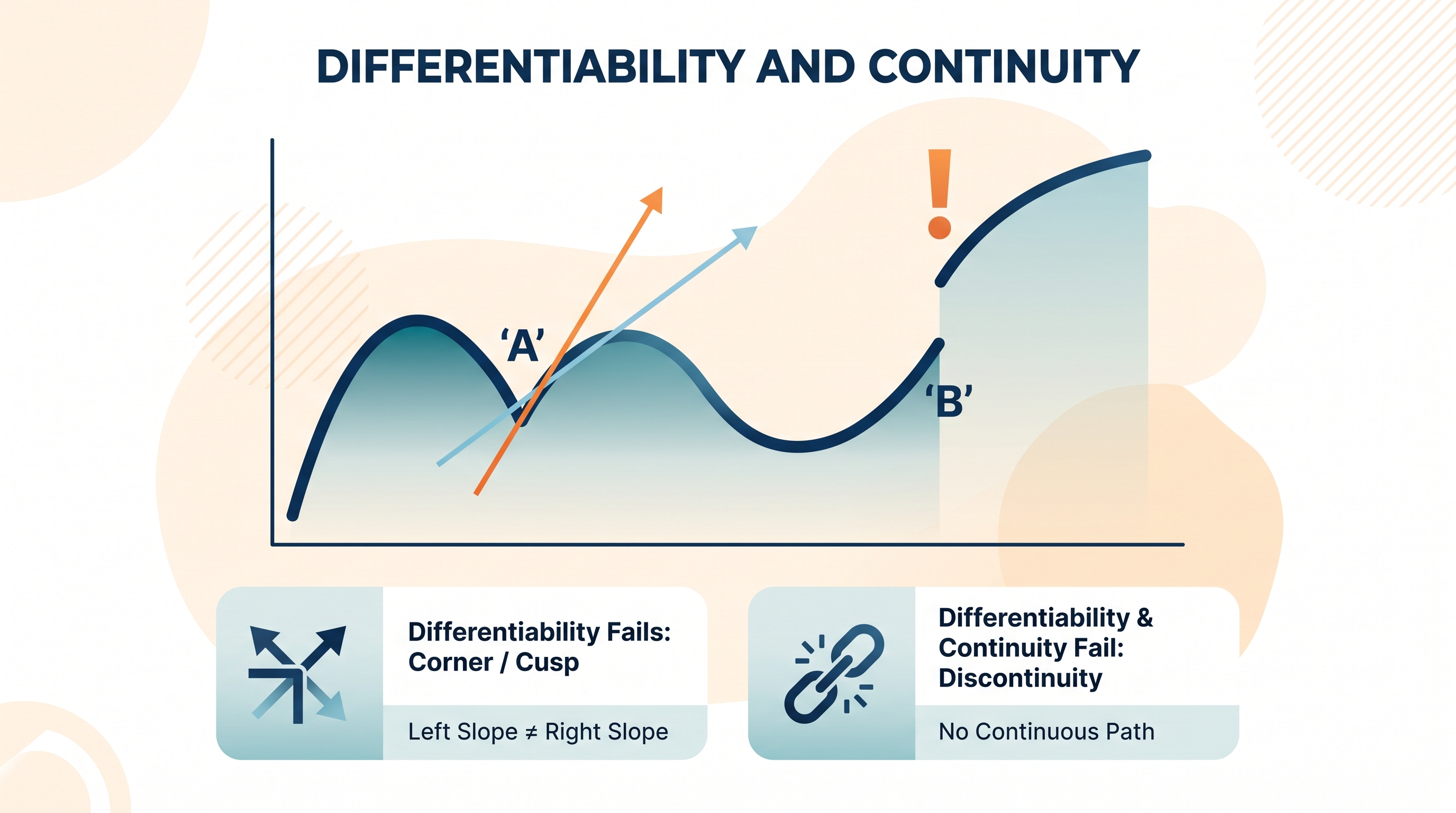
Two standard failures are especially important:
- Sharp corner or crossover: For $f(x)=|x|$ at $x=0$, the left-hand difference quotient approaches $-1$, while the right-hand difference quotient approaches $1$. Since the one-sided slopes disagree, $f'(0)$ does not exist, even though $f$ is continuous at $0$.
- Vertical tangent: For $f(x)=\sqrt[3]{x}$ at $x=0$, the tangent is vertical. The slopes become unbounded, so there is no ordinary finite derivative at $0$.
A discontinuity also rules out differentiability immediately. In particular, if $a$ is not in the domain of $f$, then it cannot be in the domain of $f'$.
AP reasoning focus: 3.E Justification
Skill 3.E: Provide reasons or rationales for solutions and conclusions requires a reason, not just a label. “Not differentiable” is incomplete. A stronger conclusion names the mechanism: the one-sided slopes differ, the tangent is vertical, or the function is not continuous.
Misconception check: Continuity does not guarantee differentiability. Continuity means the graph has no break; differentiability additionally requires one well-defined finite tangent slope.
Retrieval check: The limit
$$ \lim_{h\to0}\frac{|4+h|-4}{h} $$
represents which derivative? Is the function differentiable at the approached point? Identify the function and point first, then compare the one-sided slopes.
Source Materials
- Learn More (.pdf)
- AP Calculus AB and BC Course and Exam Description
- AP Calculus AB Course Overview
- AP Calculus Course at a Glance
- AP Calculus AB and BC Course at a Glance Poster
- Adopt AP Calculus AB
- AP Calculus AB
- AP Calculus AB
- • An evaluation of vJ (2) is not necessary, but if a value is presented, it must be correct. The correct