From the free course AP Calculus AB on Lykke
4.6 Approximating Values of a Function Using Local Linearity and Linearization
Key concepts: Tangent-line approximation · Local linearity · Linearization · Taylor-polynomial representation for approximating values near x = a (BC only)
How to build the tangent-line approximation L(x) = f(a) + f'(a)(x - a), use it to estimate values such as the square root of 6, and use concavity to tell over- from underestimates.
4.6 Approximating Values of a Function Using Local Linearity and Linearization
Close to a point where you know a function's value and its slope, the function behaves almost like its tangent line. That makes the tangent line a practical tool: it turns a hard value such as $\sqrt{6}$ into simple arithmetic, and the shape of the graph tells you whether the estimate is too high or too low.
Local linearity: a curve becomes almost straight nearby
Near a point $x=a$, a smooth curve resembles its tangent line. The tangent line is therefore a locally linear approximation: a line that models the function accurately for inputs close to $a$. This is CHA-3.F.1 and supports Suggested Skill 1.F: Approximate values of a function using the equation of a tangent line.
If $f(a)$ and $f'(a)$ are known, the tangent line at $x=a$ is
$$ L(x)=f(a)+f'(a)(x-a). $$
The approximation is
$$ f(x)\approx L(x) $$
when $x$ is near $a$. The expression $L(x)$ is called the linearization of $f$ at $x=a$.
Worked example: estimating $\sqrt{6}$
Choose the nearby function $f(x)=\sqrt{x}$ and the convenient known point $a=4$, because $f(4)=2$. Since
$$ f'(x)=\frac{1}{2\sqrt{x}}, $$
we have
$$ f'(4)=\frac14. $$
Thus the linearization is
$$ L(x)=2+\frac14(x-4). $$
At $x=6$,
$$ \sqrt{6}\approx L(6) =2+\frac14(2) =2.5. $$
The actual value is approximately $2.449$, so this tangent-line estimate is an overestimate. That comparison is not an accident: $f(x)=\sqrt{x}$ is concave down near $x=4$, and a tangent line lies above a concave-down curve. In general, CHA-3.F.2 connects nearby concavity to approximation error: concave-up behavior produces a tangent-line underestimate, while concave-down behavior produces a tangent-line overestimate.
Misconception check — “A tangent line gives the exact value.”
The tangent line agrees exactly with the function at the point of tangency, $x=a$. Away from $a$, it gives an approximation whose accuracy depends on how close $x$ is to $a$ and how much the graph bends.
Retrieval check
A sphere has radius $r(t)$ and volume $V(t)=\frac43\pi r^3$. If $\frac{dr}{dt}$ is known, differentiate with respect to $t$ before inserting the current radius. For linearization, explain why a concave-up function produces a tangent-line underestimate: the graph bends upward and lies above its tangent line near the point of tangency.
Source Materials
- Learn More (.pdf)
- AP Calculus AB and BC Course and Exam Description
- AP Calculus AB Course Overview
- AP Calculus Course at a Glance
- AP Calculus AB and BC Course at a Glance Poster
- Adopt AP Calculus AB
- AP Calculus AB
- AP Calculus AB
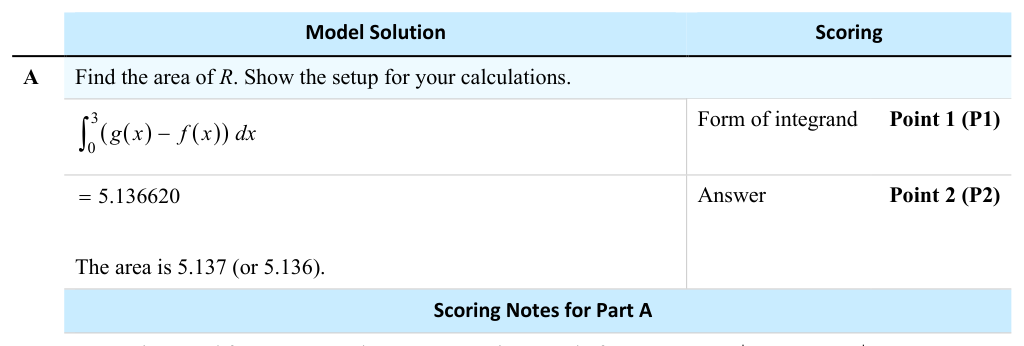
- • P1 is earned for a response that presents an integrand of g x ( ) −f (x), g x ( ) −f (x) , f (x) −g x ( ),
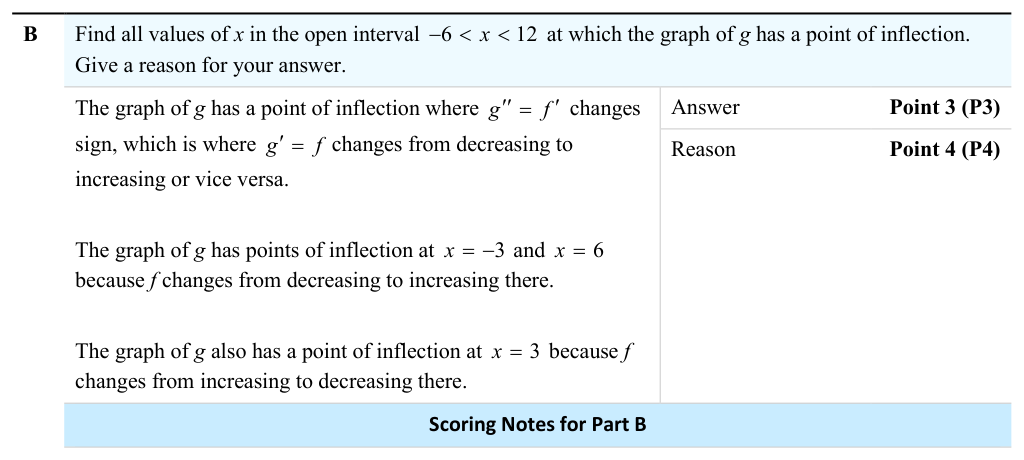
- • P3 is earned only for an answer of x = −3, x = 3, and x = 6 . If any other/additional values of x in
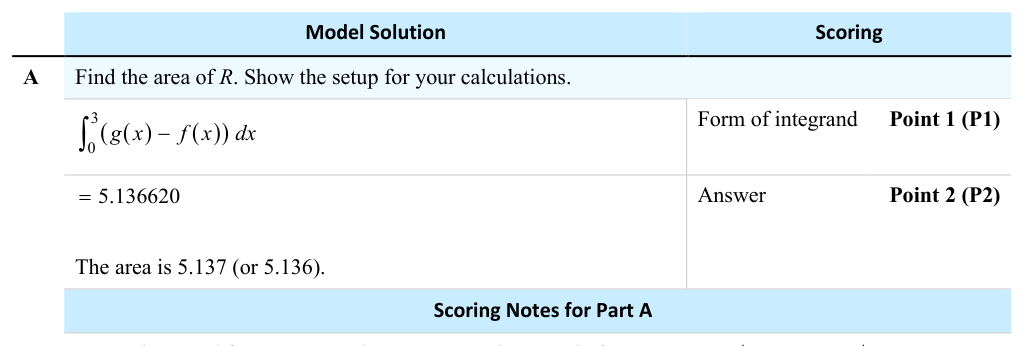
- • P1 is earned for a response that presents an integrand of g x ( ) −f (x), g x ( ) −f (x) , f (x) −g x ( ),
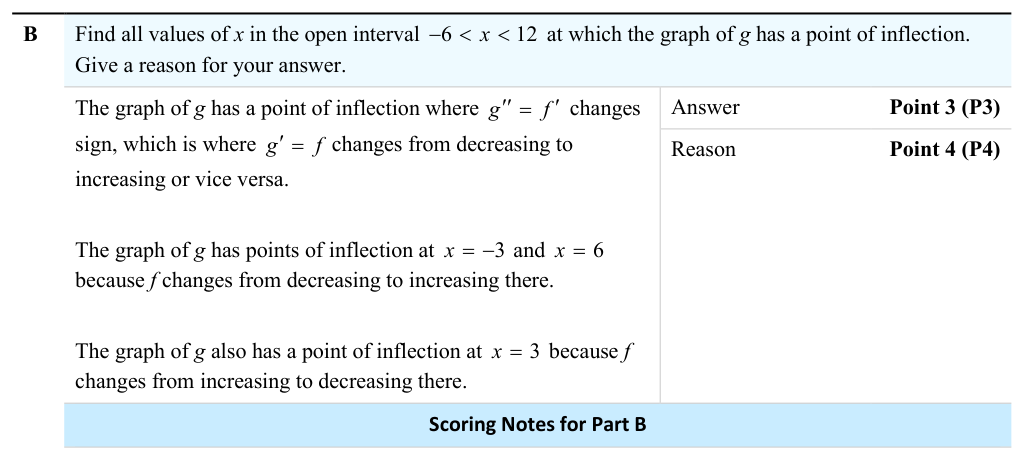
- • P3 is earned only for an answer of x = −3, x = 3, and x = 6 . If any other/additional values of x in