From the free course AP Calculus AB on Lykke
2.2 Defining the Derivative of a Function and Using Derivative Notation
Key concepts: The derivative of a function · Defining the derivative using a limit · Derivative notation, including f'(x), y', and f' · Using analytical, numerical, graphical, and verbal representations of derivatives · Limits as foundational tools for understanding derivatives
Defines the derivative as a limit of difference quotients, treats it as a function in its own right, and explains derivative notation and the four ways a derivative is represented.
2.2 Defining the Derivative of a Function and Using Derivative Notation
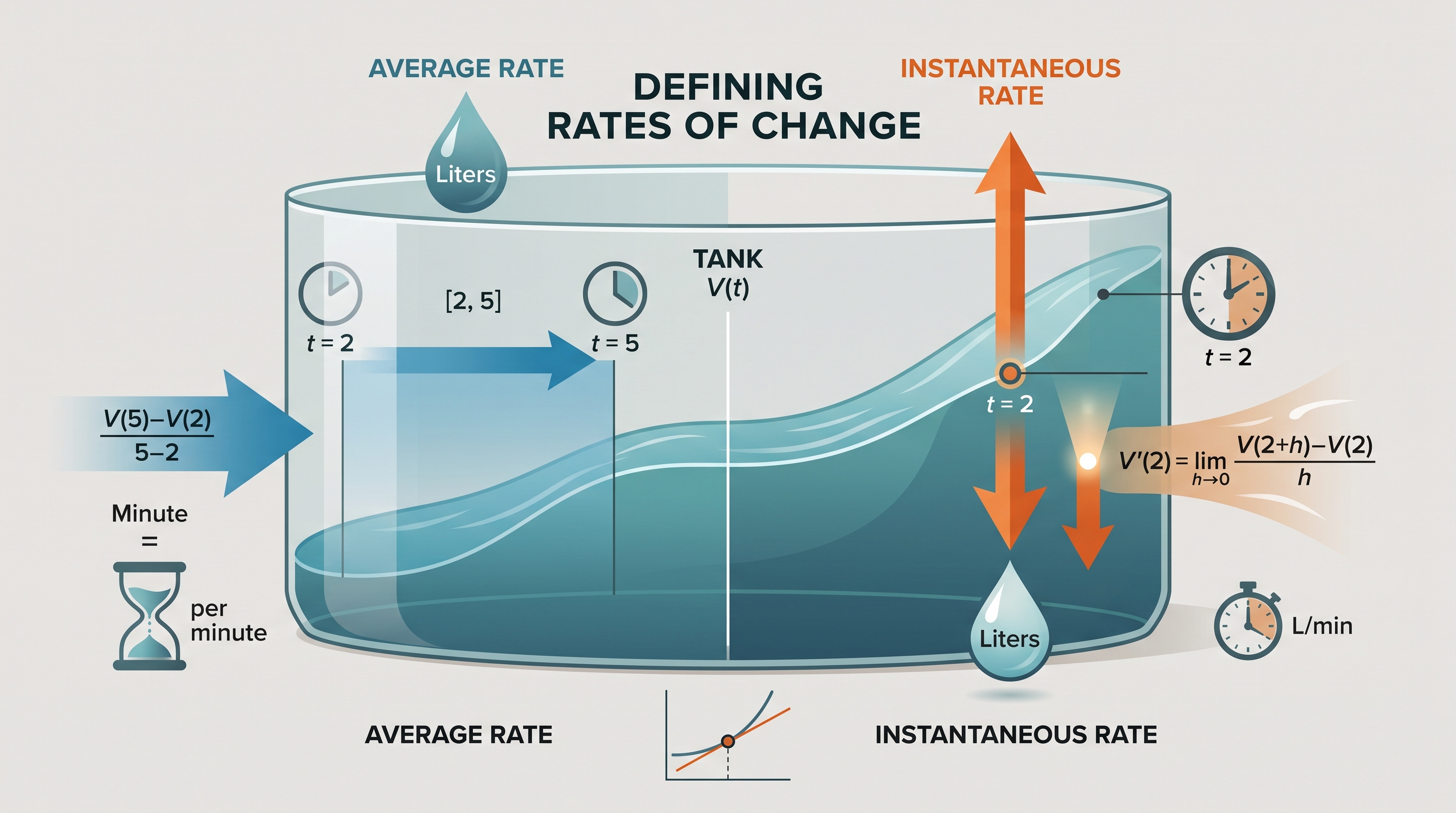
Topic 2.1 found the instantaneous rate of change at a single input as a limit of average rates. This page names that limit the derivative, extends it from one input to a whole function, and sets out its notation.
The derivative at a point
The derivative at a point is the limit of average rates of change as the interval shrinks to zero. At $x=a$,
$$ f'(a)=\lim_{h\to0}\frac{f(a+h)-f(a)}{h}, $$
provided this limit exists. An equivalent form is
$$ f'(a)=\lim_{x\to a}\frac{f(x)-f(a)}{x-a}, $$
also provided the limit exists.
Key idea: A derivative is not an average over a tiny interval. It is the limiting value of those averages.
The derivative as a function
Nothing in that limit depends on the particular input $a$. Replacing $a$ with a variable $x$ defines a new function, the derivative of $f$: $f'(x)=\lim_{h\to0}\frac{f(x+h)-f(x)}{h}$, defined wherever the limit exists. For $f(x)=x^2+2x$ the difference quotient simplifies to $2x+2+h$, so $f'(x)=2x+2$ and $f'(1)=4$.
Derivative notation and representations
The derivative of $f$ with respect to $x$ may be written in several equivalent ways:
$$ f'(x), \qquad y', \qquad f'. $$
The expression $f'(x)$ emphasizes that the derivative is itself a function: each input $x$ receives the instantaneous rate of change at that location. The notation $f'(a)$ means the particular derivative value at $x=a$.
Leibniz notation $\frac{dy}{dx}$ is a fourth way to write the derivative of $y=f(x)$, read “the derivative of $y$ with respect to $x$”. It is one symbol, not a fraction to cancel; its value at $x=a$ is written $\left.\frac{dy}{dx}\right|_{x=a}$.
A derivative communicates the same idea through four representations:
| Representation | What it tells you |
|---|---|
| Analytical | A formula such as $f'(x)=2x+2$ |
| Numerical | A limit or computed value such as $f'(1)=4$ |
| Graphical | The slope of the tangent line to $y=f(x)$ |
| Verbal | “At $t=1$, position is increasing at $4\ \text{m/s}$.” |
Because $f'(a)$ is the slope of the tangent line at $(a,f(a))$, that line has equation $y=f(a)+f'(a)(x-a)$. For $f(x)=x^2+2x$ at $x=1$ this is $y=3+4(x-1)$.
AP skills and reasoning processes
Topic 2.2 develops Skill 1.D: Identify an appropriate mathematical procedure by recognizing when the limit definition of the derivative is required, and Skill 4.C: Use appropriate mathematical notation by correctly writing expressions such as $f'(a)$, $y'$, and
$$ \lim_{h\to0}\frac{f(a+h)-f(a)}{h}. $$
Misconception check
Misconception: “The derivative is just the function divided by $x$.” The derivative measures change in the output relative to change in the input; it is built from a difference quotient. Also, a derivative need not exist: if the defining limit fails to exist, then $f'(a)$ is undefined at that point.
Source Materials
- Learn More (.pdf)
- AP Calculus AB and BC Course and Exam Description
- AP Calculus AB Course Overview
- AP Calculus Course at a Glance
- AP Calculus AB and BC Course at a Glance Poster
- Adopt AP Calculus AB
- AP Calculus AB
- AP Calculus AB
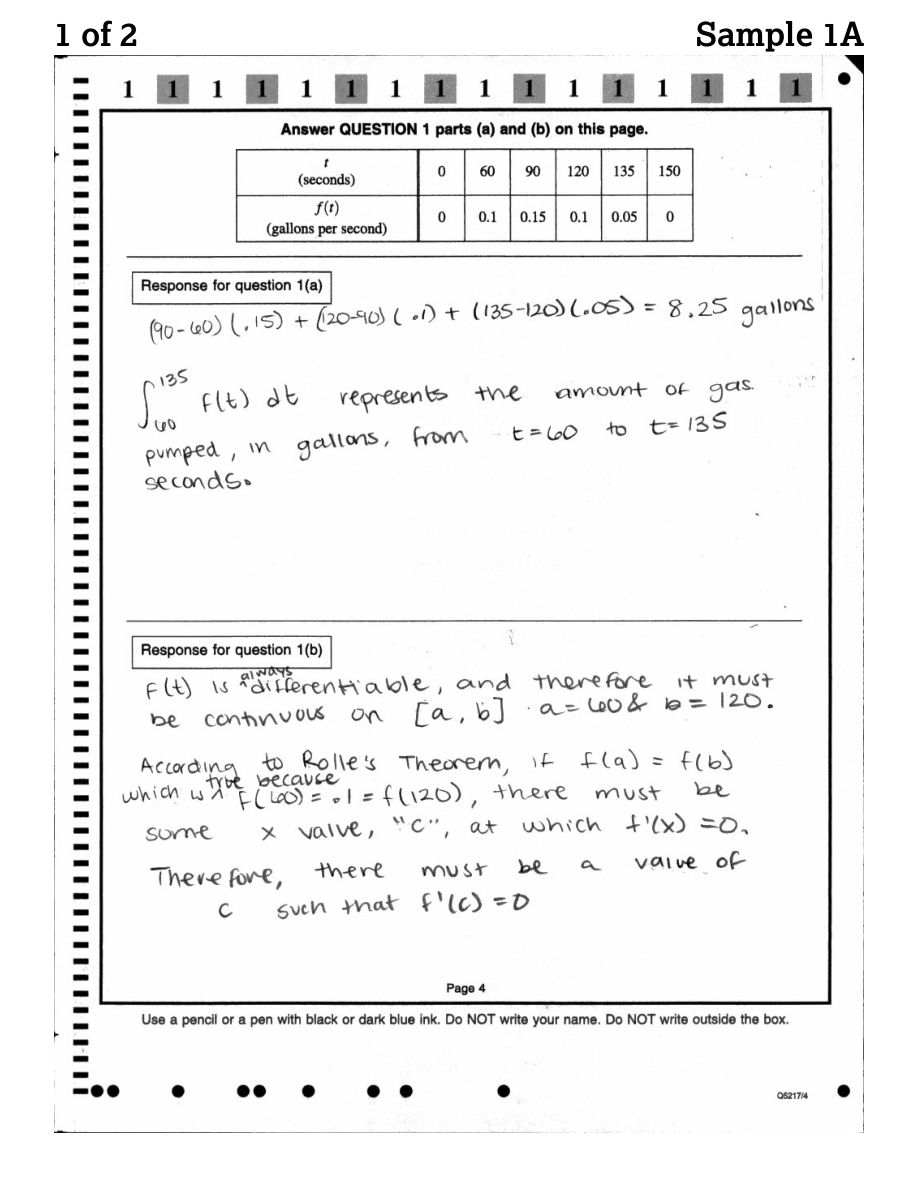
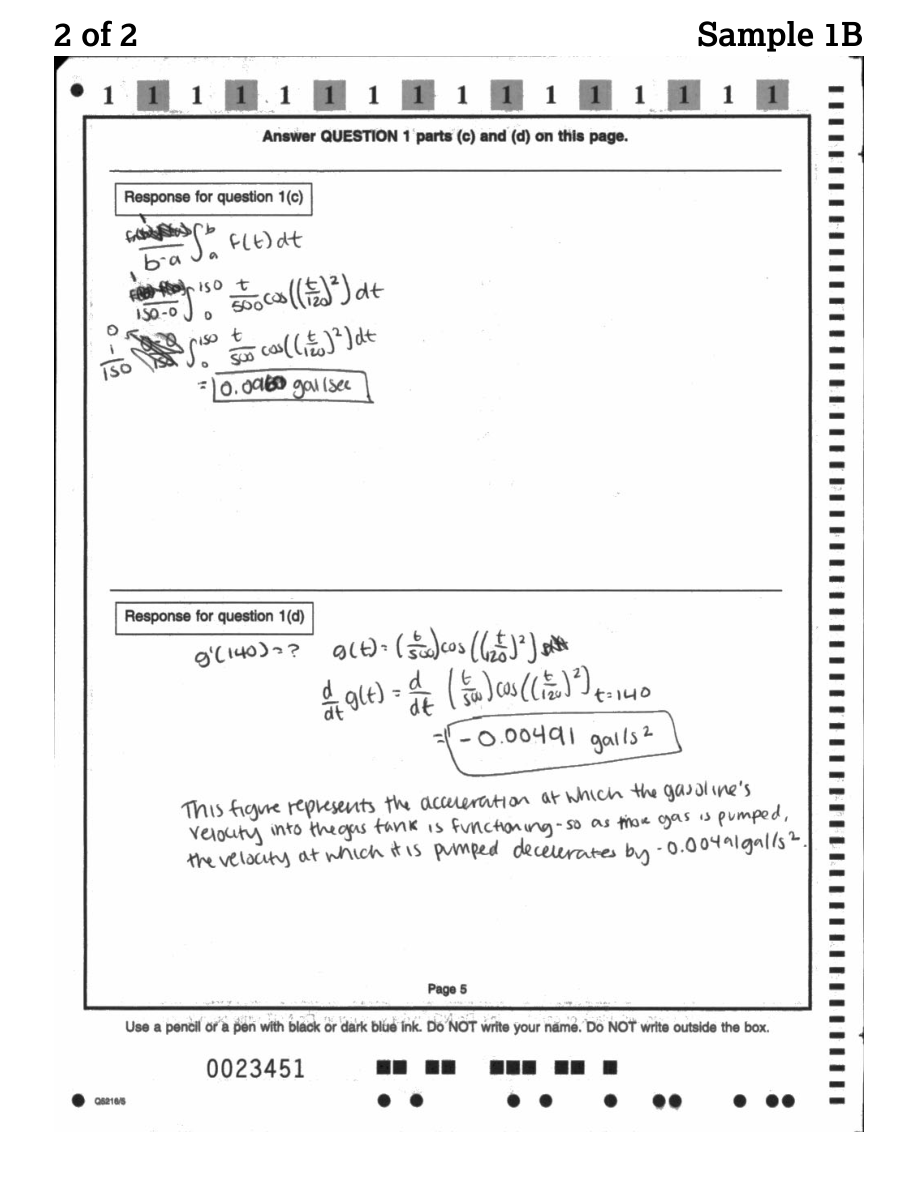
- Figure — Sample Responses Q1 (p. 5)
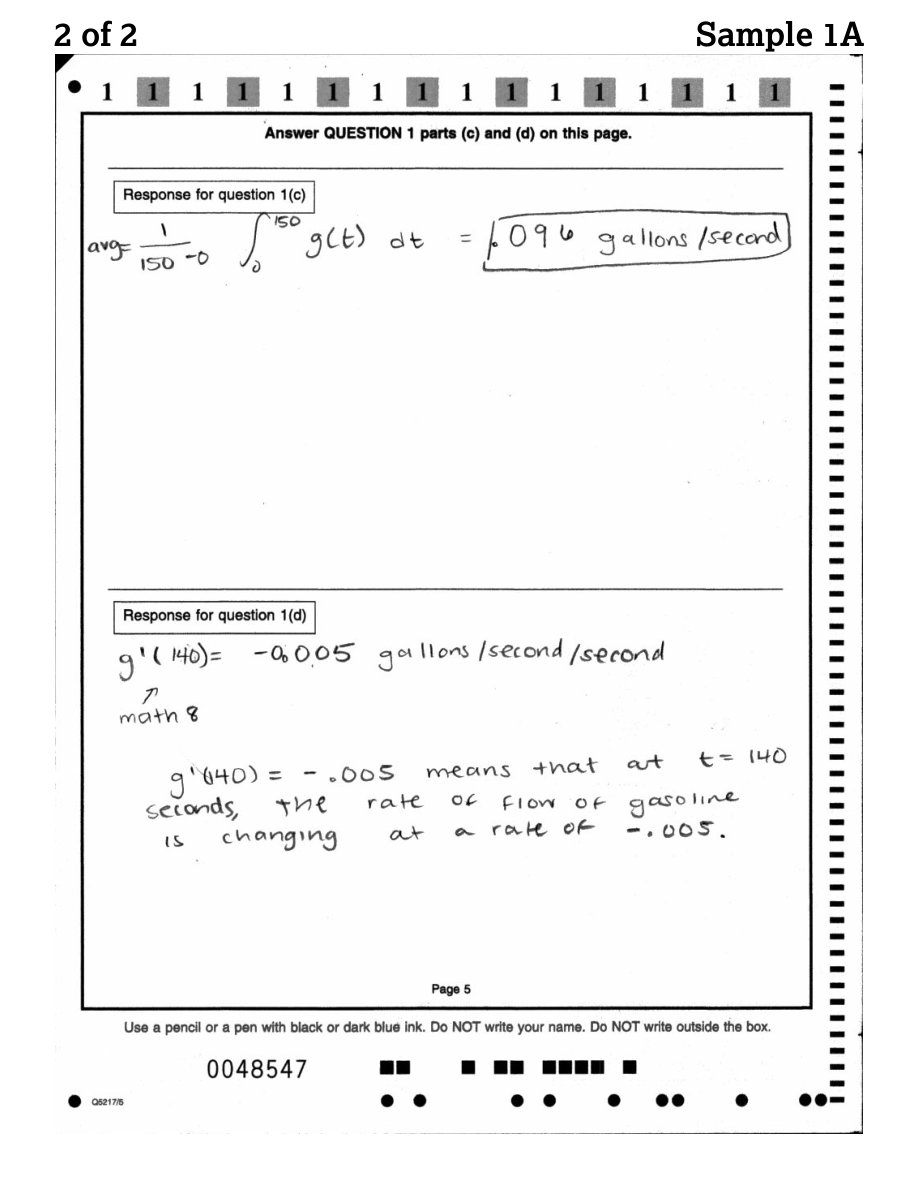
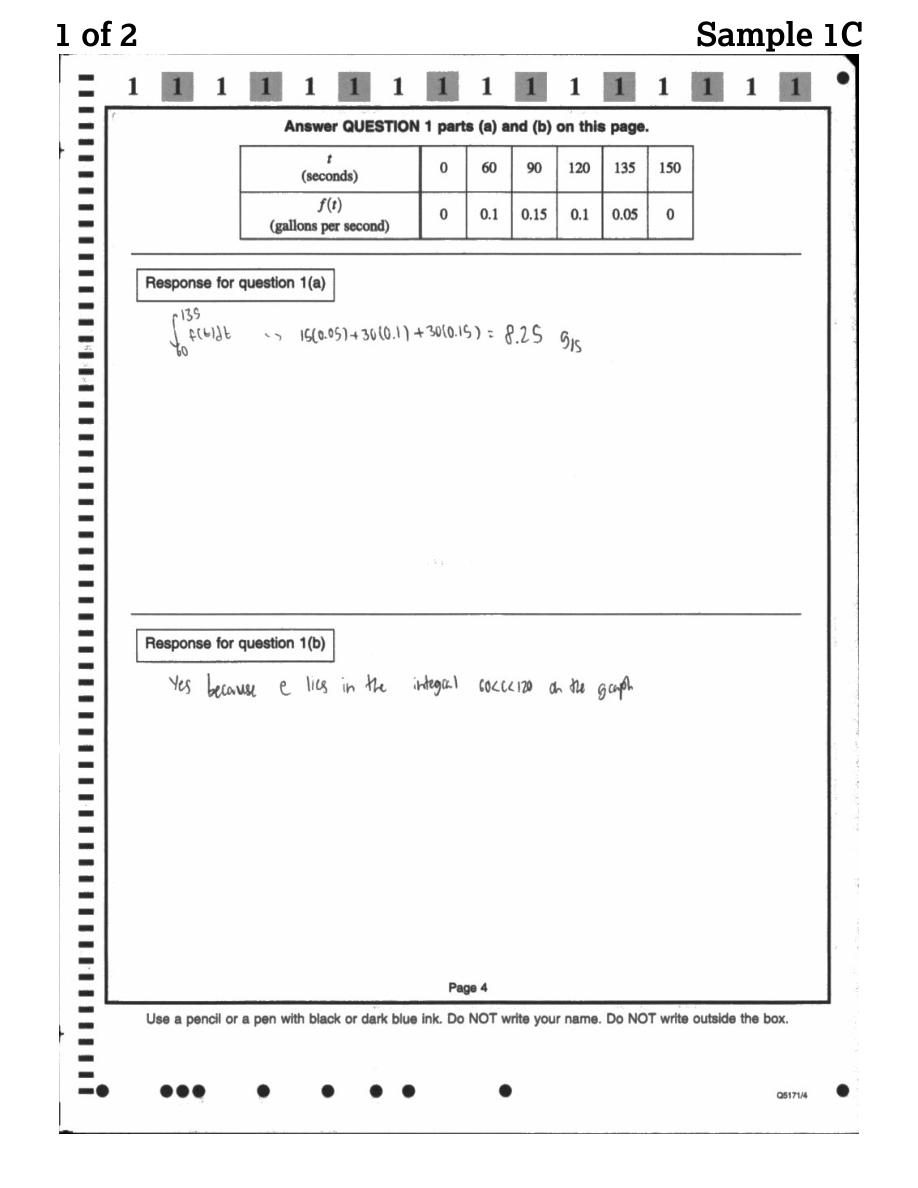
- Figure — Sample Responses Q1 (p. 6)
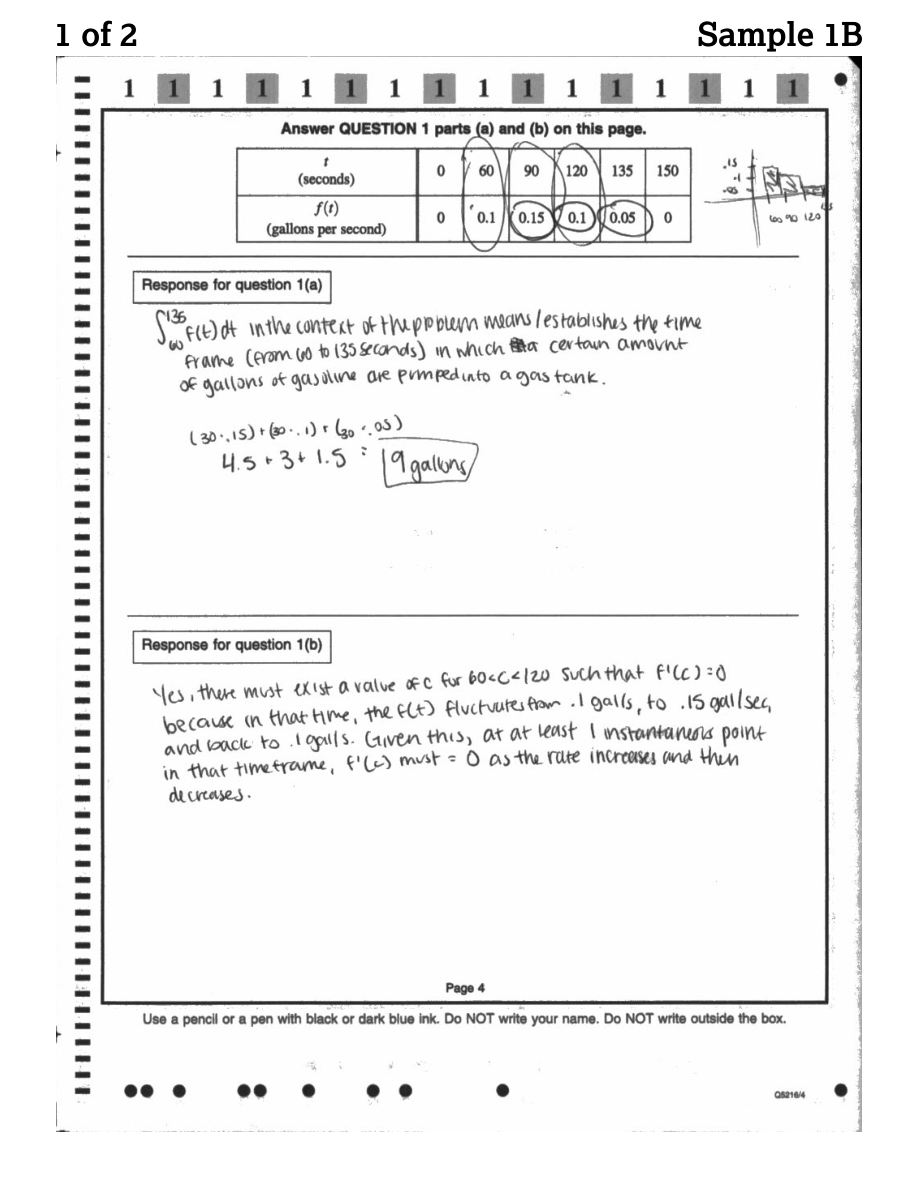
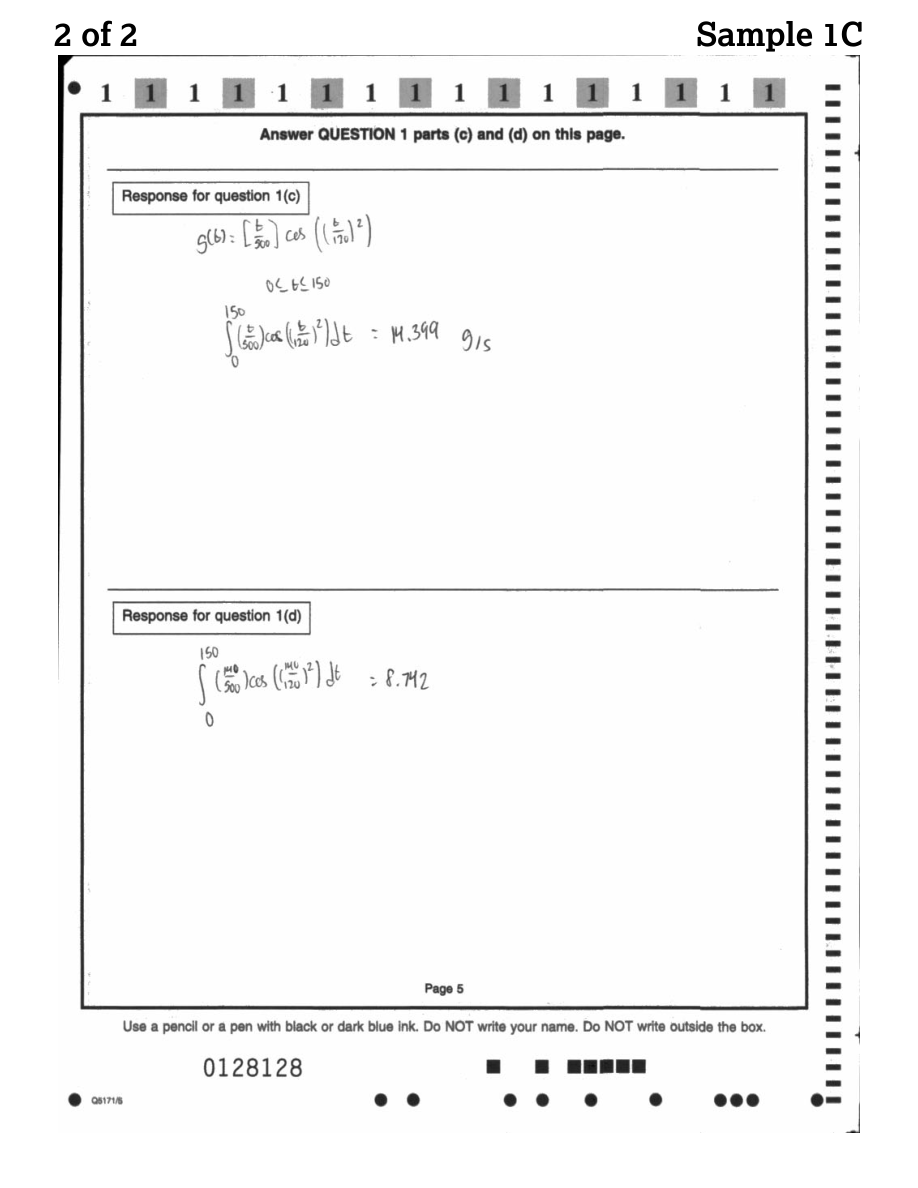
- Figure — Sample Responses Q1 (p. 7)
- Figure — Sample Responses Q1 (p. 8)