From the free course AP Calculus AB on Lykke
1.9 Connecting Multiple Representations of Limits
Key concepts: Limits and continuity · Connecting multiple representations of limits · Translating among numerical, graphical, analytical, and verbal representations · Skill 2.C: Connecting representations · Using calculators to evaluate limits, derivatives, or definite integrals · Writing the mathematical setup before reporting a calculator result · AP Calculus AB and BC course framework · Mathematical Practices: Connecting Representations · Limits as a context for integrating multiple representations
How one limit appears as a table, a graph, a formula and a sentence, and how to translate between those representations and check that they agree.
1.9 Connecting Multiple Representations of Limits
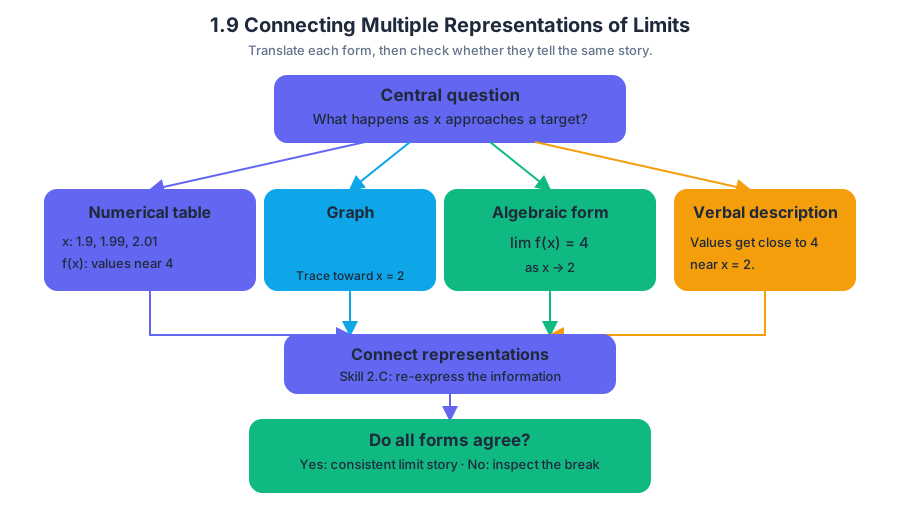
A limit is not trapped inside an equation: the same mathematical behavior can appear as a table of values, a graph, an algebraic expression, or a verbal description. The essential question is: Do all representations tell the same story about what happens as $x$ approaches a target value?
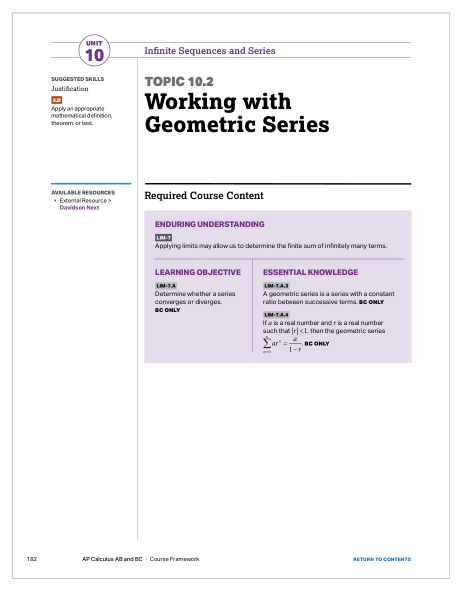
Topic 1.9: Connecting Multiple Representations of Limits emphasizes translating mathematical information among numerical, graphical, analytical, and verbal forms. The associated suggested skill is Skill 2.C: Connecting Representations — “Identify a re-expression of mathematical information presented in a given representation.”
One limit, four mathematical languages
Suppose the temperature near a sensor is modeled by
$$ T(x)=\frac{x^2-9}{x-3}, $$
where $x$ measures a location along a pipe. At $x=3$, the formula is undefined, but for nearby values of $x$,
$$ T(x)=\frac{(x-3)(x+3)}{x-3}=x+3. $$
Thus,
$$ \lim_{x\to 3}T(x)=6. $$
The same conclusion can be translated across representations:
- Analytical: simplify the expression to $x+3$ for $x\ne 3$, then evaluate the limit.
- Numerical: values such as $T(2.9)=5.9$ and $T(3.1)=6.1$ approach $6$.
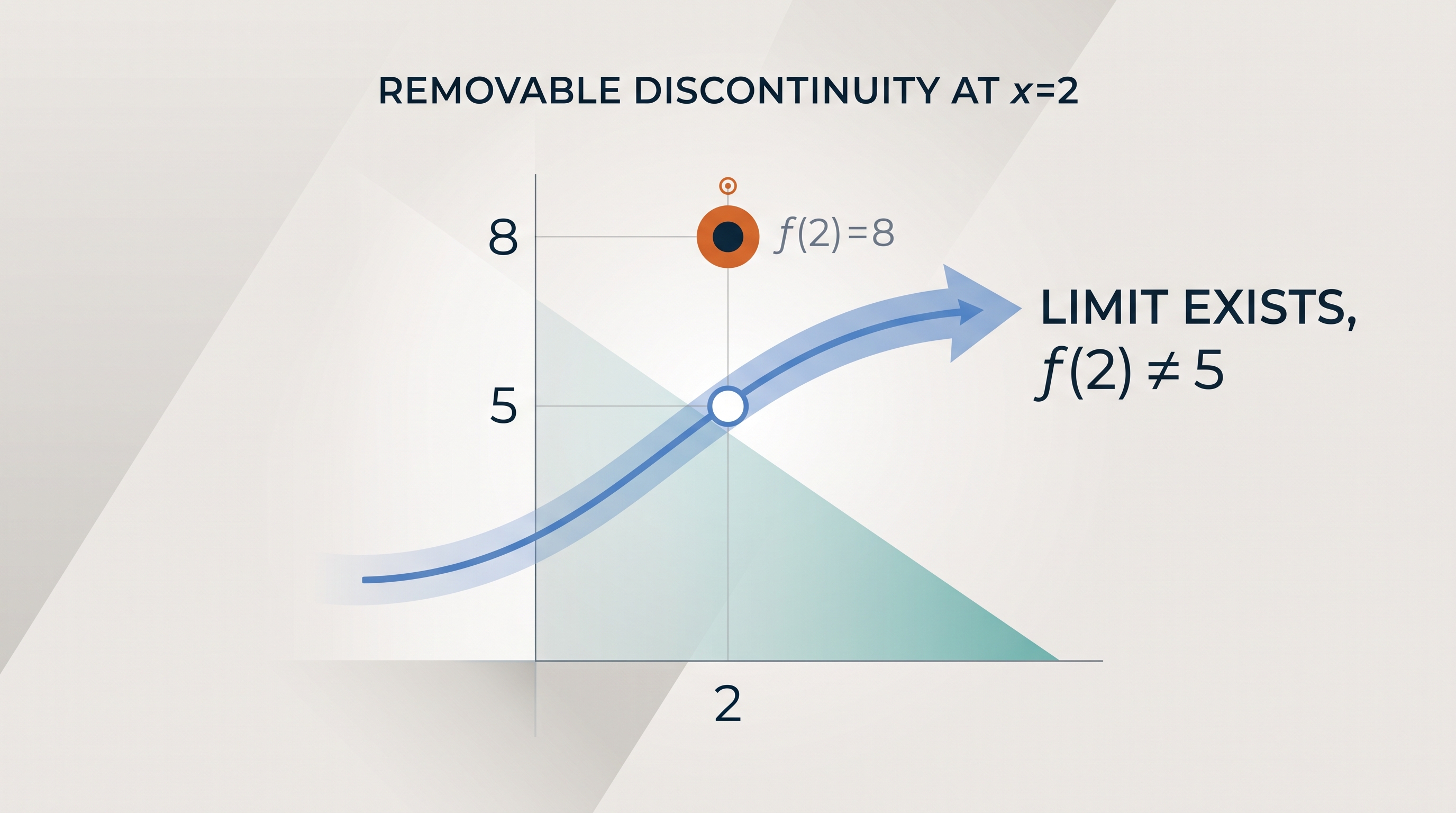
- Graphical: the graph follows the line $y=x+3$ but has a hole at $(3,6)$.
- Verbal: as the location approaches $3$ from either side, the temperature approaches $6$ units.
The function’s actual value at $x=3$ is not needed to determine the limit. A limit describes nearby behavior, not necessarily the value at the target. This distinction is the bridge between Topic 1.9 and Topic 1.10.
Calculator-supported representations
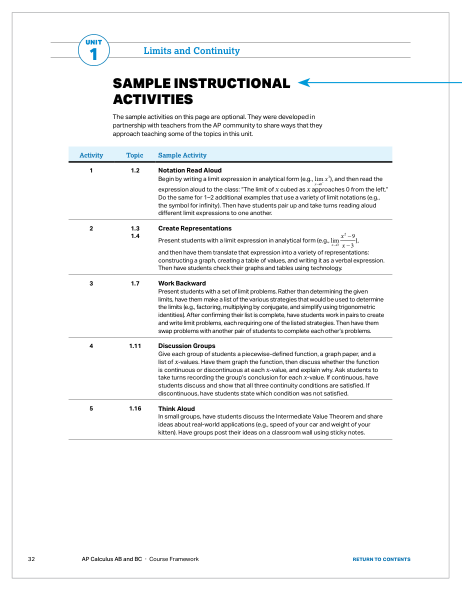
A graphing calculator can generate a graph, a table, or a numerical limit estimate, making it useful for developing conjectures and checking whether representations agree. It does not replace the mathematical communication that explains what was entered and what the result means.
When a required calculator capability is used, write both the setup and the calculator’s result. For example, to investigate the removable discontinuity above, record
$$ \text{Setup: }\lim_{x\to 3}\frac{x^2-9}{x-3}, \qquad \text{calculator result: }6. $$
If another built-in feature or program produces the result, include the mathematical steps needed to produce it. A decimal by itself is evidence of an output, not evidence of reasoning.
Misconception check: “If $f(a)$ is undefined, the limit does not exist.”
Correction: A function may be undefined at $a$ while its two-sided limit exists. A hole is precisely the graphical signature of this possibility.
Retrieval check
A table gives $f(1.9)=3.8$, $f(1.99)=3.98$, $f(2.01)=4.02$ and $f(2.1)=4.2$. Re-express this numerical information analytically and verbally. The table suggests $\lim_{x\to2}f(x)=4$; in words, as $x$ gets close to $2$ from either side, $f(x)$ gets close to $4$. A graph would show both branches heading toward height $4$ at $x=2$.
Source Materials
- Learn More (.pdf)
- AP Calculus AB and BC Course and Exam Description
- AP Calculus AB Course Overview
- AP Calculus Course at a Glance
- AP Calculus AB and BC Course at a Glance Poster
- Adopt AP Calculus AB
- AP Calculus AB
- AP Calculus AB
- AP Calculus AB and BC · Course Framework return to Contents 25
- 26 AP Calculus AB and BC · Course Framework return to Contents
- (Note: Your calculator should be in radian mode.)
- (Note: Your calculator should be in radian mode.)