From the free course AP Calculus AB on Lykke
2.7 Derivatives of \(\cos x\), \(\sin x\), \(e^x\), and \(\ln x\)
Key concepts: Derivatives of cos x, sin x, e^x, and ln x · The chain rule and its applications · Maclaurin series for sin x and cos x · AP Exam assessment of derivative rules · Derivatives of tangent, cotangent, secant, and cosecant functions
The derivatives of sin x, cos x, e^x and ln x, the sign and domain conditions that go with them, and why the sine and cosine rules are consistent with their series.
2.7 Derivatives of (\cos x), (\sin x), (e^x), and (\ln x)
Polynomials are not the only functions with simple derivatives. Four more, $\sin x$, $\cos x$, $e^x$ and $\ln x$, appear in almost every later derivative because they model oscillation, growth and scaling. This page gives their derivatives and the condition attached to each.
Enduring Understanding FUN-3: Recognizing opportunities to apply derivative rules can simplify differentiation.
The essential derivative formulas
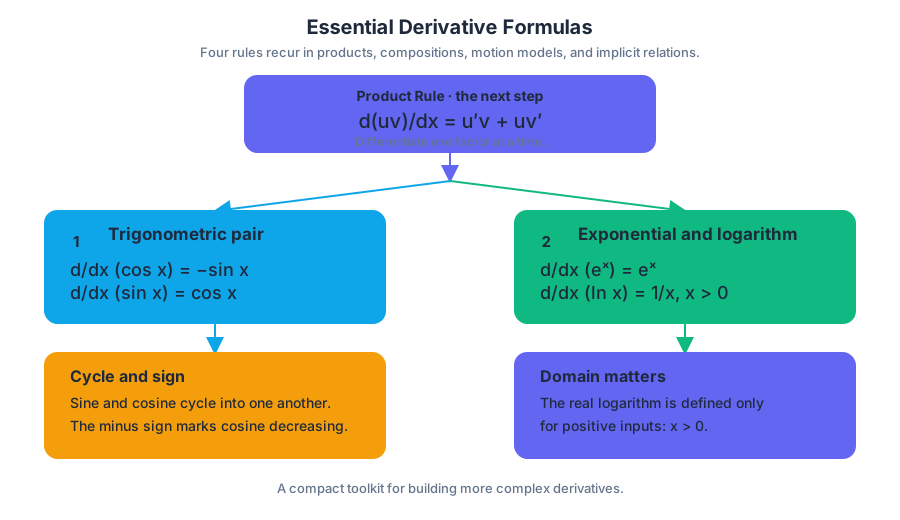
The four basic derivatives below are especially important because they recur inside products, compositions, motion models, and implicit relations.
$$ \frac{d}{dx}(\cos x)=-\sin x \qquad \frac{d}{dx}(\sin x)=\cos x $$
$$ \frac{d}{dx}(e^x)=e^x \qquad \frac{d}{dx}(\ln x)=\frac{1}{x}, \quad x>0 $$
The exponential function is remarkable because its rate of change equals its current value. The sine and cosine functions cycle into one another, with the negative sign appearing when cosine decreases. The logarithm rule requires $x>0$ because $\ln x$ is defined over the real numbers only for positive inputs.
These rules also evaluate limits that are derivatives in disguise. Because $\lim_{h\to0}\frac{\sin(\frac{\pi}{6}+h)-\frac12}{h}$ is the definition of the derivative of $\sin x$ at $x=\frac{\pi}{6}$, its value is $\cos\frac{\pi}{6}=\frac{\sqrt3}{2}$.
The chain rule inside these rules
The formulas above give derivatives of functions whose input is simply $x$. If the input is another function, use the chain rule: differentiate the outside function, keep the inside function, and multiply by the derivative of the inside.
Learning Objective FUN-3.C is to calculate derivatives of compositions of differentiable functions, supported by Essential Knowledge FUN-3.C.1: the chain rule provides a way to differentiate composite functions.
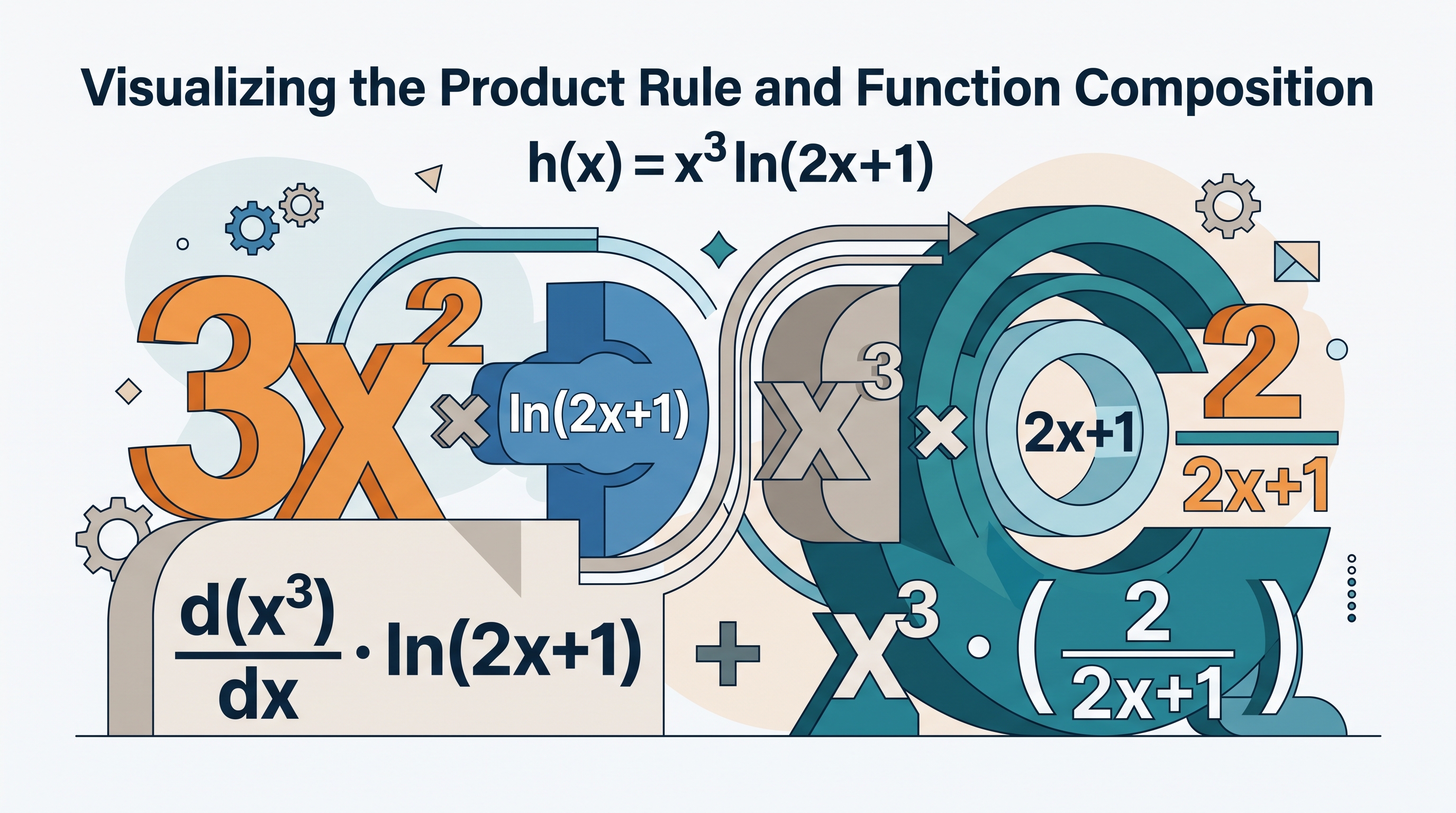
For example, with $y=\cos(3x^2)$, the outside function is cosine and the inside function is $3x^2$:
$$ \frac{dy}{dx}=-\sin(3x^2)\cdot 6x. $$
Why the trigonometric rules are trustworthy
The Maclaurin series make the sine and cosine derivatives visible term by term:
$$ \sin x=x-\frac{x^3}{3!}+\frac{x^5}{5!}-\frac{x^7}{7!}+\cdots $$
$$ \cos x=1-\frac{x^2}{2!}+\frac{x^4}{4!}-\frac{x^6}{6!}+\cdots $$
Differentiating these series produces the alternating pattern:
$$ \frac{d}{dx}(\sin x)=\cos x, \qquad \frac{d}{dx}(\cos x)=-\sin x. $$
Identities and later differentiation rules establish the remaining trigonometric derivatives without needing to memorize unrelated formulas as isolated facts.
AP assessment lens
Topic 2.7 is assessed mainly through Skill 1.E: Apply appropriate mathematical rules or procedures, with and without technology. These four derivatives rarely appear alone, so recall has to be automatic, including the negative sign in $-\sin x$ and the condition $x>0$ for $\ln x$.
On free-response work, write the derivative rule clearly, preserve factors long enough to show the structure, and include units when the quantity represents a rate. A correct final number without supporting work may not demonstrate the reasoning required by the scoring rubric.
Retrieval check: Differentiate $p(x)=4\sin x+3\cos x-2e^x+\ln x$ for $x>0$. The expected result is $p'(x)=4\cos x-3\sin x-2e^x+\frac{1}{x}$: every term keeps its coefficient, and only the cosine term changes sign.
Source Materials
- Learn More (.pdf)
- AP Calculus AB and BC Course and Exam Description
- AP Calculus AB Course Overview
- AP Calculus Course at a Glance
- AP Calculus AB and BC Course at a Glance Poster
- Adopt AP Calculus AB
- AP Calculus AB
- AP Calculus AB
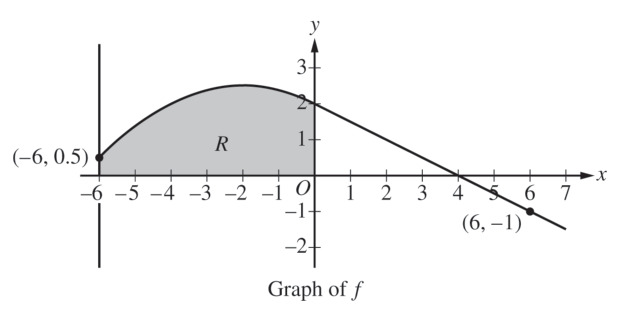
- 4. The graph of the differentiable function f , shown for x 6 7 £ £ − , has a horizontal tangent at x = −2 and is
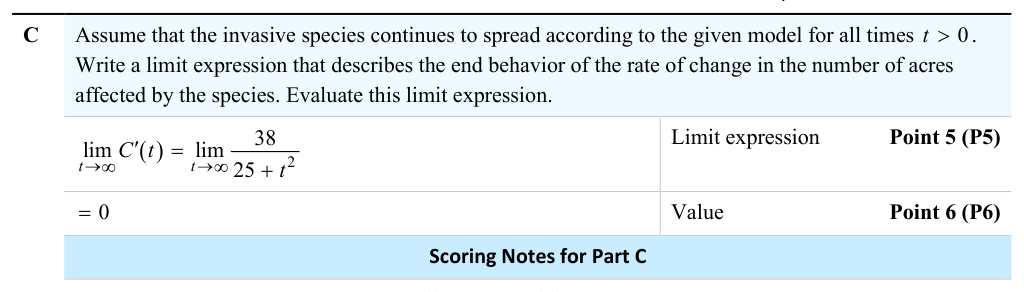
- • P5 can be earned for either lim C t ′( ) or lim C(t) . t→∞ t→∞
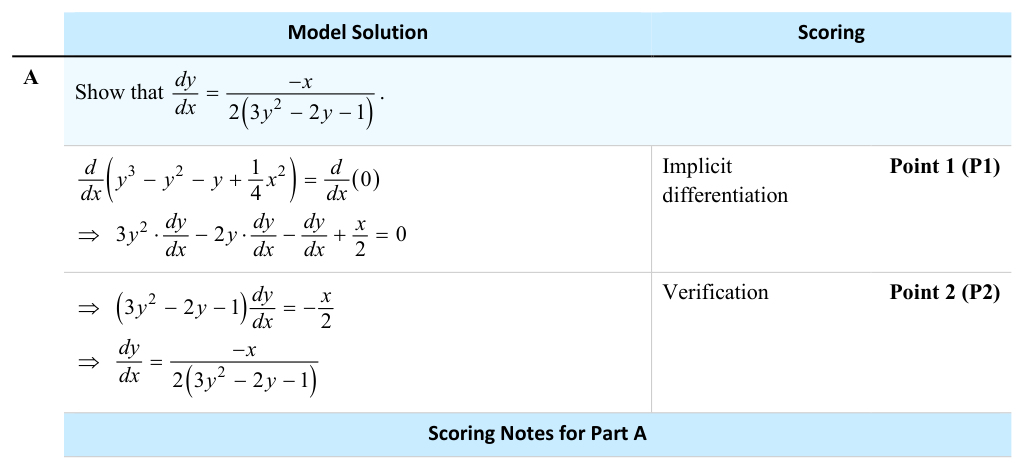
- • P1 is earned only for the correct implicit differentiation of y y 3 2 1 − − + y x2 0 4 = . Responses may
- • P5 can be earned for either lim C t ′( ) or lim C(t) . t→∞ t→∞