From the free course AP Calculus AB on Lykke
7.7 Finding Particular Solutions Using Initial Conditions and Separation of Variables
Key concepts: Solving differential equations to determine functions and develop models · Finding particular solutions using initial conditions · Separation of variables · Using integration to solve differential equations · Using initial conditions to determine the constant of integration
How to find the particular solution of a separable differential equation by integrating both sides and using an initial condition to determine the constant.
7.7 Finding Particular Solutions Using Initial Conditions and Separation of Variables
A differential equation becomes a model when its rate rule is paired with enough information to identify one specific function. The decisive move is often simple: separate the variables, integrate both sides, use an initial condition, and rearrange.
Enduring Understanding FUN-7: Solving differential equations allows us to determine functions and develop models.
From a rate rule to one particular function
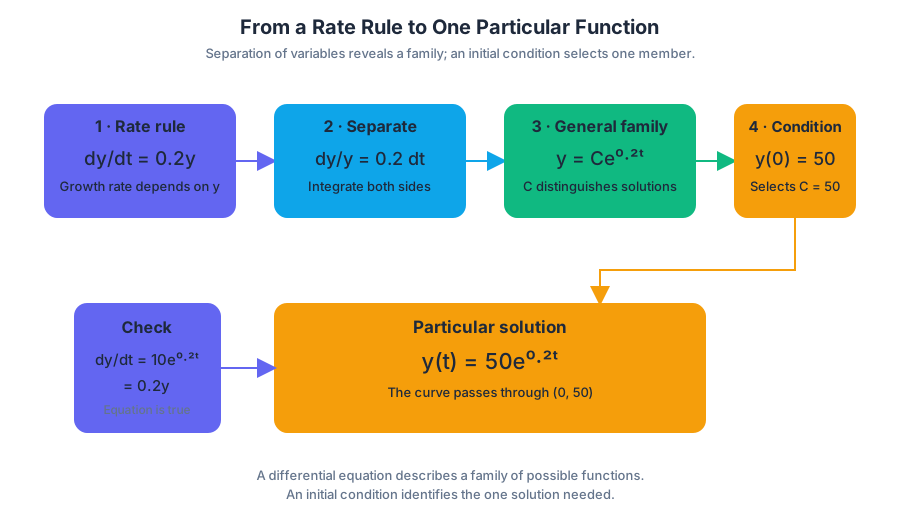
A solution to a differential equation is a function that makes the equation true when its derivatives are substituted into it. For example, if $y(t)=50e^{0.2t}$, then $$ \frac{dy}{dt}=10e^{0.2t}=0.2\left(50e^{0.2t}\right)=0.2y. $$ Therefore, $y(t)=50e^{0.2t}$ is a solution of $\frac{dy}{dt}=0.2y$.
A differential equation usually has a family of solutions. The constant of integration distinguishes one member of that family from another. An initial condition, such as $y(0)=50$, identifies the particular solution passing through the specified point.
The separable-equation pipeline
For a separable differential equation, place all expressions involving the dependent variable on one side and all expressions involving the independent variable on the other:
$$ \frac{dy}{dt}=g(t)h(y) \quad\Longrightarrow\quad \frac{1}{h(y)},dy=g(t),dt. $$
Then integrate both sides, include the constant of integration, apply the initial condition, and solve for the desired function.
Worked example: a changing quantity with an initial measurement
Suppose a quantity $P$ satisfies $$ \frac{dP}{dt}=\frac{3t}{P}, \qquad P(1)=2. $$ The initial condition says that when $t=1$, the quantity has value $P=2$.
Step 1: Separate the variables. $$ P,dP=3t,dt $$
Step 2: Integrate both sides. $$ \int P,dP=\int 3t,dt $$ $$ \frac{P^2}{2}=\frac{3t^2}{2}+C. $$
Step 3: Use the initial condition to determine $C$. Substitute $P=2$ and $t=1$: $$ \frac{2^2}{2}=\frac{3(1)^2}{2}+C $$ $$ 2=\frac{3}{2}+C, \qquad C=\frac12. $$
Step 4: Rearrange to obtain the particular solution. $$ \frac{P^2}{2}=\frac{3t^2}{2}+\frac12 $$ $$ P^2=3t^2+1. $$ Because the initial value is positive, choose the positive branch: $$ \boxed{P(t)=\sqrt{3t^2+1}}. $$
The sign choice matters. Both $P=\sqrt{3t^2+1}$ and $P=-\sqrt{3t^2+1}$ satisfy the squared equation, but only the positive function satisfies $P(1)=2$.
The pipeline works the same way when the rate is proportional to the amount. For $\frac{dy}{dt}=ky$, separating gives $\frac{1}{y},dy=k,dt$, integrating gives $\ln|y|=kt+C$, and solving for $y$ gives the family $y=Ce^{kt}$. Topic 7.8 studies this exponential model in detail; here it is one more family from which an initial condition selects a single member.
AP skills in this topic
This work develops 1.E — Apply appropriate mathematical rules or procedures, with and without technology: separation, antidifferentiation, logarithm rules, constant selection, and algebraic rearrangement must remain visible. It also exercises the representation and modeling processes associated with [2.C], [3.G], and [4.D] by translating among equations, conditions, graphs, context, and notation.
Misconception check
“The constant of integration can be ignored because the initial condition supplies the missing information.” The initial condition does not replace $C$; it determines $C$. Omitting $C$ before applying the condition usually eliminates the entire family of possible solutions.
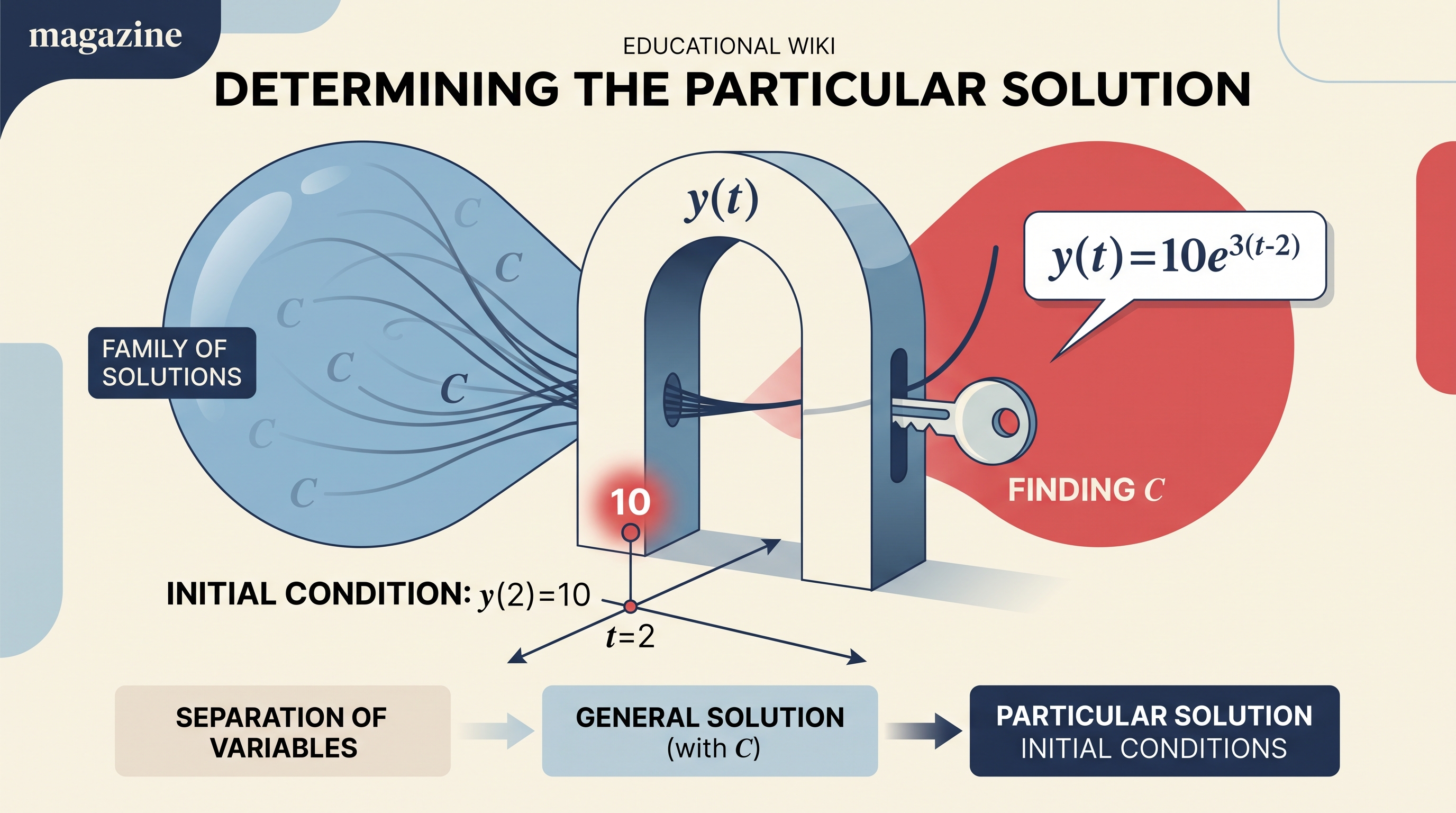
Retrieval check: For $$ \frac{dy}{dt}=3y, \qquad y(2)=10, $$ identify the model type and find the particular solution. The equation has exponential form, so $y=Ce^{3t}$. Since $10=Ce^6$, the answer is $$ \boxed{y(t)=10e^{3(t-2)}}. $$
Source Materials
- Learn More (.pdf)
- AP Calculus AB and BC Course and Exam Description
- AP Calculus AB Course Overview
- AP Calculus Course at a Glance
- AP Calculus AB and BC Course at a Glance Poster
- Adopt AP Calculus AB
- AP Calculus AB
- AP Calculus AB
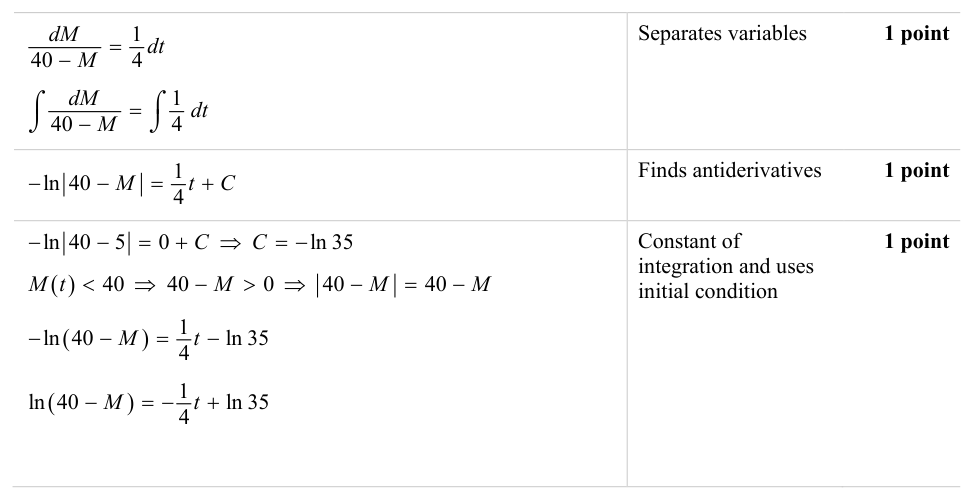
- equation ( ) 1 40 4 dM M dt = − with initial condition ( ) 0 5. M =
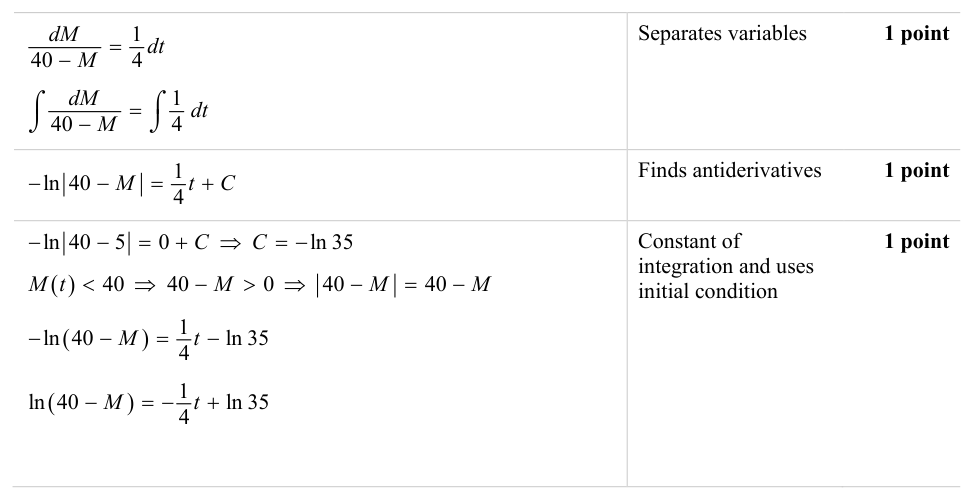
- equation ( ) 1 40 4 dM M dt = − with initial condition ( ) 0 5. M =