From the free course AP Calculus AB on Lykke
1.8 Determining Limits Using the Squeeze Theorem
Key concepts: Determining limits using the Squeeze Theorem · Identifying when a theorem or test is appropriate for a limit
The Squeeze Theorem: finding the limit of a rapidly oscillating expression by trapping it between two simpler functions that approach the same value.
1.8 Determining Limits Using the Squeeze Theorem
Some limits resist every algebraic rewrite: a factor such as $\sin\left(\frac{1}{x}\right)$ oscillates faster and faster near the target, so there is nothing to cancel and substitution is meaningless. The Squeeze Theorem finds such limits indirectly, by trapping the difficult function between two simpler functions that approach the same value.
Enduring Understanding LIM-1: Reasoning with definitions, theorems, and properties can be used to justify claims about limits.
Learning Objective LIM-1.E: Determine the limits of functions using equivalent expressions for the function or the Squeeze Theorem.
The Squeeze Theorem: proving a trapped limit
The Squeeze Theorem determines a limit when a function is bounded above and below by two functions that approach the same value.
If $g(x)\le f(x)\le h(x)$ near $x=a$, and
$$ \lim_{x\to a}g(x)=\lim_{x\to a}h(x)=L, $$
then
$$ \lim_{x\to a}f(x)=L. $$
Worked example: an oscillating sensor signal
A vibration sensor records a signal
$$ s(t)=t^2\sin\left(\frac{1}{t}\right) $$
near $t=0$. The factor $\sin\left(\frac{1}{t}\right)$ oscillates increasingly rapidly, so direct substitution is not useful. But sine always satisfies
$$ -1\le \sin\left(\frac{1}{t}\right)\le1. $$
Because $t^2\ge0$,
$$ -t^2\le t^2\sin\left(\frac{1}{t}\right)\le t^2. $$
Both outside functions approach $0$:
$$ \lim_{t\to0}(-t^2)=0 \qquad\text{and}\qquad \lim_{t\to0}t^2=0. $$
Therefore, the Squeeze Theorem gives
$$ \boxed{\lim_{t\to0}t^2\sin\left(\frac{1}{t}\right)=0}. $$
The oscillation never disappears, but its amplitude is forced into the narrowing interval $[-t^2,t^2]$. The “trap” closes at $0$.
When is the theorem appropriate?
The Squeeze Theorem is appropriate when a difficult factor is bounded and another factor drives the bounds toward one common value. It is especially useful for expressions involving oscillation, such as $\sin(1/x)$ or $\cos(1/x)$, where algebraic rearrangement alone cannot remove the rapid oscillation.
Misconception check — “Rapid oscillation means the limit does not exist.” Oscillation by itself may prevent a limit, but multiplying by a shrinking factor can force the entire expression toward one value. The bounds, not the visual irregularity alone, determine the conclusion.
Retrieval check
Find $\lim_{x\to0}x\cos\left(\frac{1}{x}\right)$. Because $x$ can be negative, bound the product with absolute values: $-|x|\le x\cos\left(\frac{1}{x}\right)\le|x|$. Both $-|x|$ and $|x|$ approach $0$ as $x\to0$, so the Squeeze Theorem gives a limit of $0$.
Source Materials
- Learn More (.pdf)
- AP Calculus AB and BC Course and Exam Description
- AP Calculus AB Course Overview
- AP Calculus Course at a Glance
- AP Calculus AB and BC Course at a Glance Poster
- Adopt AP Calculus AB
- AP Calculus AB
- AP Calculus AB
- 0 1 35 40 5 4 4 t dM dt = = − =
- Figure — Chief Reader Report (p. 19)
- Figure — Chief Reader Report (p. 31)
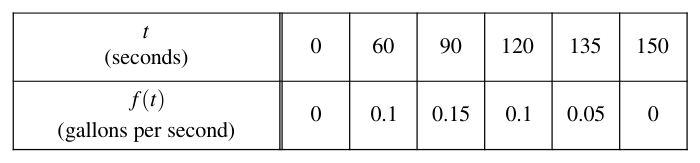
- 1. A customer at a gas station is pumping gasoline into a gas tank. The rate of flow of gasoline is modeled by a