From the free course AP Calculus AB on Lykke
2.8 The Product Rule
Key concepts: The product rule for differentiable functions · The chain rule and its applications · Using the product rule in implicit differentiation · AP Exam assessment of derivative rules · Essential knowledge: derivatives of products can be found using the product rule · The quotient rule · Finding g′(2) and showing the work leading to the answer
The product rule (fg)' = f'g + fg', why f'g' is wrong, and how to apply the rule to repeated products, products with a chain-rule factor, and mixed x-y terms in implicit differentiation.
2.8 The Product Rule
A changing signal may combine several behaviors at once: a polynomial trend, exponential growth, and periodic oscillation. Differentiation handles such expressions by matching each function with its derivative and then using the product rule, which separates how each factor contributes to the total rate of change.
Enduring Understanding FUN-3: Recognizing opportunities to apply derivative rules can simplify differentiation.
The examples on this page use the basic derivatives from Topic 2.7: $\frac{d}{dx}(\sin x)=\cos x$, $\frac{d}{dx}(\cos x)=-\sin x$, $\frac{d}{dx}(e^x)=e^x$, and $\frac{d}{dx}(\ln x)=\frac{1}{x}$ for $x>0$.
Products: why one derivative is not enough
If $f$ and $g$ are differentiable, their product changes because both factors may change. The required rule is:
Product Rule, FUN-3.B.1
For differentiable functions $f$ and $g$, $$ (fg)'=f'g+fg'. $$
This supports Learning Objective FUN-3.B: Calculate derivatives of products and quotients of differentiable functions. Notice the two terms: first, $f$ changes while $g$ is held in the multiplying position; second, $g$ changes while $f$ remains. Writing only $f'g'$ incorrectly combines two rates that do not represent the product’s rate of change.
Worked example: evaluating $g'(2)$
Let
$$ g(x)=x^2e^x\cos x. $$
Treat this as a product of $x^2$ and $e^x\cos x$:
$$ g'(x)=2x(e^x\cos x)+x^2\frac{d}{dx}(e^x\cos x). $$
Apply the product rule again to the inner product:
$$ \frac{d}{dx}(e^x\cos x)=e^x\cos x-e^x\sin x. $$
Therefore,
$$ g'(x)=2xe^x\cos x+x^2e^x\cos x-x^2e^x\sin x, $$
so
$$ g'(x)=e^x\left[(2x+x^2)\cos x-x^2\sin x\right]. $$
At $x=2$,
$$ g'(2)=e^2\left[8\cos 2-4\sin 2\right]\approx -51.47. $$
The supporting work matters: it shows which factors were differentiated and where each product-rule term came from.
The chain rule inside these rules
The formulas above give derivatives of functions whose input is simply $x$. If the input is another function, use the chain rule: differentiate the outside function, keep the inside function, and multiply by the derivative of the inside.
Learning Objective FUN-3.C is to calculate derivatives of compositions of differentiable functions, supported by Essential Knowledge FUN-3.C.1: the chain rule provides a way to differentiate composite functions.
For a product such as
$$ y=e^{x^2}\sin(4x), $$
apply both rules:
$$ y'=e^{x^2}(2x)\sin(4x)+e^{x^2}\cos(4x)(4). $$
Misconception check — “differentiate each factor separately and multiply.” The expression $f'g'$ is not the derivative of $fg$. Use the product rule for multiplication and the chain rule for a function placed inside another function; an expression can require both.
Product rule in implicit differentiation
Implicit differentiation becomes essential when $y$ is not isolated. If a term contains both $x$ and $y$, differentiate it as a product and remember that $y$ depends on $x$.
For
$$ x^2y+\sin y=7, $$
differentiate with respect to $x$:
$$ 2xy+x^2\frac{dy}{dx}+\cos y\frac{dy}{dx}=0. $$
Collect the $\frac{dy}{dx}$ terms:
$$ \left(x^2+\cos y\right)\frac{dy}{dx}=-2xy, $$
so
$$ \frac{dy}{dx}=\frac{-2xy}{x^2+\cos y}. $$
The factor $x^2y$ requires the product rule; the term $\sin y$ requires the chain rule.
AP assessment lens
These ideas are assessed through FUN 2.7 and FUN 2.8, especially Skill 1.E: Apply appropriate mathematical rules or procedures, with and without technology. Pattern recognition also matters: identify whether the expression is a product, a composition, or both before calculating.
On free-response work, write the derivative rule clearly, preserve factors long enough to show the structure, and include units when the quantity represents a rate. A correct final number without supporting work may not demonstrate the reasoning required by the scoring rubric.
Retrieval check
Differentiate
$$ h(x)=x^3\ln(2x+1). $$
The expected structure is
$$ h'(x)=3x^2\ln(2x+1)+x^3\left(\frac{2}{2x+1}\right). $$
The first term comes from the product rule; the factor $\frac{2}{2x+1}$ comes from the chain rule.
Source Materials
- Learn More (.pdf)
- AP Calculus AB and BC Course and Exam Description
- AP Calculus AB Course Overview
- AP Calculus Course at a Glance
- AP Calculus AB and BC Course at a Glance Poster
- Adopt AP Calculus AB
- AP Calculus AB
- AP Calculus AB
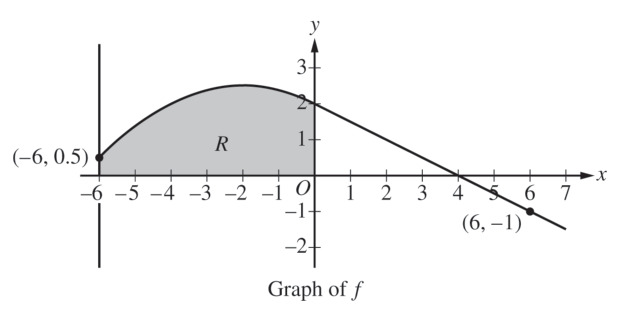
- 4. The graph of the differentiable function f , shown for x 6 7 £ £ − , has a horizontal tangent at x = −2 and is
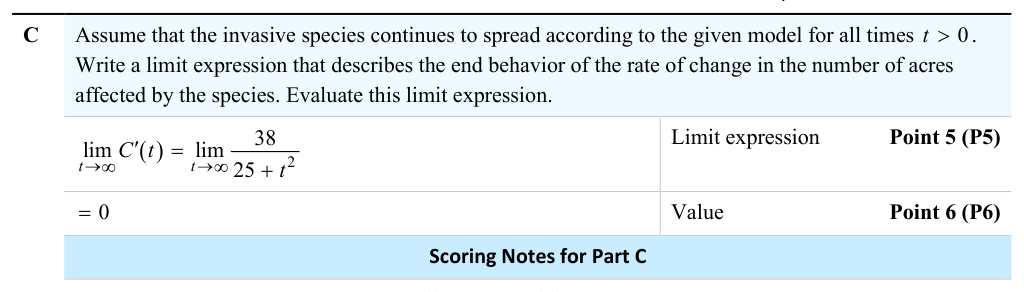
- • P5 can be earned for either lim C t ′( ) or lim C(t) . t→∞ t→∞
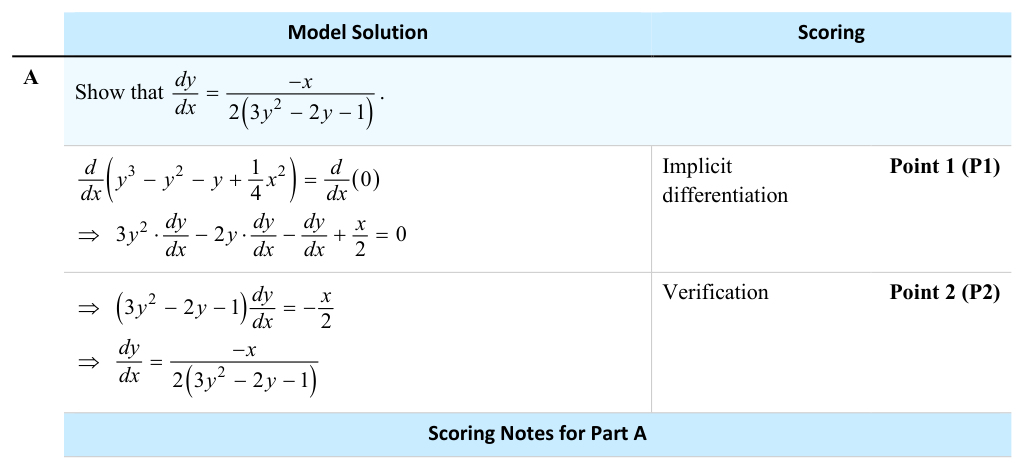
- • P1 is earned only for the correct implicit differentiation of y y 3 2 1 − − + y x2 0 4 = . Responses may
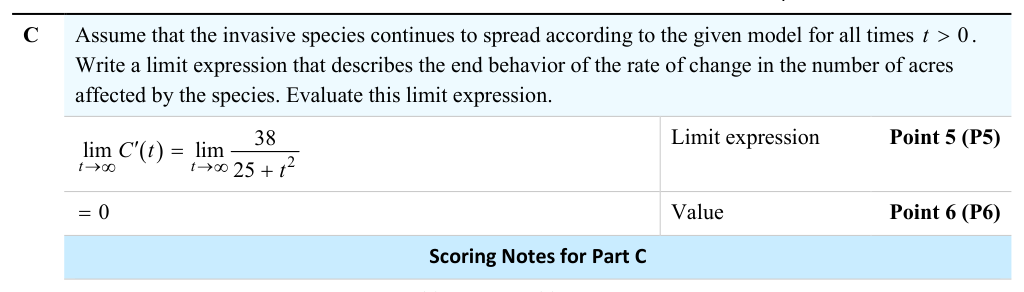
- • P5 can be earned for either lim C t ′( ) or lim C(t) . t→∞ t→∞