From the free course AP Calculus AB on Lykke
AP Practice 2
Key concepts: Translating among tabular, graphical, analytical, and verbal representations of functions · Continuity and differentiability at domain boundaries · Using the underlying context to decide between differentiation and integration · Exponential growth and decay models · Geometric and harmonic series, including alternating series · Predicting infinite totals through geometric-series models · Mathematical practices involving justification, communication, and notation · AP Calculus AB and BC multiple-choice exam structure · Differentiating composite trigonometric functions · Identifying values where a function is not differentiable
A strong calculus solution can move fluently between a table, graph, equation, and sentence without changing the underlying meaning. The same fluency also reveals which operation belongs: differentiation measures an instantaneous rate, while integration accumulates a rate over an interval.
AP Practice 2
A strong calculus solution can move fluently between a table, graph, equation, and sentence without changing the underlying meaning. The same fluency also reveals which operation belongs: differentiation measures an instantaneous rate, while integration accumulates a rate over an interval.
Exam map: where this practice belongs
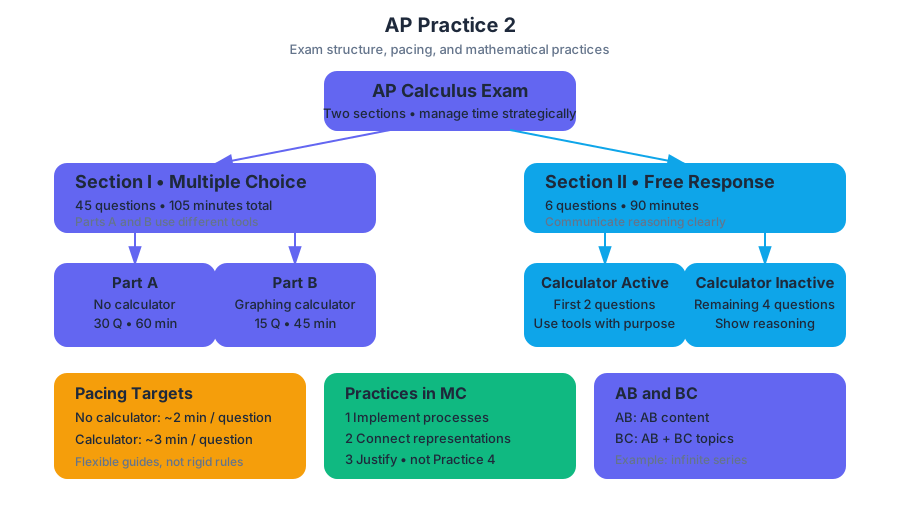
For the current AP Calculus AB and BC exam format, Section I is multiple choice and contains two parts:
| Part | Calculator policy | Questions | Time |
|---|---|---|---|
| Section I, Part A | No calculator | $30$ | $60$ minutes |
| Section I, Part B | Graphing calculator permitted | $15$ | $45$ minutes |
Section II contains $6$ free-response questions completed in $90$ minutes. The first $2$ questions are calculator-active, and the remaining $4$ questions are calculator-inactive. AB students are assessed on the AB content; BC students encounter the AB content plus BC topics such as infinite series. In the multiple-choice section, Mathematical Practice 1: Implementing Mathematical Processes, Mathematical Practice 2: Connecting Representations, and Mathematical Practice 3: Justification are assessed; Mathematical Practice 4: Communication and Notation is not assessed there, although clear communication and notation matter especially in free response.
A useful pacing target is about $2$ minutes per question in no-calculator multiple choice and about $3$ minutes per question in calculator multiple choice. These are guides, not rigid rules: if a representation can be interpreted directly, do not spend calculator time performing algebra that the graph or table already answers.
Representation translation: one quantity, four languages
Suppose a tank’s water level is described by the sentence: “At time $t=3$ hours, the level is increasing at $4$ centimeters per hour.” The analytical representation is $h'(3)=4$, the verbal representation gives the units and meaning, a graph of $h$ has slope $4$ at $t=3$, and a table for $h$ would show nearby average slopes approaching $4$.
Worked question 1: read the table, then speak its meaning
A differentiable function $R$ gives a reading rate in words per minute. The table shows $R(0)=90$, $R(2)=100$, $R(8)=150$, and $R(10)=162$. Estimate $R'(1)$ using the available data.
$$ R'(1)\approx \frac{R(2)-R(0)}{2-0} =\frac{100-90}{2}=5. $$
The estimate is $5$ words per minute per minute. The calculation is an analytical representation, the table is numerical, and the final sentence is verbal. A complete response must not merely write $5$; it must identify what $5$ measures and include units.
Rewarded reasoning: connects the table to an average-rate approximation, identifies that the result estimates an instantaneous rate, and states appropriate units.
Misconception check — confusing $R(1)$ with $R'(1)$. The value $R(1)$ would be a reading rate. The value $R'(1)$ describes how that reading rate is changing. They have different meanings and different units.
Differentiation or integration? Let the context decide
Use differentiation when the question asks for a rate at a particular instant: velocity at $t=4$, the rate at which a population is changing, or the slope of a graph. Use integration when a rate is accumulated across an interval: total distance from velocity, total water entering from an inflow rate, or total words read from a reading-rate function.
Worked question 2: choose the operation before calculating
A machine produces items at a rate $p(t)$ items per hour. Which expression gives the total number of items produced from $t=2$ to $t=7$?
$$ \int_2^7 p(t),dt $$
The integral is correct because the problem asks for a total accumulated amount. By contrast, $p'(5)$ would measure how rapidly the production rate itself is changing at $t=5$.
Exponential growth and decay
A statement such as “the population increases at a rate proportional to its current population” translates into
$$ \frac{dP}{dt}=kP. $$
Its model is
$$ P(t)=P_0e^{kt}, $$
where $P_0$ is the initial population. If $k>0$, the model represents growth; if $k<0$, it represents decay.
Worked question 3: translate the rate statement
A chemical sample contains $80$ grams initially and decays at a rate proportional to the amount present, with proportionality constant $-0.25$. The model is
$$ \frac{dA}{dt}=-0.25A, \qquad A(t)=80e^{-0.25t}. $$
After $4$ hours,
$$ A(4)=80e^{-1}\approx 29.431. $$
The negative sign belongs in the differential equation because the amount is decreasing. Omitting it produces growth rather than decay.
Boundary behavior and differentiability
At an interior breakpoint, both sides matter. Consider
$$ f(x)= \begin{cases} x^2, & x\le 2,\ 4x-4, & x>2. \end{cases} $$
Here $x=2$ is an interior breakpoint, not a domain boundary, because the domain includes values both less than and greater than $2$.
The left-hand limit is
$$ \lim_{x\to2^-}f(x)=4, $$
and the right-hand limit is
$$ \lim_{x\to2^+}f(x)=4. $$
Since $f(2)=4$, the function is continuous at $x=2$. The one-sided derivatives are
$$ \lim_{x\to2^-}\frac{d}{dx}(x^2)=4, \qquad \lim_{x\to2^+}\frac{d}{dx}(4x-4)=4, $$
so $f$ is also differentiable at $x=2$.
At a genuine domain boundary, only the derivative from within the domain is relevant. For
$$ g(x)=\sqrt{x-1}, \qquad x\ge1, $$
the point $x=1$ is a domain boundary. Continuity uses the right-hand limit:
$$ \lim_{x\to1^+}\sqrt{x-1}=0=g(1). $$
A boundary derivative, when defined in the course’s one-sided sense, is tested using the right-hand difference quotient. There is no left-hand domain from which to approach.
Worked question 4: find where differentiability fails
For
$$ q(x)=|x-3|, $$
the function is continuous at $x=3$, but its left-hand slope is $-1$ and its right-hand slope is $1$. Because the one-sided derivatives disagree, $q$ is not differentiable at $x=3$.
Key distinction: differentiability implies continuity, but continuity does not imply differentiability.
Infinite totals and series
If a repeatedly distributed piece is always a fixed fraction $r$ of the previous piece, the total is modeled by a geometric series:
$$ a+ar+ar^2+ar^3+\cdots. $$
When $|r|<1$, the infinite total is
$$ \sum_{n=0}^{\infty}ar^n=\frac{a}{1-r}. $$
For example, if a $12$-inch strip of licorice is divided so that each next piece is $\frac13$ of the previous piece, then the predicted total represented by all pieces is
$$ 12\left(1+\frac13+\frac19+\cdots\right) =\frac{12}{1-\frac13}=18\text{ inches}. $$
A harmonic series has terms such as
$$ \sum_{n=1}^{\infty}\frac1n $$
and diverges, meaning its partial sums grow without a finite limit. An alternating series changes signs, such as
$$ \sum_{n=1}^{\infty}(-1)^{n+1}\frac1n. $$
This alternating harmonic series converges even though the corresponding positive harmonic series diverges. These series topics are BC content.
Worked question 5: predict the infinite total
A donut is divided so that the first recipient receives $10$ units, the second receives $\frac12$ as much, and every later recipient receives half as much as the previous recipient. The total eventually distributed is
$$ \sum_{n=0}^{\infty}10\left(\frac12\right)^n =\frac{10}{1-\frac12}=20. $$
The model works because the common ratio satisfies $|r|<1$.
Mixed practice: choose, translate, justify
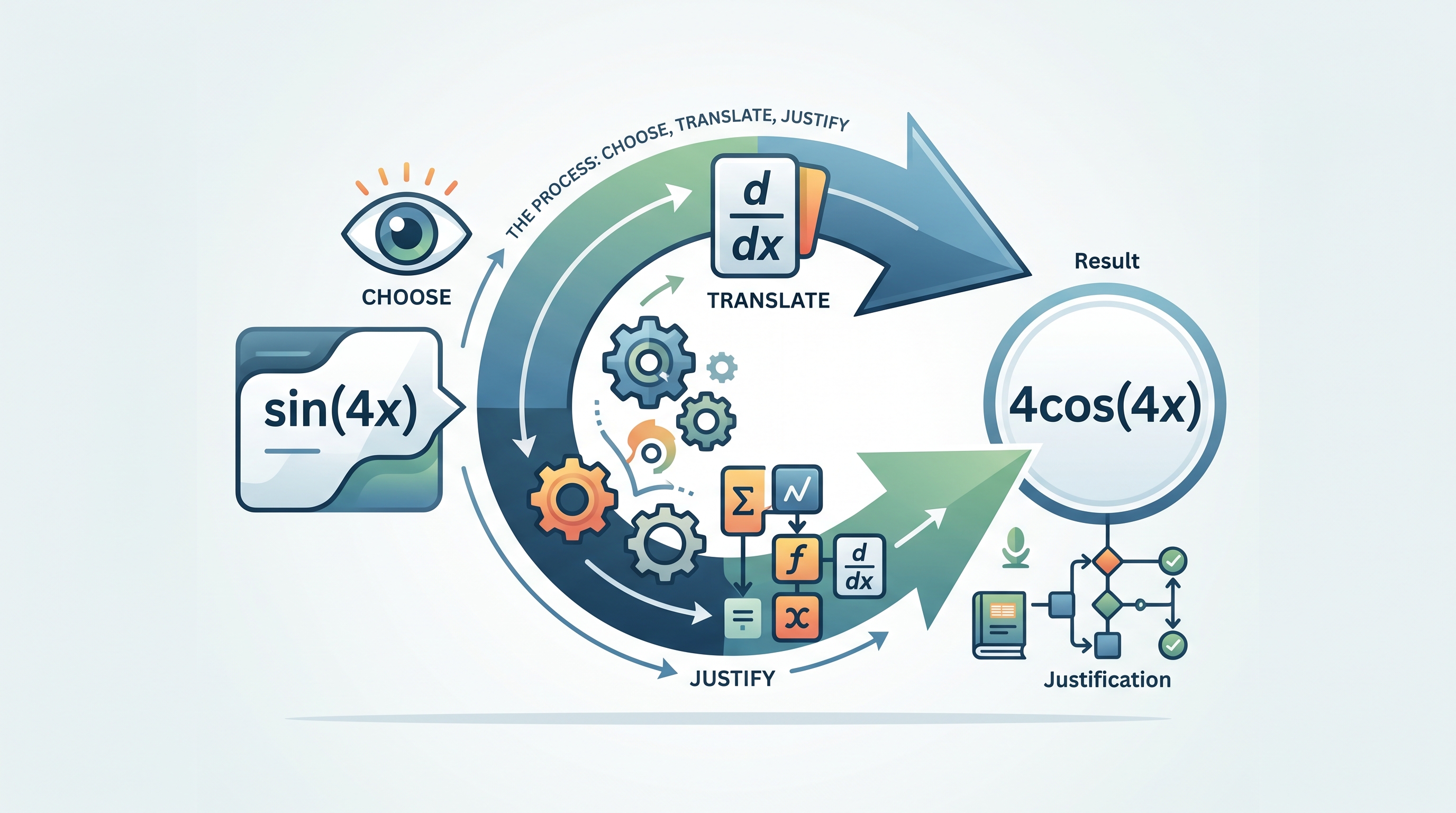
Question 6. Let $s(x)=\sin(4x)$. Which statement is correct?
A. $s'(x)=\cos(4x)$
B. $s'(x)=4\cos(4x)$
C. $s'(x)=\sin(4)$
D. $s'(x)=4\sin(x)$
The correct answer is B, because the outer derivative gives $\cos(4x)$ and the inner derivative of $4x$ gives $4$:
$$ \frac{d}{dx}\sin(4x)=\cos(4x)\cdot4=4\cos(4x). $$
Error-review routine: For each missed item, label the error as one of four types: representation translation, operation selection, boundary reasoning, or series/model interpretation. Then rewrite the answer in a complete sentence with units or conditions. For free response, preserve the chain of reasoning: equation, substitution or theorem condition, result, and interpretation. That practice develops Mathematical Practice 1: Implementing Mathematical Processes, Mathematical Practice 2: Connecting Representations, and Mathematical Practice 3: Justification, while strengthening the communication expected across roughly $10%$ to $25%$ of indicated assessment emphasis.
Source Materials
- Learn More (.pdf)
- AP Calculus AB and BC Course and Exam Description
- AP Calculus AB Course Overview
- AP Calculus Course at a Glance
- AP Calculus AB and BC Course at a Glance Poster
- Adopt AP Calculus AB
- AP Calculus AB
- AP Calculus AB
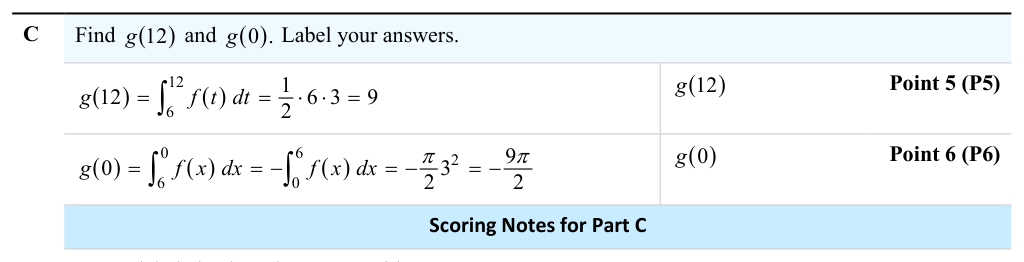
- • Unlabeled values do not earn either P5 or P6.
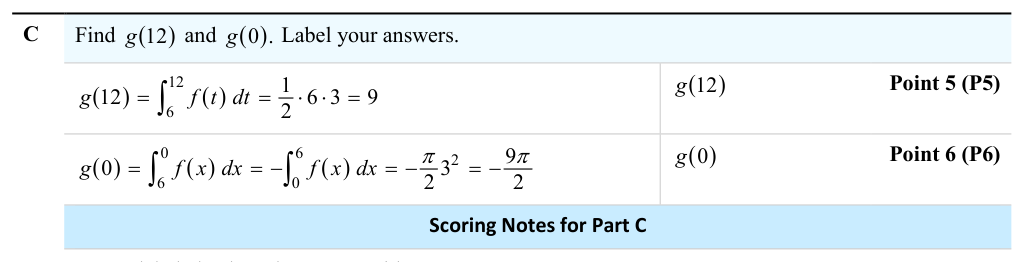
- • Unlabeled values do not earn either P5 or P6.
- AP Calculus AB-AP Students
- AP/College Calculus AB