From the free course AP Calculus AB on Lykke
6.3 Riemann Sums, Summation Notation, and Definite Integral Notation
Key concepts: Unit 6: Integration and Accumulation of Change · Definite integrals · Discrete models and limiting cases · Modeling real-world behavior through accumulation and change · AP Calculus AB and BC course expectations
How a Riemann sum in summation notation becomes the definite integral as a limit, and what each part of the integral notation means in context.
6.3 Riemann Sums, Summation Notation, and Definite Integral Notation
A finite sum can estimate accumulated change, but the definite integral gives the exact limiting accumulation when the partition becomes arbitrarily fine. The Fundamental Theorem of Calculus then reveals the remarkable fact that integration and differentiation undo one another.
From a finite sum to the definite integral
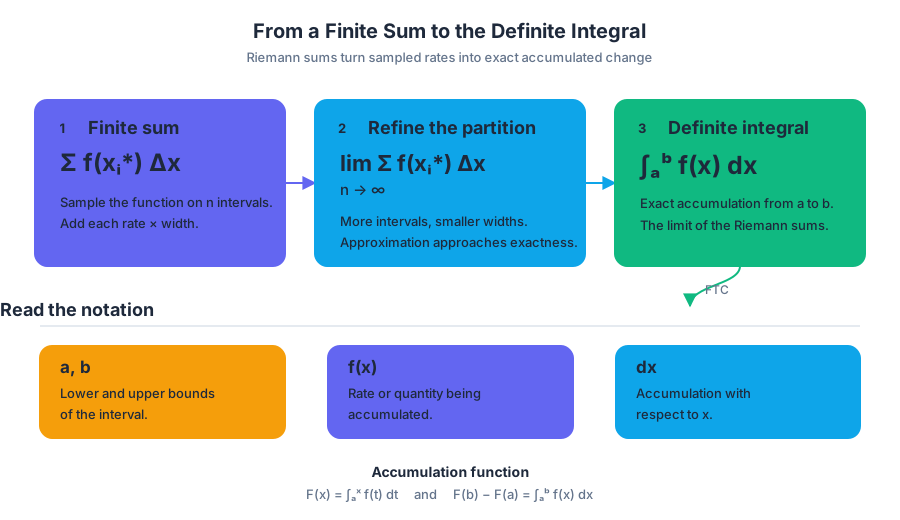
The approximation model established for Riemann sums can be compressed into summation notation. If a function $f$ is evaluated at sample points $x_i^*$ across subintervals of width $\Delta x$, then the accumulated approximation has the form
$$ \sum_{i=1}^{n} f(x_i^*)\Delta x. $$
As the number of subintervals increases and their widths approach zero, this sum approaches the exact accumulated value:
$$ \lim_{n\to\infty}\sum_{i=1}^{n} f(x_i^*)\Delta x
\int_a^b f(x),dx. $$
The symbol $\int_a^b f(x),dx$ is the definite integral of $f$ from $a$ to $b$. The lower bound $a$ and upper bound $b$ identify the interval, $f(x)$ is the rate or quantity being accumulated, and $dx$ indicates that the accumulation is taken with respect to $x$.
What the notation means in context
Suppose $r(t)$ is a rate measured in liters per minute. Then
$$ \int_0^5 r(t),dt $$
represents the total change in volume during the first $5$ minutes, measured in liters. If $r(t)$ is sometimes negative, the integral records net change: positive contributions add and negative contributions subtract.
Definite integral = accumulated signed change over an interval.
A discrete data set does not automatically justify a continuous integral. To replace observations at isolated times with $\int_a^b r(t),dt$, we assume that the rate varies continuously or that a reasonable continuous model, interpolation, or approximation represents the behavior between observations. The integral is therefore a limiting model of the underlying process, not merely a different notation for a table of measurements.
Misconception check
Misconception: “The integral always gives total amount.” A definite integral gives net accumulated change. If a rate becomes negative, its contribution reduces the result. Also, the bounds matter: $\int_a^b f(x),dx$ and $\int_b^a f(x),dx$ have opposite signs.
AP Calculus alignment and retrieval check
Topic 6.3 Riemann Sums, Summation Notation, and Definite Integral Notation chiefly develops Skill 2.C: Identify a re-expression of mathematical information presented in a given representation. The same accumulation can be written as a finite sum, as a limit of sums, or as a definite integral, and you should be able to move between those forms.
Retrieval check: Write $\lim_{n\to\infty}\sum_{i=1}^{n}\left(1+\frac{3i}{n}\right)^2\frac{3}{n}$ as a definite integral. The factor $\frac{3}{n}$ is $\Delta x$, so the interval has length $3$, and the sample points $x_i=1+\frac{3i}{n}$ are the right endpoints of the subintervals of $[1,4]$. The limit equals $\int_1^4 x^2,dx$.
Source Materials
- Learn More (.pdf)
- AP Calculus AB and BC Course and Exam Description
- AP Calculus AB Course Overview
- AP Calculus Course at a Glance
- AP Calculus AB and BC Course at a Glance Poster
- Adopt AP Calculus AB
- AP Calculus AB
- AP Calculus AB
- Figure — Sample Responses Q4 (p. 2)
- Figure — Sample Responses Q4 (p. 5)
- Figure — Sample Responses Q4 (p. 6)
- Figure — Sample Responses Q4 (p. 7)