From the free course AP Calculus AB on Lykke
8.2 Connecting Position, Velocity, and Acceleration of Functions Using Integrals
Key concepts: Using definite integrals to connect position, velocity, and acceleration · The Fundamental Theorem of Calculus · Approximated values versus actual values · Numerical methods for approximating definite integrals · Using integrals to solve applied optimization problems
How definite integrals of velocity and acceleration give displacement, final position, change in velocity and total distance traveled for a moving object.
8.2 Connecting Position, Velocity, and Acceleration of Functions Using Integrals
Velocity is the rate of change of position, and acceleration is the rate of change of velocity. Differentiation moves down that chain; a definite integral moves back up it, turning a known rate into the net change it produces over a time interval. This page uses that idea to find displacement, final position, change in velocity and total distance traveled.
Motion: integrals accumulate change
If $v(t)$ is velocity, then integrating velocity gives displacement, the net change in position:
$$ s(b)-s(a)=\int_a^b v(t),dt. $$
If $a(t)$ is acceleration, then integrating acceleration gives the change in velocity:
$$ v(b)-v(a)=\int_a^b a(t),dt. $$
These are applications of the Fundamental Theorem of Calculus: if an accumulation function is defined by an integral, its derivative recovers the rate being accumulated.
Suppose a cyclist has velocity
$$ v(t)=4-t $$
for $0\le t\le5$, measured in meters per second, and starts at position $s(0)=10$ meters. The displacement is
$$ \int_0^5(4-t),dt =\left[4t-\frac{t^2}{2}\right]_0^5 =20-\frac{25}{2} =7.5\text{ meters}. $$
Therefore,
$$ s(5)=10+7.5=17.5\text{ meters}. $$
The cyclist’s total distance traveled is not necessarily $7.5$ meters. Since $v(t)=0$ at $t=4$, the cyclist reverses direction. Total distance is
$$ \int_0^5 |v(t)|,dt =\int_0^4(4-t),dt+\int_4^5(t-4),dt =8+\frac12 =8.5\text{ meters}. $$
Displacement is signed; distance is never negative. Speed is $|v(t)|$, while acceleration is $v'(t)$.
Approximations, numerical integrals, and optimization
When an antiderivative is unavailable or data are given in a table, a definite integral can be approximated with a numerical method such as a left Riemann sum, right Riemann sum, midpoint sum, or trapezoidal sum. An approximation is an estimate of the actual accumulated quantity; its accuracy depends on the method, subinterval widths, and the behavior of the function.
A definite integral can also become an objective function in an applied optimization problem. Suppose a pump’s production rate is
$$ r(t)=12-t^2 $$
units per hour for $0\le t\le T$, and operating the pump incurs a fixed loss of $20$ units. The net accumulated output is
$$ N(T)=\int_0^T(12-t^2),dt-20 =12T-\frac{T^3}{3}-20. $$
To maximize output, differentiate:
$$ N'(T)=12-T^2. $$
The critical point in the feasible interval $0\le T\le5$ is $T=\sqrt{12}\approx3.464$. Checking candidates,
$$ N(0)=-20,\qquad N(5)=60-\frac{125}{3}-20\approx-1.667, $$
and
$$ N(\sqrt{12}) =12\sqrt{12}-\frac{(\sqrt{12})^3}{3}-20 \approx7.713. $$
Thus the maximum net output occurs at approximately $T=3.464$ hours, producing about $7.713$ units. The integral creates the accumulated objective; calculus compares its critical points and endpoints.
Skill 1.E, Finding the average value of a function on an interval, requires correct setup, evaluation or approximation, units, and interpretation. Skill 1.D, Connecting position, velocity, and acceleration of functions using integrals, requires identifying the rate being accumulated and distinguishing net change from total amount. For contextual responses, use the language of EK CHA-4.D.2: the definite integral of a rate of change over an interval gives the net change of the quantity.
Retrieval check: A continuous flow rate is $q(t)$ liters per minute on $[2,8]$. Write, but do not evaluate, the average flow rate and the total volume added. Then state which integral would determine displacement if $q$ were instead velocity.
Source Materials
- Learn More (.pdf)
- AP Calculus AB and BC Course and Exam Description
- AP Calculus AB Course Overview
- AP Calculus Course at a Glance
- AP Calculus AB and BC Course at a Glance Poster
- Adopt AP Calculus AB
- AP Calculus AB
- AP Calculus AB
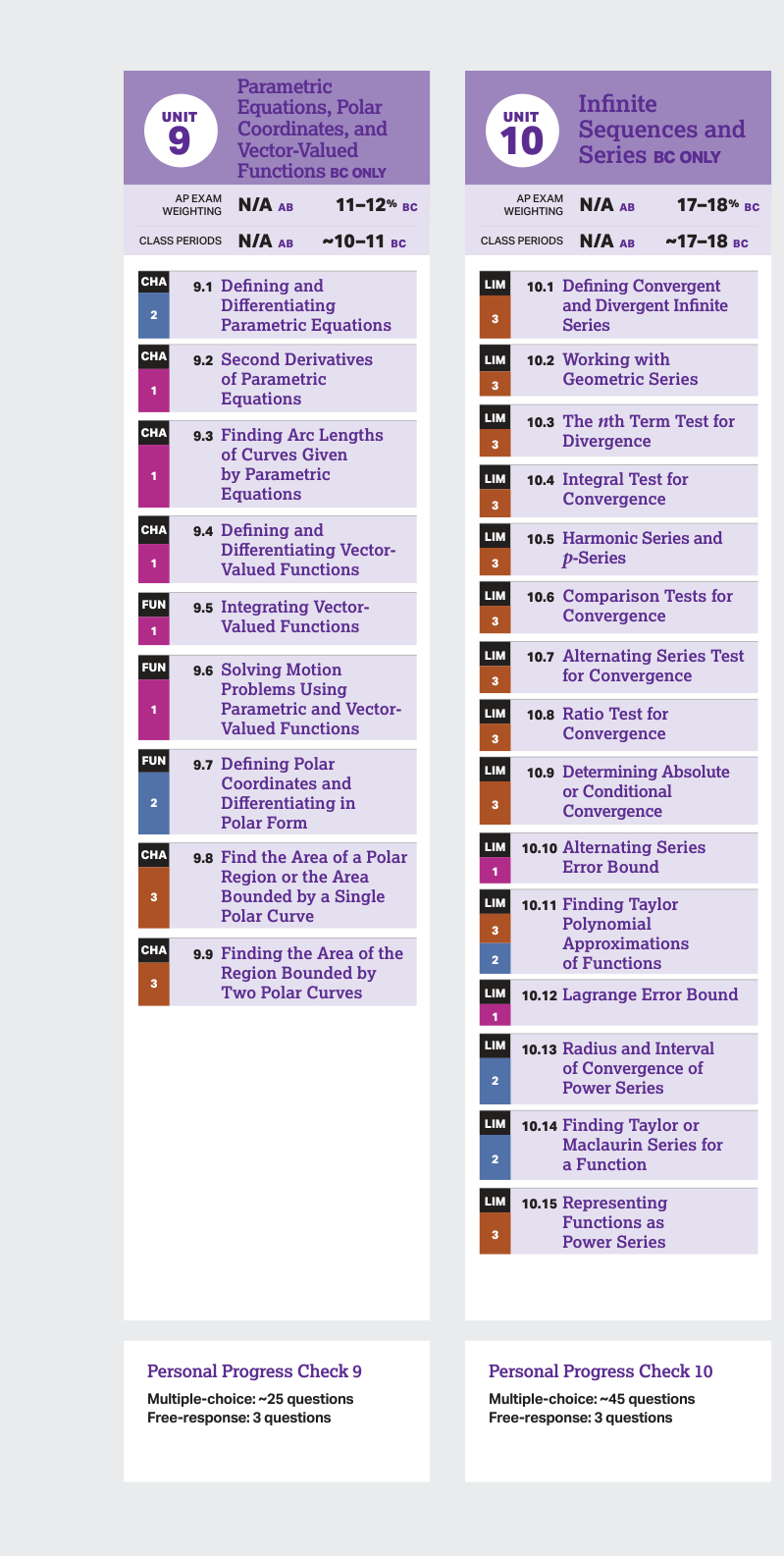
- Figure — AP Calculus Course at a Glance (p. 1)
- Figure — AP Calculus Course at a Glance (p. 4)
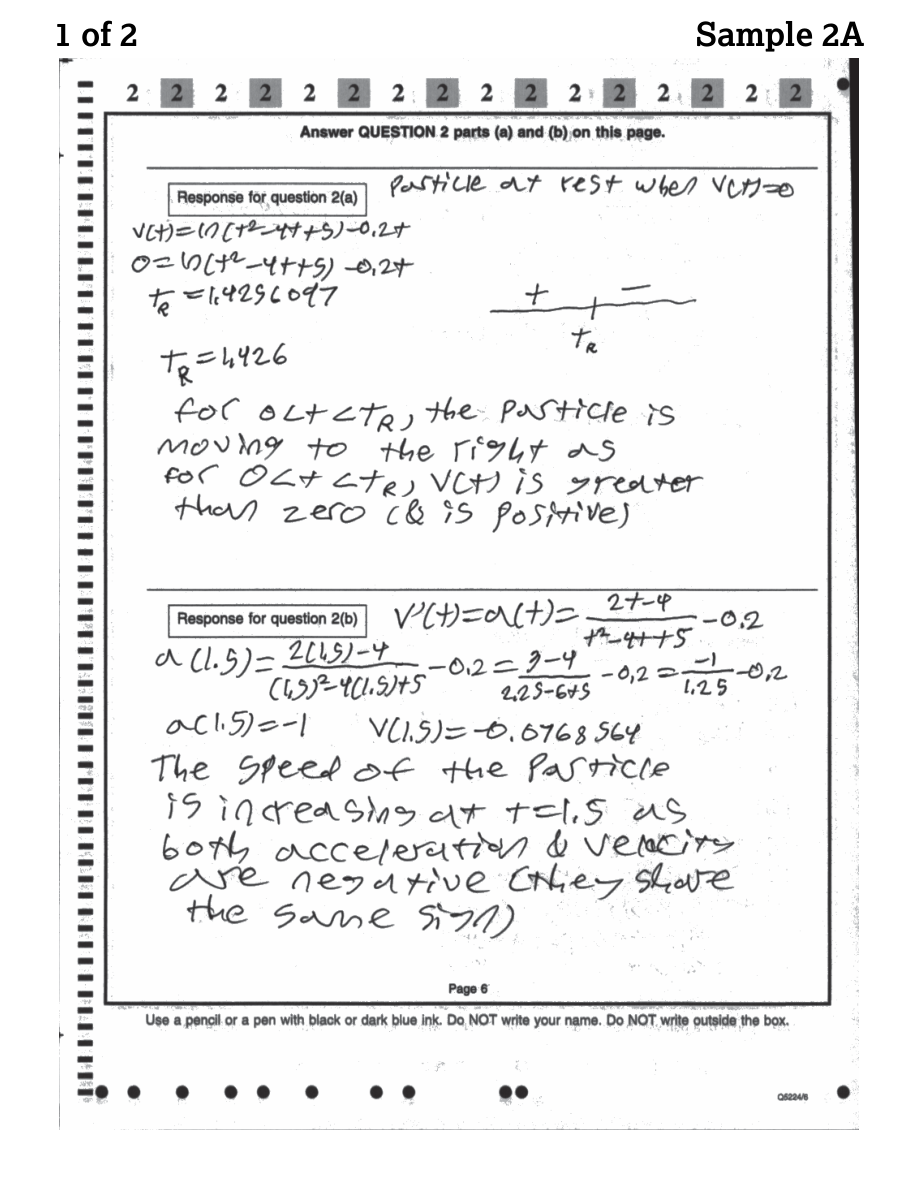
- Figure — Sample Responses Q2 (p. 6)
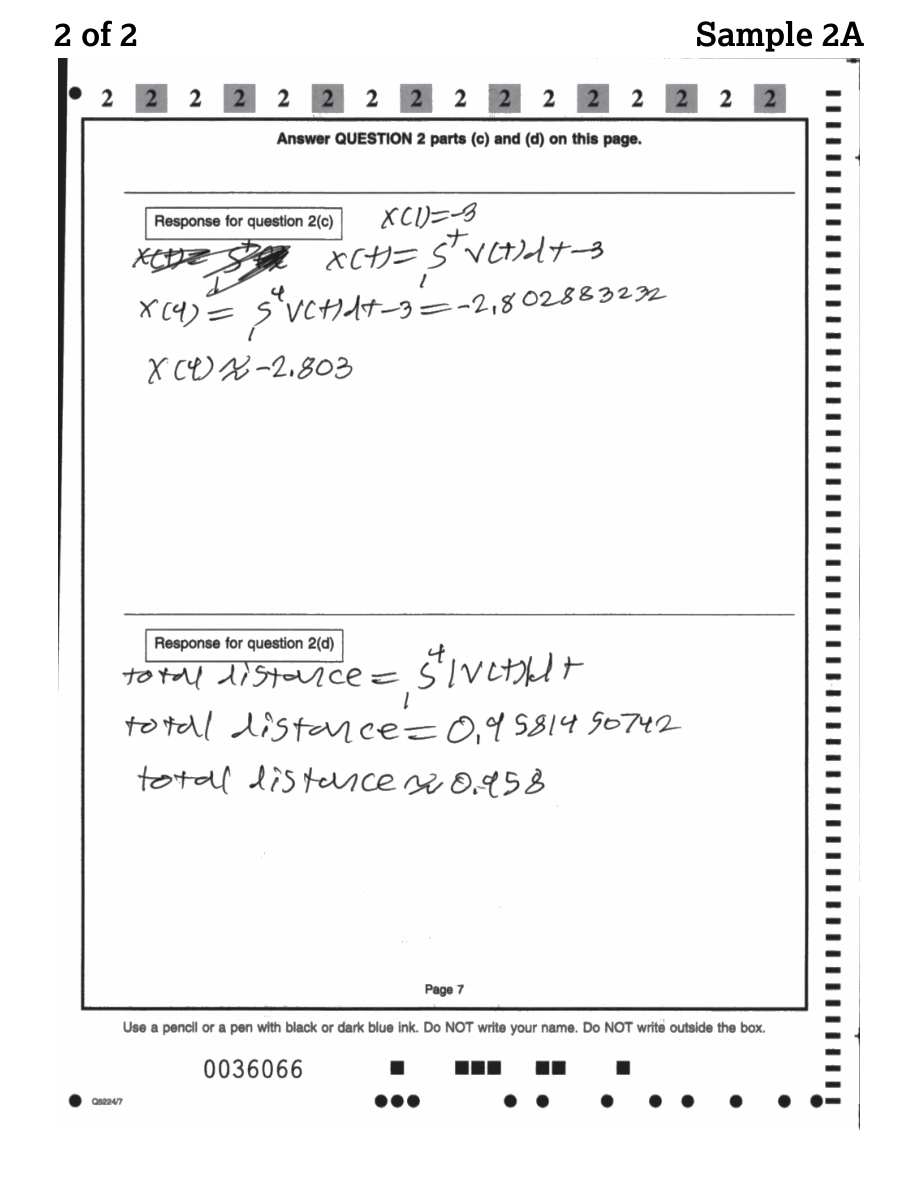
- Figure — Sample Responses Q2 (p. 7)