From the free course AP Calculus AB on Lykke
3.2 Implicit Differentiation
Key concepts: Implicit functions · Chain rule · Product rule · Differentiation of inverse functions · Applying derivative rules strategically
How to find $dy/dx$ for a curve defined by an equation in $x$ and $y$: differentiate both sides, attach $dy/dx$ to every $y$-term through the chain rule, then solve for the slope.
3.2 Implicit Differentiation
Many curves, such as circles and ellipses, are described by an equation that mixes $x$ and $y$ and cannot be solved neatly for a single $y=f(x)$. Implicit differentiation finds the slope $\frac{dy}{dx}$ of such a curve directly from its equation, by applying the chain rule from Topic 3.1 to every term that contains $y$.
Implicit differentiation: when $y$ is not isolated
An implicit function is defined by an equation relating $x$ and $y$, rather than by an equation already solved as $y=f(x)$. The circle
$$ x^2+y^2=25 $$
is an implicit relation. Solving first for $y$ would produce two branches, so implicit differentiation is usually cleaner.
Differentiate both sides with respect to $x$, remembering that $y$ depends on $x$:
$$ \frac{d}{dx}(x^2)+\frac{d}{dx}(y^2)=\frac{d}{dx}(25), $$
$$ 2x+2y\frac{dy}{dx}=0. $$
The factor $\frac{dy}{dx}$ appears because differentiating $y^2$ uses the chain rule: the outer function is $u^2$, while the inner function is $u=y(x)$.
Solving,
$$ \frac{dy}{dx}=-\frac{x}{y}. $$
At the point $(3,4)$, the tangent slope is
$$ \left.\frac{dy}{dx}\right|_{(3,4)}=-\frac34. $$
For a relation containing products, apply the product rule before collecting derivative terms. If
$$ x^2+xy+y^2=7, $$
then
$$ 2x+\left(x\frac{dy}{dx}+y\right)+2y\frac{dy}{dx}=0. $$
Collecting,
$$ (x+2y)\frac{dy}{dx}=-(2x+y), $$
so
$$ \frac{dy}{dx}=-\frac{2x+y}{x+2y}. $$
Implicit differentiation can also be used when the equation contains quotients; the quotient rule applies exactly as it does for explicit functions.
Skills and retrieval check
This topic targets FUN-3—Recognizing opportunities to apply derivative rules can simplify differentiation—especially FUN-3.C—Calculate derivatives of compositions of differentiable functions—with FUN-3.C.1—The chain rule provides a way to differentiate composite functions. It also targets FUN-3.D—Calculate derivatives of implicitly defined functions—with FUN-3.D.1—The chain rule is the basis for implicit differentiation. Suggested Skill 1.C is Identify an appropriate mathematical rule or procedure based on the classification of a given expression; Suggested Skill 1.E is Apply appropriate mathematical rules or procedures, with and without technology.
Retrieval check: Identify the inner function in $y=\ln(5x^3-2)$, then find $dy/dx$. For the implicit relation $x^3+y^3=16$, explain why differentiating $y^3$ produces $3y^2,dy/dx$ rather than merely $3y^2$.
Source Materials
- Learn More (.pdf)
- AP Calculus AB and BC Course and Exam Description
- AP Calculus AB Course Overview
- AP Calculus Course at a Glance
- AP Calculus AB and BC Course at a Glance Poster
- Adopt AP Calculus AB
- AP Calculus AB
- AP Calculus AB
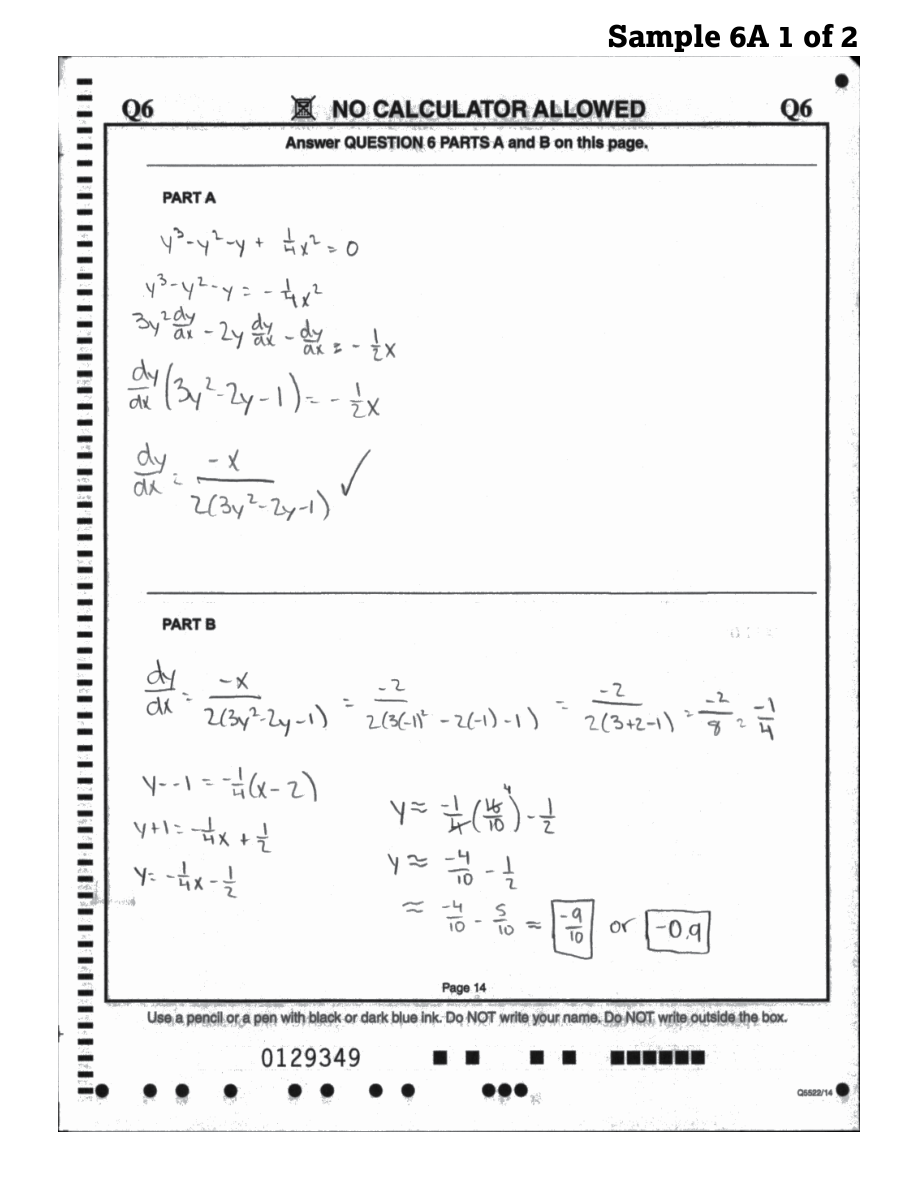
- Figure — Sample Responses Q6 (p. 6)
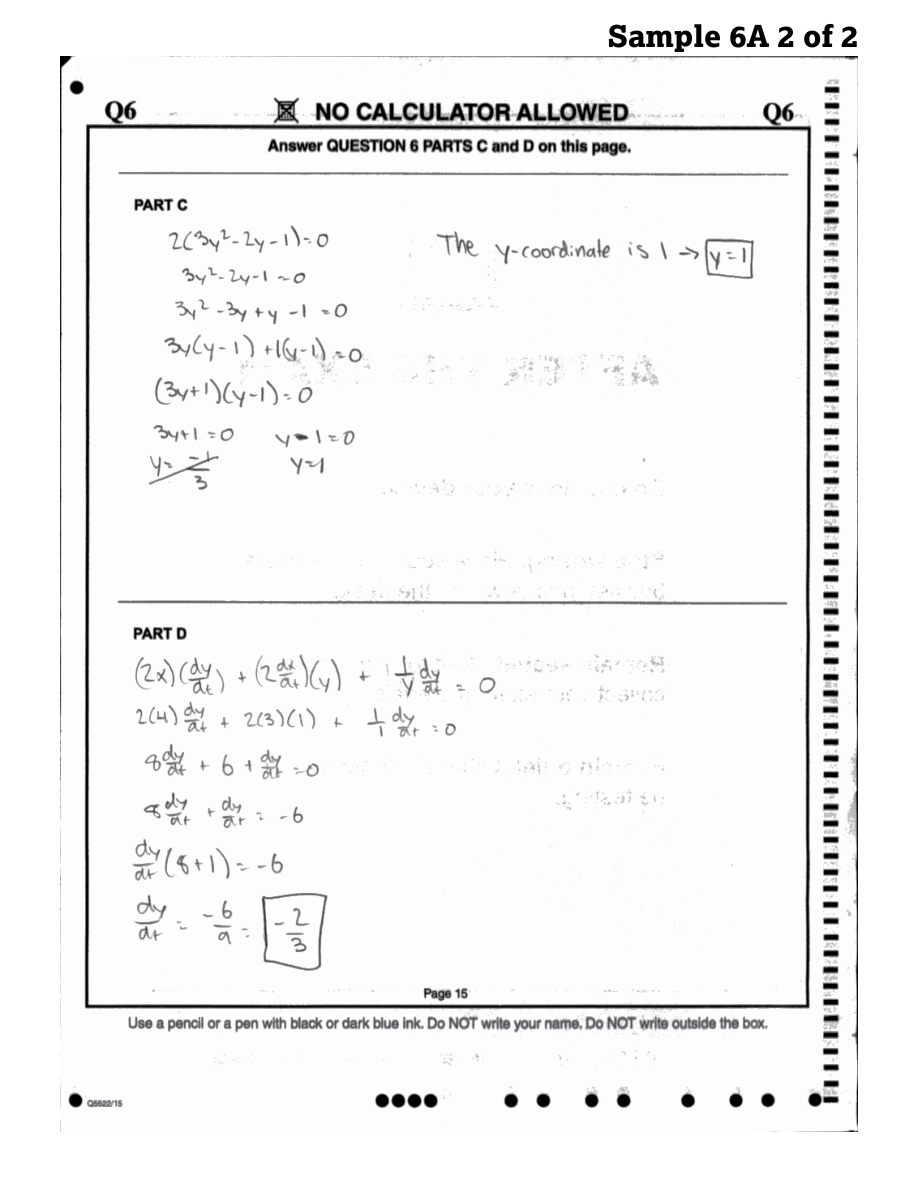
- Figure — Sample Responses Q6 (p. 7)
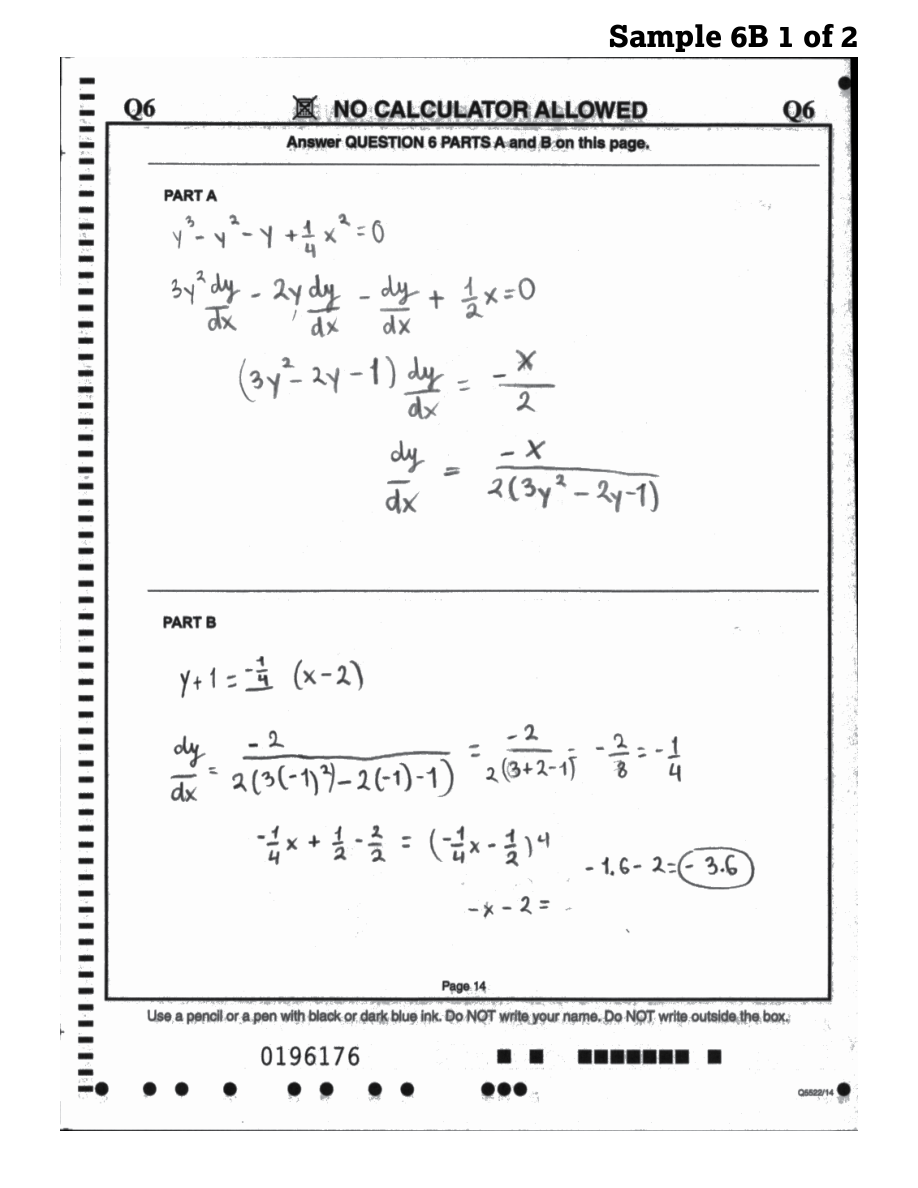
- Figure — Sample Responses Q6 (p. 8)
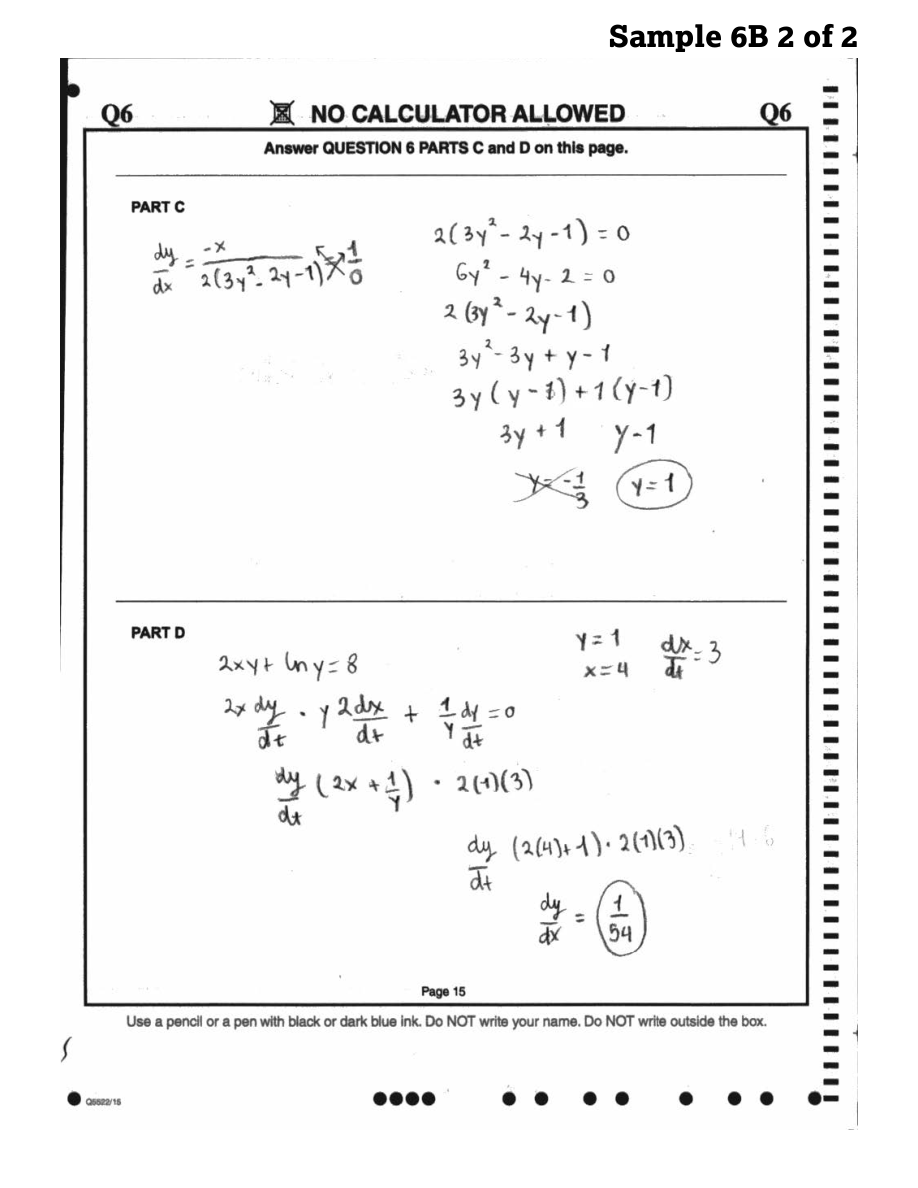
- Figure — Sample Responses Q6 (p. 9)