From the free course AP Calculus AB on Lykke
1.12 Confirming Continuity over an Interval
Key concepts: Confirming continuity over an interval · A function is continuous on an interval when it is continuous at every point in that interval · Checking continuity on closed intervals · Checking continuity on open intervals · Checking continuity on half-open intervals · Identifying functions that are not continuous at an interval point · Using correct continuity notation and justification
How to confirm continuity on open, closed and half-open intervals using the domains of standard functions and one-sided limits at included endpoints.
1.12 Confirming Continuity over an Interval
Topic 1.11 defined continuity at a single point: $f(a)$ is defined, $\lim_{x\to a}f(x)$ exists, and the two are equal. Most results in calculus, such as the Intermediate Value Theorem, need more than that—continuity on a whole interval. This page shows how to confirm it without testing infinitely many points one at a time.
Continuity on an interval
The pointwise definition scales directly to intervals:
LIM-2.B.1: A function is continuous on an interval if the function is continuous at each point in the interval.
This means that a claim such as “$f$ is continuous on $[0,4]$” is a global claim supported by pointwise reasoning. You must know that every point from $0$ through $4$ passes the continuity test, including the endpoints under the appropriate one-sided interpretation.
A powerful shortcut is supplied by LIM-2.B.2:
LIM-2.B.2: Polynomial, rational, power, exponential, logarithmic, and trigonometric functions are continuous on all points in their domains.
For example, $p(x)=x^4-2x+7$ is continuous everywhere because it is a polynomial. The rational function
$$ r(x)=\frac{x+1}{x-2} $$
is continuous wherever it is defined, so it is continuous on $[0,1]$, but not continuous on $[0,3]$ because $x=2$ lies in that interval and makes the denominator zero.
Interval endpoints: closed, open, and half-open
At an interior point, continuity uses the two-sided limit. At an endpoint, only values from inside the interval matter.
| Interval | Points to check | Endpoint interpretation |
|---|---|---|
| $[a,b]$ | Every interior point plus $a$ and $b$ | Use $\displaystyle\lim_{x\to a^+}f(x)=f(a)$ and $\displaystyle\lim_{x\to b^-}f(x)=f(b)$ |
| $(a,b)$ | Every point strictly between $a$ and $b$ | No endpoint values are included |
| $[a,b)$ | Every point from $a$ through, but not including, $b$ | Check $a$ from the right; do not check $b$ as a point in the interval |
| $(a,b]$ | Every point after $a$ through $b$ | Do not check $a$; check $b$ from the left |
Worked example: one function, three interval claims
Consider
$$ g(x)=\ln(x+2). $$
Its domain is $x>-2$. Because logarithmic functions are continuous on all points in their domains by LIM-2.B.2, $g$ is continuous on $[0,5]$, $(0,5)$, and $[0,5)$. At the included endpoint $x=0$, the relevant statement is
$$ \lim_{x\to 0^+}\ln(x+2)=\ln 2=g(0). $$
The endpoint $x=5$ requires no check for $[0,5)$ because $5$ is not part of that interval.
Now consider
$$ h(x)=\frac{1}{x+1}. $$
It is continuous on $[-2,0]$ only if its domain contains every point in that interval. But $x=-1$ lies in $[-2,0]$, and $h(-1)$ is undefined. Thus $h$ is not continuous on $[-2,0]$. It is continuous on $[-2,-1)$ and on $(-1,0]$, because the excluded point is not part of either interval.
Misconception check — “Endpoints always require two-sided limits.” For continuity on $[a,b]$, the endpoint $a$ is tested from the right and $b$ from the left. A two-sided limit would ask about values outside the interval, which are irrelevant to continuity over that interval.
AP reasoning: claim, evidence, conclusion
The relevant AP practices are Implementing Mathematical Processes, Connecting Representations, Justification, and Communication and Notation. In practice, a strong response identifies the function type or problematic point, states the domain or endpoint limit being used, and concludes with the exact interval claim.
A complete justification might read: “The function $r(x)=\frac{x+1}{x-2}$ is rational and therefore continuous on its domain. Since $2\notin[0,1]$, $r$ is continuous on $[0,1]$.” That reasoning is stronger than “the graph has no breaks,” because it names the theorem and checks the interval’s domain.
Retrieval check
For $F(x)=\sqrt{x-1}$, decide whether $F$ is continuous on $[1,9]$. What type of endpoint limit is needed at $x=1$? The answer is yes: $F$ is a power function continuous throughout its domain $[1,\infty)$, and at $x=1$ continuity is confirmed with the right-hand limit $\displaystyle\lim_{x\to1^+}F(x)=F(1)=0$.
Source Materials
- Learn More (.pdf)
- AP Calculus AB and BC Course and Exam Description
- AP Calculus AB Course Overview
- AP Calculus Course at a Glance
- AP Calculus AB and BC Course at a Glance Poster
- Adopt AP Calculus AB
- AP Calculus AB
- AP Calculus AB
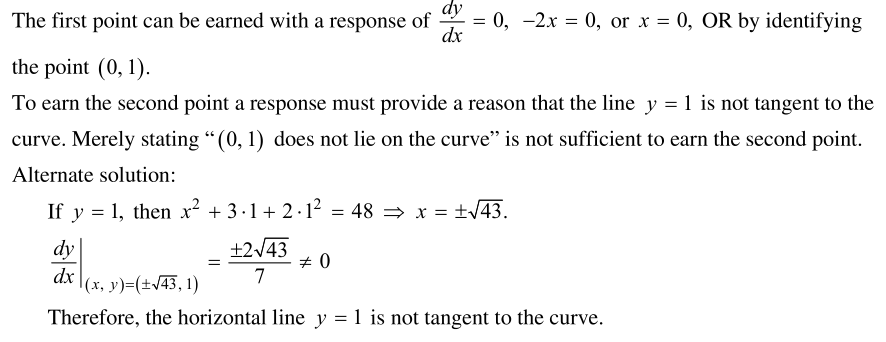
- • A response that uses this method earns the first point by using y = 1 in 2 2 3 2 48 x y y + + = .
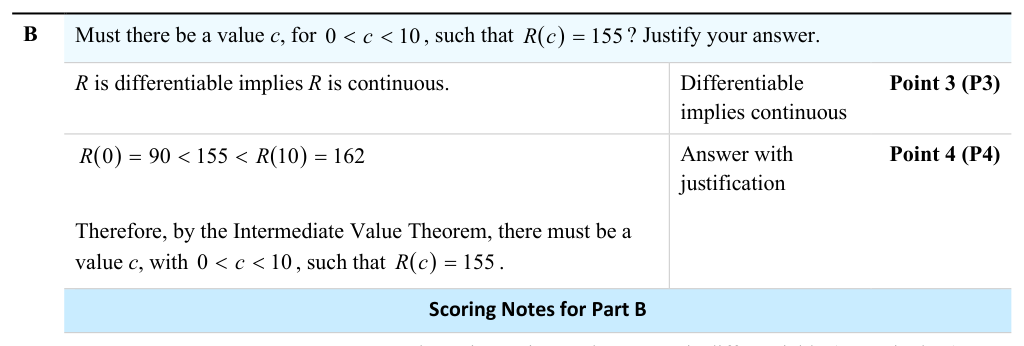
- • To earn P3, a response must state that R is continuous because R is differentiable (or equivalent). A response that simply states “R is continuous” without justification does not earn P3.
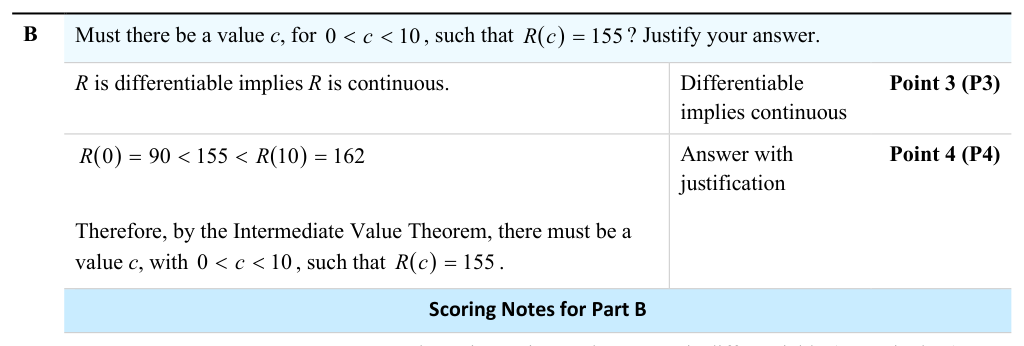
- • To earn P3, a response must state that R is continuous because R is differentiable (or equivalent). A response that simply states “R is continuous” without justification does not earn P3.