From the free course AP Calculus AB on Lykke
4.3 Rates of Change in Applied Contexts Other Than Motion
Key concepts: Rates of change in applied contexts other than motion · Applying derivatives to quantities other than time · Identifying common underlying structures across contextual problems · Connecting algebraic derivatives to real-world rates of change
How a derivative describes change in settings other than motion, such as population, cost or concentration, including inputs other than time, with correct units.
4.3 Rates of Change in Applied Contexts Other Than Motion
A derivative measures how one quantity changes as another quantity changes, whether the quantities describe motion, population, chemical concentration, revenue, or the size of a biological habitat. The input does not have to be time: if population $P$ depends on food supply $F$, then $\dfrac{dP}{dF}$ measures population change per unit of food supply.
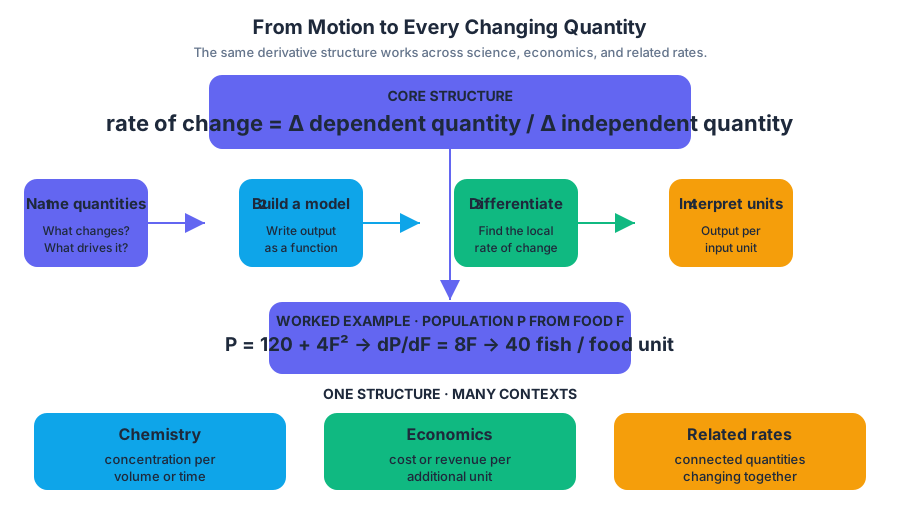
From motion to every changing quantity
The essential structure is always a changing output compared with a changing input:
$$ \text{rate of change}=\frac{\text{change in dependent quantity}}{\text{change in independent quantity}}. $$
For example, suppose the population $P$ of a fish species depends on the available food supply $F$. If
$$ P=120+4F^2, $$
then differentiating with respect to $F$ gives
$$ \frac{dP}{dF}=8F. $$
At a food supply of $F=5$ units,
$$ \frac{dP}{dF}=8(5)=40. $$
The population is increasing at approximately $40$ fish per additional unit of food supply when $F=5$. The units are fish per food-supply unit, not fish per unit of time.
The same steps work in economics. If $C(q)=500+12q+0.02q^2$ is the cost in dollars of producing $q$ units, then $C'(q)=12+0.04q$ and $C'(100)=16$. When $100$ units are being produced, cost is increasing at about $16$ dollars per additional unit, a rate economists call the marginal cost.
This is Topic 4.3 Rates of Change in Applied Contexts Other Than Motion, aligned with Enduring Understanding CHA-3: Derivatives allow us to solve real-world problems involving rates of change, Learning Objective CHA-3.C: Interpret rates of change in applied contexts, and Essential Knowledge CHA-3.C.1: The derivative can be used to solve problems involving rates of change in applied contexts.
The associated Connecting Representations skill 2.A: Identify common underlying structures in problems involving different contextual situations asks you to recognize that a chemistry problem about concentration, an economics problem about cost, and a biology problem about population can share the same mathematical pattern. First identify the input and output; then differentiate the relationship and attach meaningful units.
Retrieval check: The concentration of a drug in the bloodstream is $D(t)$ milligrams per liter, $t$ hours after a dose. What are the units of $D'(t)$, and what does $D'(2)=-0.8$ mean? The units are milligrams per liter per hour; two hours after the dose, the concentration is decreasing at $0.8$ milligrams per liter per hour.