From the free course AP Calculus AB on Lykke
5.2 Extreme Value Theorem, Global Versus Local Extrema, and Critical Points
Key concepts: Extreme Value Theorem · Continuity on a closed interval · Global (absolute) extrema · Local extrema · Critical points · Using the first derivative to identify extrema · Justifying conclusions with mathematical reasoning · Existence theorems and conclusions about behavior without precisely locating values
What the Extreme Value Theorem guarantees, how global and local extrema differ, and how critical points and endpoints locate absolute extrema on a closed interval.
5.2 Extreme Value Theorem, Global Versus Local Extrema, and Critical Points
Topic 5.1's Mean Value Theorem guarantees that a certain rate occurs somewhere, without saying where. The Extreme Value Theorem is the same kind of existence theorem for values: under the right conditions, a function must reach a highest and a lowest value. This page states those conditions, separates global from local extrema, and introduces critical points, the only interior locations where an extremum can occur.
5.2 The Extreme Value Theorem: proving extrema exist
The Extreme Value Theorem (EVT) states:
If a function $f$ is continuous over the closed interval $[a,b]$, then the Extreme Value Theorem guarantees that $f$ has at least one minimum value and at least one maximum value on $[a,b]$.
This is the exact hypothesis in FUN-1.C.1 and the core of learning objective FUN-1.C: Justify conclusions about functions by applying the Extreme Value Theorem. The phrase closed interval is essential: both endpoints must be included.
A function may fail to attain an extreme value if continuity or closedness is missing. For example, $f(x)=\dfrac{1}{x}$ is not continuous on an interval containing $x=0$, and $f(x)=x$ on the open interval $(0,1)$ has neither an attained absolute minimum nor an attained absolute maximum.
Global, local, and critical points
A global (absolute) maximum on a domain is a function value at least as large as every other value in that domain. A global (absolute) minimum is at most every other value. A local (relative) maximum is highest only within a nearby interval, while a local (relative) minimum is lowest nearby.
A critical point occurs at a point in the domain where
$$ f'(x)=0 $$
or where $f'(x)$ does not exist. This definition is FUN-1.C.2. The corresponding $x$-value is often called a critical number.
FUN-1.C.3 states that all local (relative) extrema occur at critical points, although not all critical points are local extrema. For instance, $f(x)=x^3$ has $f'(0)=0$, but the function continues increasing through $x=0$; therefore, $x=0$ is critical but is not a local maximum or minimum.
Sign-change insight: If $f'$ changes from negative to positive at $x=2$, the function changes from decreasing to increasing, so $f$ has a local minimum at $x=2$.
Absolute extrema on a closed interval
To locate an absolute minimum or maximum on $[a,b]$, evaluate $f$ at every relevant interior critical point and at both endpoints. The endpoint check is indispensable: a global extreme can occur where the derivative is not zero because endpoints are not interior points.
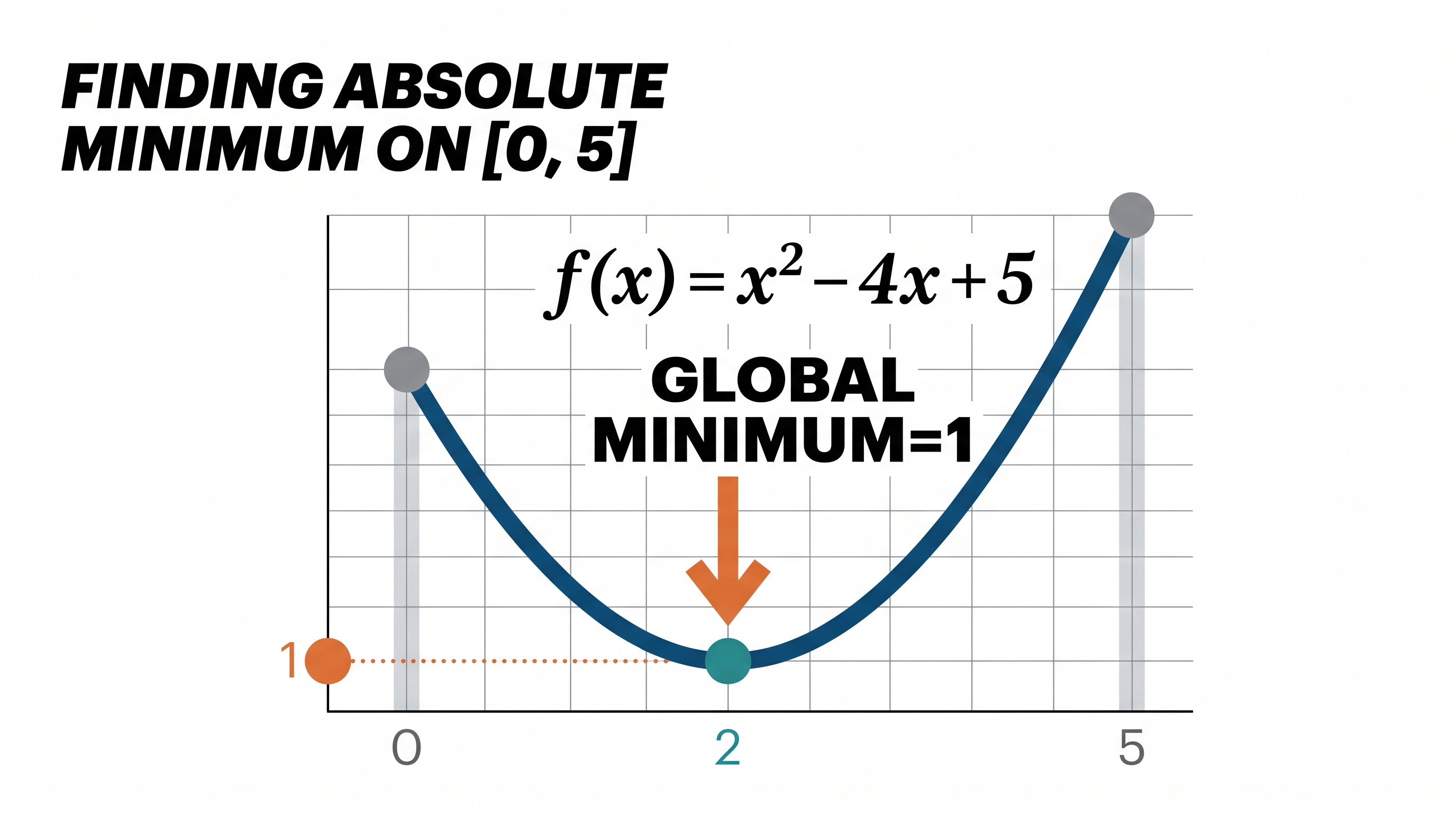
Worked example. Find the absolute minimum of
$$ f(x)=x^2-4x+5 $$
on $[0,5]$. First,
$$ f'(x)=2x-4, $$
so the critical point is $x=2$. Compare:
$$ f(0)=5,\qquad f(2)=1,\qquad f(5)=10. $$
Thus the absolute minimum value is
$$ \boxed{1} $$
at $x=2$. The conclusion is justified because the polynomial is continuous on $[0,5]$, so the EVT guarantees that an absolute minimum exists, and the critical-point/endpoints comparison identifies it.
Retrieval check. A function is continuous on $[-3,4]$, and $f'(x)$ is undefined at $x=1$ but defined elsewhere. What points must be checked when searching for an absolute minimum? Answer: $x=-3$, $x=1$, and $x=4$, provided $x=1$ lies in the function’s domain.
Source Materials
- Learn More (.pdf)
- AP Calculus AB and BC Course and Exam Description
- AP Calculus AB Course Overview
- AP Calculus Course at a Glance
- AP Calculus AB and BC Course at a Glance Poster
- Adopt AP Calculus AB
- AP Calculus AB
- AP Calculus AB
- About the Advanced Placement Program® (AP®)
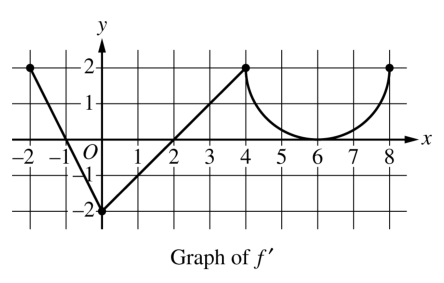
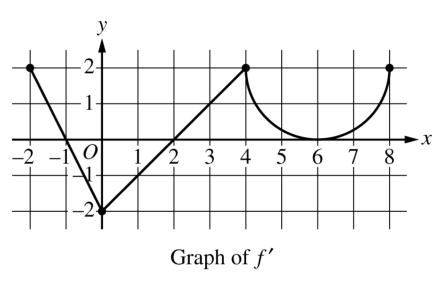
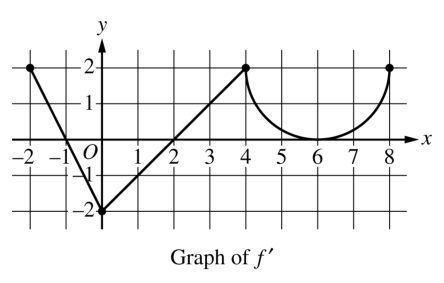
- The function f is defined on the closed interval [ ] 2, 8 − and satisfies ( ) 2 1. f = The graph of , f ′ the derivative of ,f consists of two line segments and a semicircle, as shown in the figure.
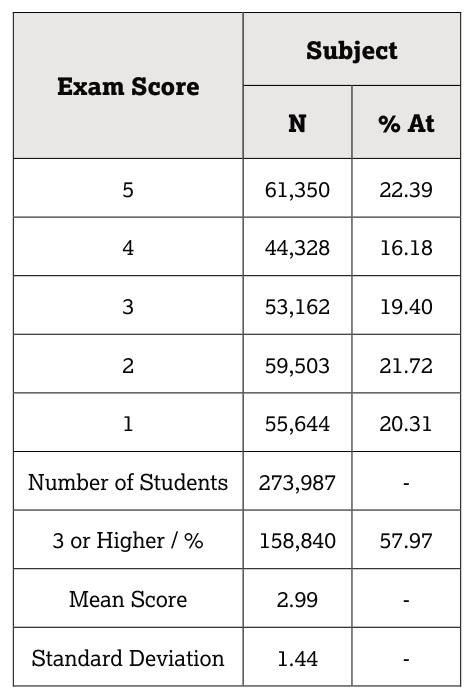
- Figure — Score Distributions (p. 1)
- Figure — Scoring Statistics (p. 1)