From the free course AP Human Geography on Lykke
7.8 Sustainable Development
Key concepts: Sustainable development · Resource depletion · Mass consumption · Effects of pollution · Impact of climate change · Poverty reduction programs and policies · Remittances, microloans, and social safety nets · Job creation and increased employment · Environmental protection measures · Human Development Index (HDI) comparison between Brazil and Afghanistan
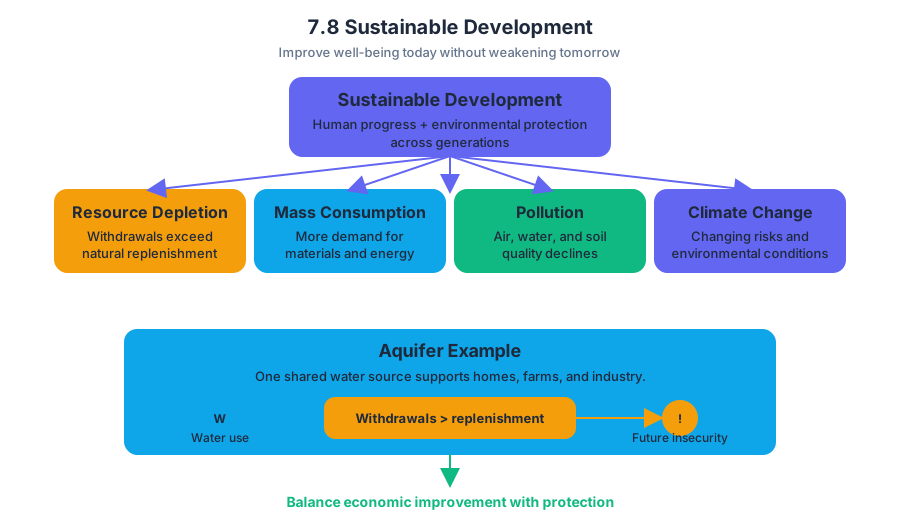
Sustainable development means improving human well-being without using resources or damaging environments in ways that undermine future generations. It responds to four connected pressures: resource depletion, mass consumption, pollution, and the effects of climate change.
7.8 Sustainable Development
Sustainable development means improving human well-being without using resources or damaging environments in ways that undermine future generations. It responds to four connected pressures: resource depletion, mass consumption, pollution, and the effects of climate change.
Imagine a community drawing water from the same underground aquifer for drinking, farming, and industry. If withdrawals exceed natural replenishment, short-term economic production may rise, but the community becomes less secure over time. A sustainable policy must therefore connect economic improvement with environmental protection rather than treating them as separate goals.
The four pressures sustainability addresses
| Challenge | What is happening | Why it creates a development problem |
|---|---|---|
| Resource depletion | Water, soil, forests, minerals, or energy sources are consumed faster than they can be replaced | Future production and human health become less secure |
| Mass consumption | Large quantities of goods and energy are produced and used | Waste, extraction, and emissions increase |
| Pollution | Harmful substances enter air, water, or soil | Health declines and ecosystems lose productivity |
| Climate change | Human activities contribute to long-term changes in climate conditions | Agriculture, infrastructure, settlements, and livelihoods face greater risk |
These pressures interact. For example, mass consumption can increase fossil-fuel use, which contributes to pollution and climate change. Climate change can then intensify water shortages or reduce agricultural productivity, making poverty reduction more difficult.
Sustainability and economic challenges
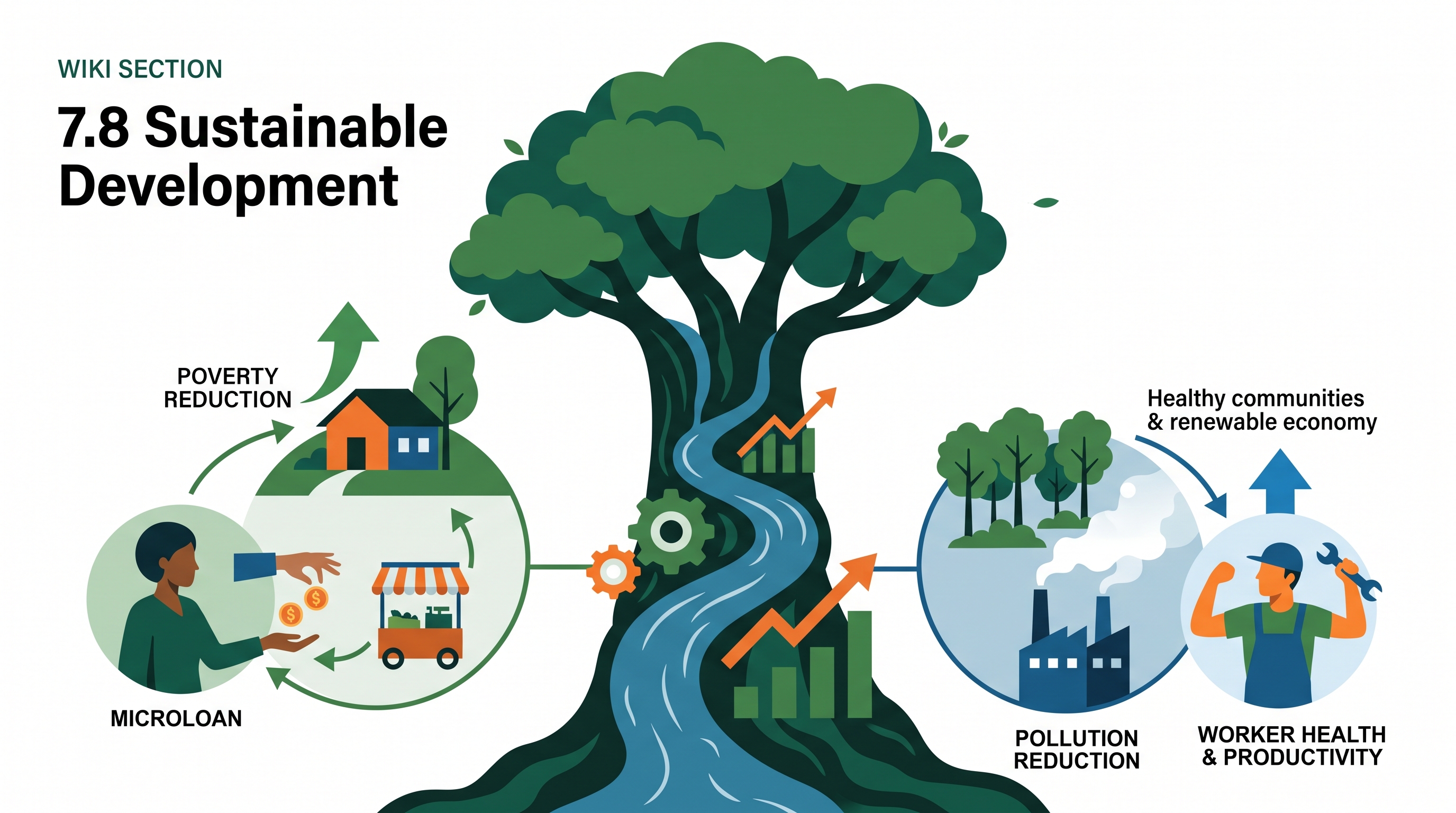
Sustainability goals can address economic challenges through poverty-reduction programs and policies. Examples include improving access to remittances, providing microloans, and creating social safety nets.
- Remittances are money transfers sent by migrants to people or communities in their places of origin. More reliable access to these funds can help households pay for food, education, health care, or small businesses.
- Microloans are small loans that can allow people with limited access to conventional banking to start or expand an income-generating activity.
- Social safety nets are public or community programs that protect people from severe economic hardship, such as assistance with food, income, or essential services.
- Increasing jobs addresses economic challenges directly by expanding access to income and reducing dependence on unstable or informal work.
These measures are associated with Sustainable Development Goals 1, 8, and 16: reducing poverty, supporting decent work and economic opportunity, and strengthening peaceful, inclusive institutions. The geographic insight is that poverty is not reduced only by increasing national income; policies must also improve people’s access to money, employment, security, and institutions.
Sustainability and environmental quality
Sustainability goals can improve environmental quality through environmental protection measures, including protecting habitats, increasing biodiversity, and reducing pollution. A cleaner environment can also improve the health of the labor force: fewer pollutants and safer water can reduce illness, allowing people to work and participate more fully in the economy.
Ecotourism illustrates the possible connection between environmental protection and economic activity. Ecotourism is tourism based in natural environments, often places threatened by industrialization or development. When carefully managed, it can create income while giving communities an economic reason to protect the environment that attracts visitors.
Key insight: Sustainability is not simply “protecting nature from people.” It seeks policies in which economic well-being and environmental quality reinforce each other.
Other sustainability strategies include investment in clean water, sanitation, hygiene, transportation, and electricity infrastructure. Shifting electricity generation from fossil fuels to solar and wind power can also create employment in the secondary and tertiary sectors, including construction, manufacturing, engineering, and related services.
Comparing development with HDI
The Human Development Index, or HDI, allows geographers to compare countries using a broader measure of development than income alone. Brazil has a higher HDI score than Afghanistan, indicating a higher overall level of human development according to the index.
| Comparison | Interpretation |
|---|---|
| Brazil’s higher HDI score | Brazil demonstrates a higher measured level of human development than Afghanistan |
| An additional HDI indicator | A second indicator can reinforce the comparison and demonstrate Brazil’s higher relative development |
| Geographic caution | A national average does not mean every person or region within Brazil has better conditions than every person or region within Afghanistan |
Misconception check — “A higher HDI means a country is sustainable.” Not necessarily. HDI measures human development, while sustainability asks whether improvements can continue without exhausting resources or degrading environmental systems. A country may have a relatively high HDI while still facing pollution, high consumption, resource depletion, or climate-related risks.
Retrieval check
A government wants to address both poverty and environmental decline. Identify one poverty-reduction policy and explain one way it could support sustainability. Then name one environmental protection measure and explain how it could also improve economic well-being.
A strong response might connect microloans to new small-business income and poverty reduction, then connect pollution reduction to better worker health and productivity. The explanation must show the causal link—not merely list a program or environmental action.
Source Materials
- AP Human Geography Course and Exam Description
- AP Human Geography Course and Exam Description Clarifications and Corrections
- AP Human Geography Course Overview
- AP Human Geography Course at a Glance
- AP Human Geography Course at a Glance Poster
- AP Human Geography
- AP Human Geography
- AP Human Geography Sample Syllabus 1