From the free course AP Human Geography on Lykke
2.9 Aging Populations
Key concepts: Aging populations
An aging population is one in which the proportion of older people increases relative to the total population. The change can result from longer lives, fewer births, or the movement of younger adults away from a place—and it can reshape labor markets, public budgets, family life, and political priorities.
2.9 Aging Populations
An aging population is one in which the proportion of older people increases relative to the total population. The change can result from longer lives, fewer births, or the movement of younger adults away from a place—and it can reshape labor markets, public budgets, family life, and political priorities.
Investigative question: Why can a country become “older” even when its elderly population is not growing rapidly?
The population pyramid tells the story
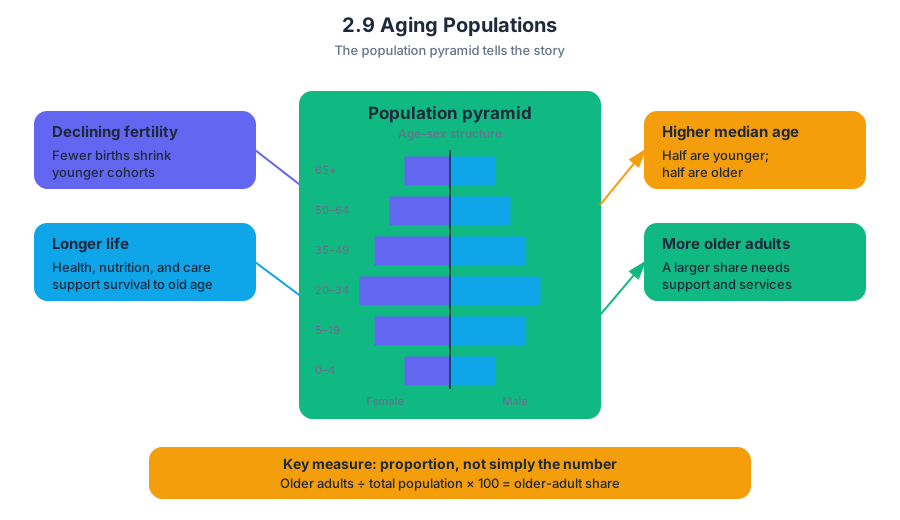
A population pyramid displays a population’s age-sex structure. When the base becomes narrow, fewer children are entering the population; when the upper sections widen, more people are surviving into older ages. Together, these changes raise the median age—the age at which half the population is younger and half is older.
Under CED 2.9.A, aging populations are associated with demographic patterns such as declining fertility and increasing life expectancy. A population may age from both ends of the age structure:
- fewer births shrink the younger cohorts;
- improved health care, nutrition, and living conditions allow more people to survive to old age;
- the resulting larger share of older people increases the population’s dependency needs.
The key measurement is proportion, not simply the number of older residents. If a country has $10$ million older people in a population of $100$ million, older adults represent $10%$ of the population. If births decline and the total population falls to $80$ million while the older population remains $10$ million, the older share rises to $12.5%$ even without an increase in the absolute number of older people.
Why fertility matters
Low fertility has a powerful aging effect because each younger cohort is smaller than the one before it. In a country where families have an average of fewer than approximately $2.1$ children per woman—the rough replacement-level fertility rate in many developed settings—the population may eventually experience a negative rate of natural increase, especially if immigration does not offset the difference between births and deaths.
Worked example: Japan. Imagine a population pyramid with a narrow base, relatively large middle-aged cohorts, and a broad upper section. The narrow base indicates that Japan’s recent fertility has declined. The large upper cohorts show that many people have survived into old age. The correct geographic interpretation is not merely “Japan has many elderly people”; it is that low fertility and high life expectancy have changed the proportions of the entire age structure.
The causes of population aging
Under CED 2.9.B, three mechanisms are especially important:
| Mechanism | How it ages a population | Typical geographic pattern |
|---|---|---|
| Declining fertility | Reduces the size of younger cohorts | Common in highly urbanized and economically developed countries |
| Increased life expectancy | Expands the number surviving to older ages | Often linked to improved medical care and living conditions |
| Out-migration of younger people | Removes working-age adults and sometimes their children | Common in rural regions and places with limited employment |
The third mechanism explains why aging is not only a national issue. A rural district can age rapidly when young adults leave for universities or jobs elsewhere. Even if older residents do not live longer than before, the departure of younger people raises the local percentage of elderly residents.
Named misconception — “Aging means everyone is living longer.”
Longer life expectancy is one cause, but it is not the only one. A place can age because fewer children are born or because young adults migrate out. Always identify the demographic process shown by the evidence.
Consequences of an aging population
Under CED 2.9.C, aging produces economic, social, and political consequences.
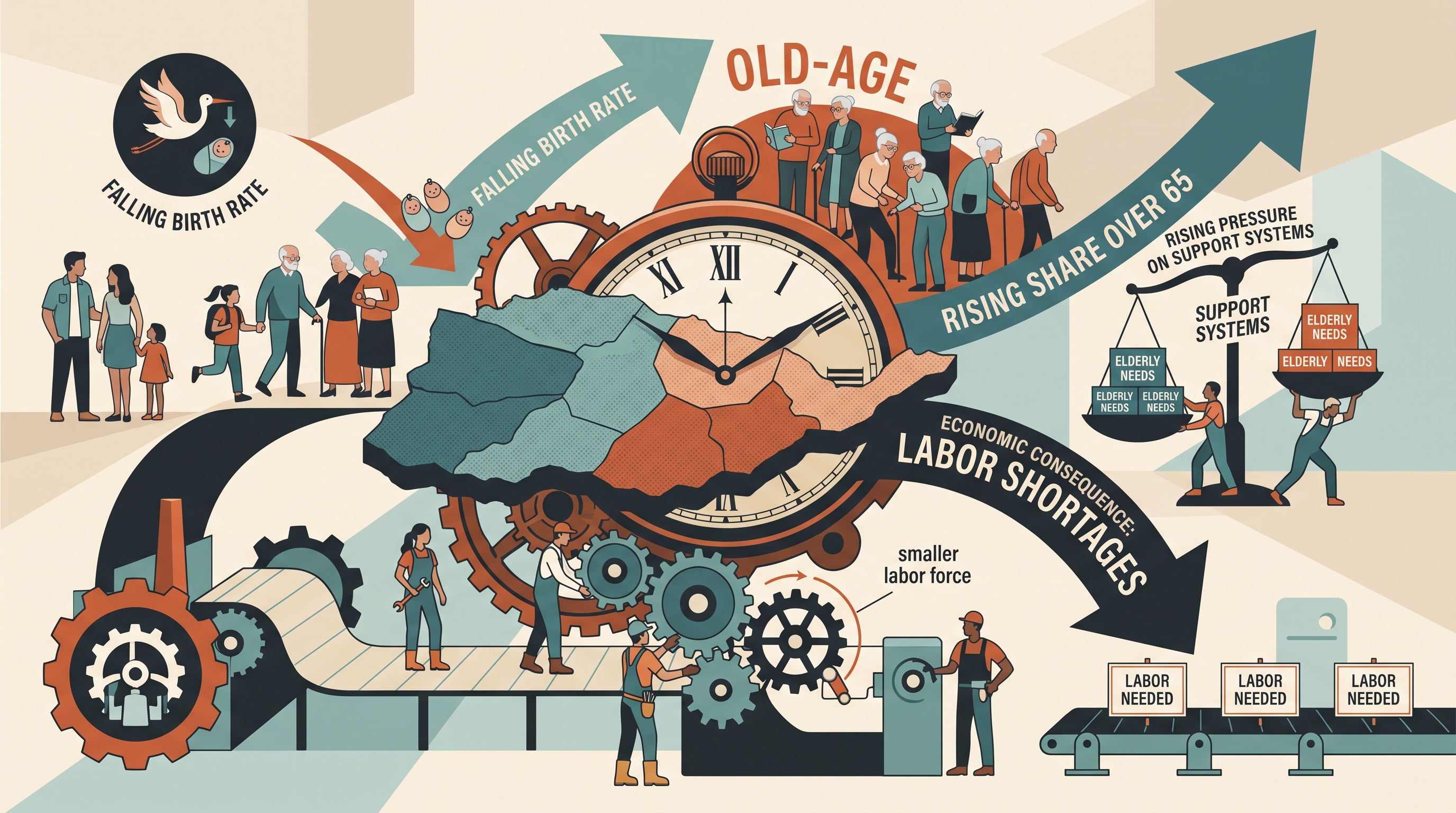
- Economic: A shrinking working-age population may create labor shortages and reduce the number of workers supporting pension and health-care systems. Governments may raise taxes, delay retirement, encourage immigration, or invest in automation.
- Social: Demand increases for hospitals, long-term care, accessible housing, and transportation. Families may face greater caregiving responsibilities.
- Political: Older voters may influence spending priorities, pension policy, health care, and immigration debates. Political leaders must balance services for older adults with investments in education, employment, and children.
A useful indicator is the dependency ratio, which compares economically dependent age groups with the working-age population. A simplified form is
$$ \text{Dependency ratio} = \frac{\text{young dependents}+\text{older dependents}} {\text{working-age population}} \times 100. $$
An aging population raises the old-age component because more people are in later-life cohorts relative to the working-age group.
AP geographic reasoning
This topic most directly develops SPS-2.A: Describe spatial patterns, SPS-2.B: Explain spatial relationships, IMP-2.A: Explain how demographic processes influence patterns and outcomes, and DATA-1.A: Identify information presented in a map, chart, table, or graph. A strong response identifies the visible age structure, names the demographic cause, and connects it to a specific consequence rather than listing unrelated effects.
Retrieval check: A rural province has a falling birth rate, a rising share of residents over age $65$, and a large outflow of people ages $20$–$34$. Name two causes of its aging population and explain one economic consequence. A complete answer should identify declining fertility and younger-adult out-migration, then connect the pattern to a smaller labor force, labor shortages, or increased pressure on support systems.
Source Materials
- AP Human Geography Course and Exam Description
- AP Human Geography Course and Exam Description Clarifications and Corrections
- AP Human Geography Course Overview
- AP Human Geography Course at a Glance
- AP Human Geography Course at a Glance Poster
- AP Human Geography
- AP Human Geography
- AP Human Geography Sample Syllabus 1