From the free course AP Human Geography on Lykke
4.3 Political Power and Territoriality
Key concepts: State · Nation · Nation-state · Stateless nation · Sovereignty and independent government · Nations aspiring to become states · Ethnic neighborhoods and spatial patterns · Assimilation and preservation of ethnic traditions · Redistricting and gerrymandering · Federal systems and the spatial distribution of political power
A state is a sovereign political entity with its own independent government. Because it controls territory, makes and enforces laws, and conducts relations with other states, the state is a primary building block of the world political map.
4.3 Political Power and Territoriality
A state is a sovereign political entity with its own independent government. Because it controls territory, makes and enforces laws, and conducts relations with other states, the state is a primary building block of the world political map.
Sovereignty is a state’s authority to govern itself and control its territory without being subordinate to another state.
Territory, power, and political identity
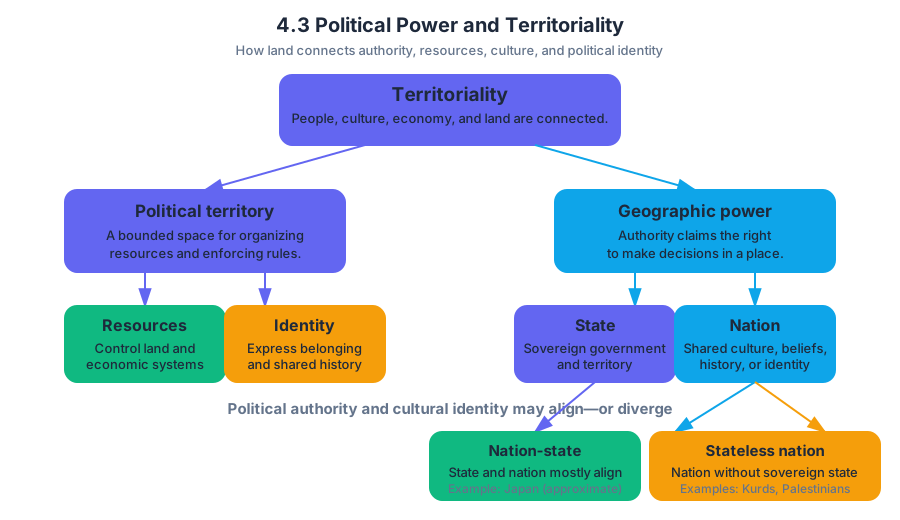
Territoriality is the connection of people, their culture, and their economic systems to the land they occupy. Political power becomes geographic when a government or group uses territory to organize resources, enforce rules, express identity, or claim the right to make decisions there.
The key distinction is between a political entity and a cultural group:
| Term | Meaning | Example |
|---|---|---|
| State | A sovereign political unit with an independent government and territory | Finland |
| Nation | A group of people who share cultural traits, history, beliefs, or a sense of common identity | The Finnish nation |
| Nation-state | A state whose political boundaries closely correspond to one nation | Japan is often used as an approximate example |
| Stateless nation | A nation that does not possess its own sovereign state | The Kurds or Palestinians |
A state therefore describes political authority, while a nation describes shared identity. These categories sometimes overlap, but they are not synonyms. A nation-state is an alignment between the two; a stateless nation experiences the opposite condition, because its shared identity extends across territory without an independent government of its own.
Nations aspiring to become states
Some nations aspire to become independent states because they believe self-government would allow them to protect their culture, control their territory, manage their economy, or make political decisions without an outside government. Scotland’s independence movement illustrates this possibility: many people identify strongly with Scotland as a nation while Scotland remains part of the United Kingdom, a sovereign state.
This aspiration does not automatically produce a new state. Creating a state requires effective government, control of territory, and—often—recognition by other states. The resulting conflict is fundamentally territorial: a nation’s cultural claim to a homeland may challenge the existing state’s sovereignty.
Ethnic neighborhoods: identity made visible
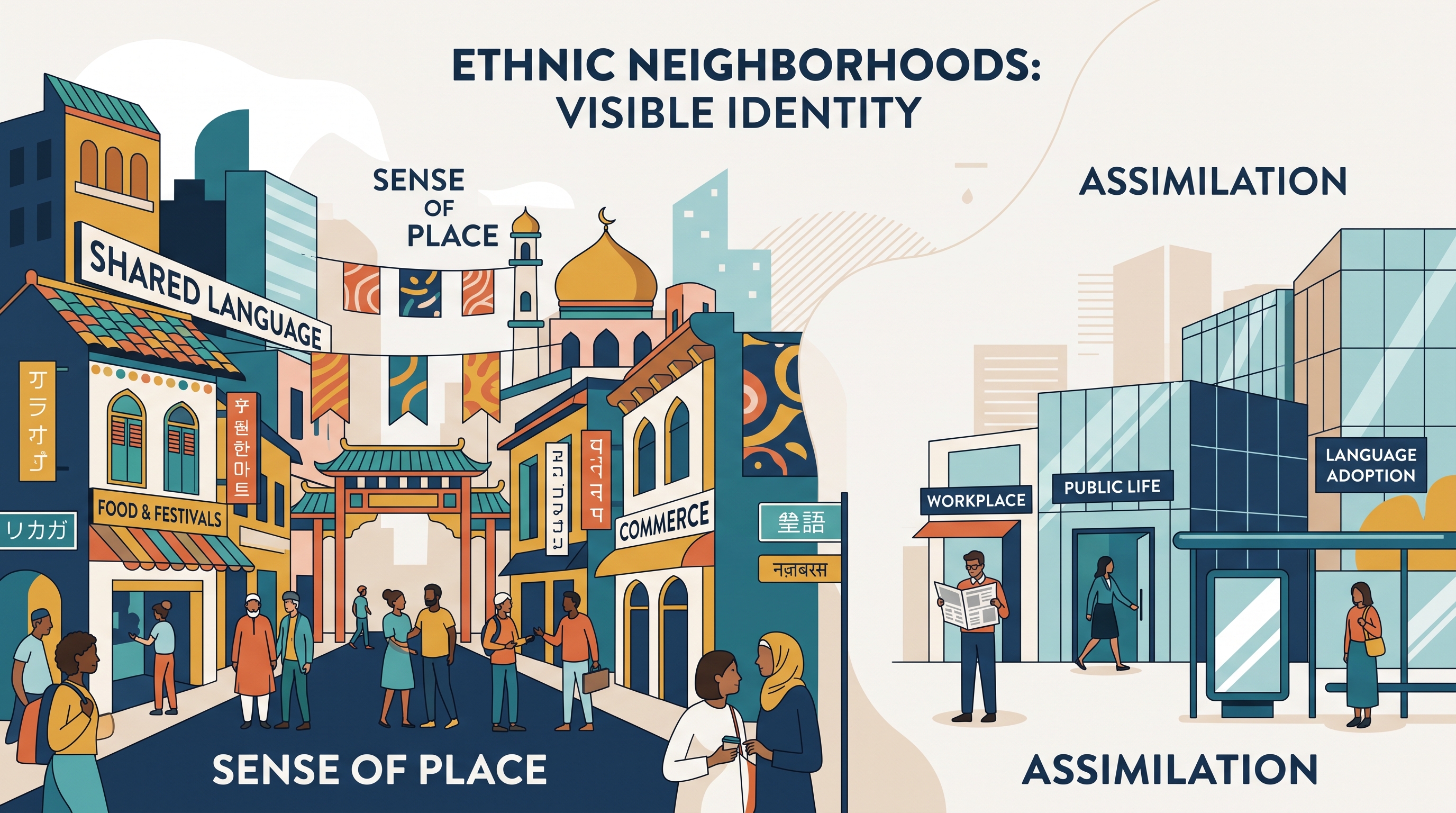
An ethnic neighborhood is an urban area where people who share ethnic traditions live, work, worship, and conduct commerce. In a large metropolitan area such as Los Angeles, these neighborhoods connect residents through shared language, food, religion, festivals, and institutions while creating a distinctive sense of place, meaning the feeling that a location has a recognizable cultural character.
Cultural landscapes preserve identity in visible form. Traditional architecture, religious buildings, restaurants, markets, and signs written in the group’s language can mark a neighborhood as connected to a particular ethnic tradition. At the same time, immigrants may assimilate by adopting the language, customs, or social practices of the dominant culture, sometimes reducing the visibility of their original cultural traits.
Important distinction: Assimilation changes cultural practices; it does not necessarily erase a group’s identity or eliminate ethnic neighborhoods.
Territorial organization and political power
Political power is not distributed only by international borders. In a federal system, authority is shared among central, subnational, and local governments. This arrangement allows different regions or communities to exercise some control over policies affecting their own territory rather than receiving every decision from the national government.
Territorial organization can also affect representation. Redistricting may divide an ethnic community among several voting districts—a process called cracking—making the group a minority in each district and reducing its political influence. The geographic arrangement of territory can therefore strengthen or weaken a nation’s or ethnic community’s ability to convert population into political power.
Reading political power at different scales
A political map must be interpreted at a stated scale of analysis, the level at which a geographic pattern is examined. At the country scale, Finland appears as a sovereign state with its own government; at a finer scale, the analysis might examine Finnish regions, municipalities, or ethnic neighborhoods.
A map may also provide geographic clues about political organization. Washington, D.C., for example, is located along the Potomac and Anacostia Rivers, near their confluence. Recognizing that physical setting helps connect the capital’s political importance to its territorial location without confusing the location of a capital with the extent of a state’s sovereignty.
Misconception check
Misconception: “Every nation is a state.” A nation is defined by shared identity; a state is defined by sovereign political authority. The Kurds can be a nation without possessing a Kurdish sovereign state, while Finland can be both a state and, in many contexts, a nation-state.
Retrieval check
- Which term means a sovereign political entity with an independent government?
- Why might an ethnic neighborhood create a sense of place?
- How can a federal system disperse political power?
- What is the difference between a nation-state and a stateless nation?
Answers: 1. State. 2. Shared traditions become visible through institutions, architecture, religious buildings, businesses, and language. 3. It shares authority among central, subnational, and local governments. 4. A nation-state combines national identity with sovereign statehood; a stateless nation has national identity without its own sovereign state.
Source Materials
- AP Human Geography Course and Exam Description
- AP Human Geography Course and Exam Description Clarifications and Corrections
- AP Human Geography Course Overview
- AP Human Geography Course at a Glance
- AP Human Geography Course at a Glance Poster
- AP Human Geography
- AP Human Geography
- AP Human Geography Sample Syllabus 1