From the free course AP Human Geography on Lykke
AP Practice 5
A strong free-response answer does more than name a geographic term: it connects a spatial pattern to a process, supports the connection with evidence, and explains why the outcome matters.
AP Practice 5
A strong free-response answer does more than name a geographic term: it connects a spatial pattern to a process, supports the connection with evidence, and explains why the outcome matters. This original, unofficial practice set targets a stimulus-based free-response question (FRQ) using agricultural data and asks you to move among Skill Category 2: Spatial Relationships, Skill Category 3: Data Analysis, and Skill Category 5: Scale Analysis.
Exam task: data-supported FRQ
Suggested timing: spend approximately 25 minutes on this question, including a brief planning period. Write in complete, geographically precise sentences. For each part, answer the task that is asked; an impressive but irrelevant fact does not earn credit.
A national government is comparing four agricultural regions to decide where to expand irrigation and agricultural extension services. The regions differ in climate, farm organization, market access, and production systems.
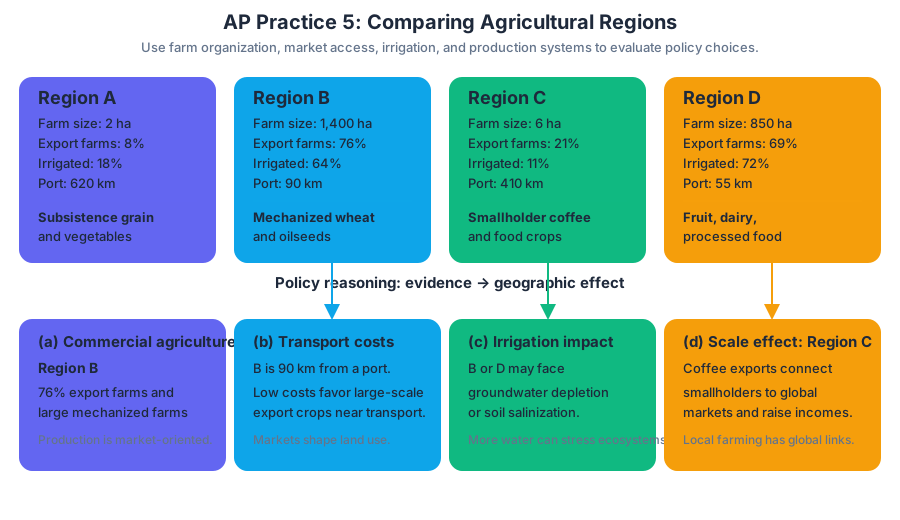
| Region | Average farm size | Share of farms producing for export | Irrigated farmland | Distance to major port | Main agricultural activity |
|---|---|---|---|---|---|
| A | 2 hectares | 8% | 18% | 620 kilometers | Subsistence grain and vegetables |
| B | 1,400 hectares | 76% | 64% | 90 kilometers | Mechanized wheat and oilseed production |
| C | 6 hectares | 21% | 11% | 410 kilometers | Smallholder coffee and food crops |
| D | 850 hectares | 69% | 72% | 55 kilometers | Fruit, dairy, and processed food |
(a) Identify one region in the table that most closely reflects commercial agriculture, and explain one piece of evidence supporting your choice.
(b) Explain one way that transportation costs could influence the spatial organization of agriculture in Region B or Region D.
(c) Explain one environmental consequence that could result from expanding irrigation in Region B or Region D.
(d) Explain one way the agricultural system in Region C could affect the region at a different geographic scale.
Worked reasoning
Part (a): identify, then prove
Region B or Region D is an acceptable choice because both show strong indicators of commercial agriculture, which is production intended primarily for sale rather than for direct household consumption. Region B has very large farms, a high export share, and substantial mechanization implied by its large-scale wheat and oilseed production.
A response that says only “Region B is commercial” is incomplete. The explanation must connect the classification to evidence in the table—for example, the 76% share of farms producing for export or the average farm size of 1,400 hectares.
Rewardable reasoning: commercial purpose → large-scale production and market orientation → Region B or D.
Part (b): connect distance to land use
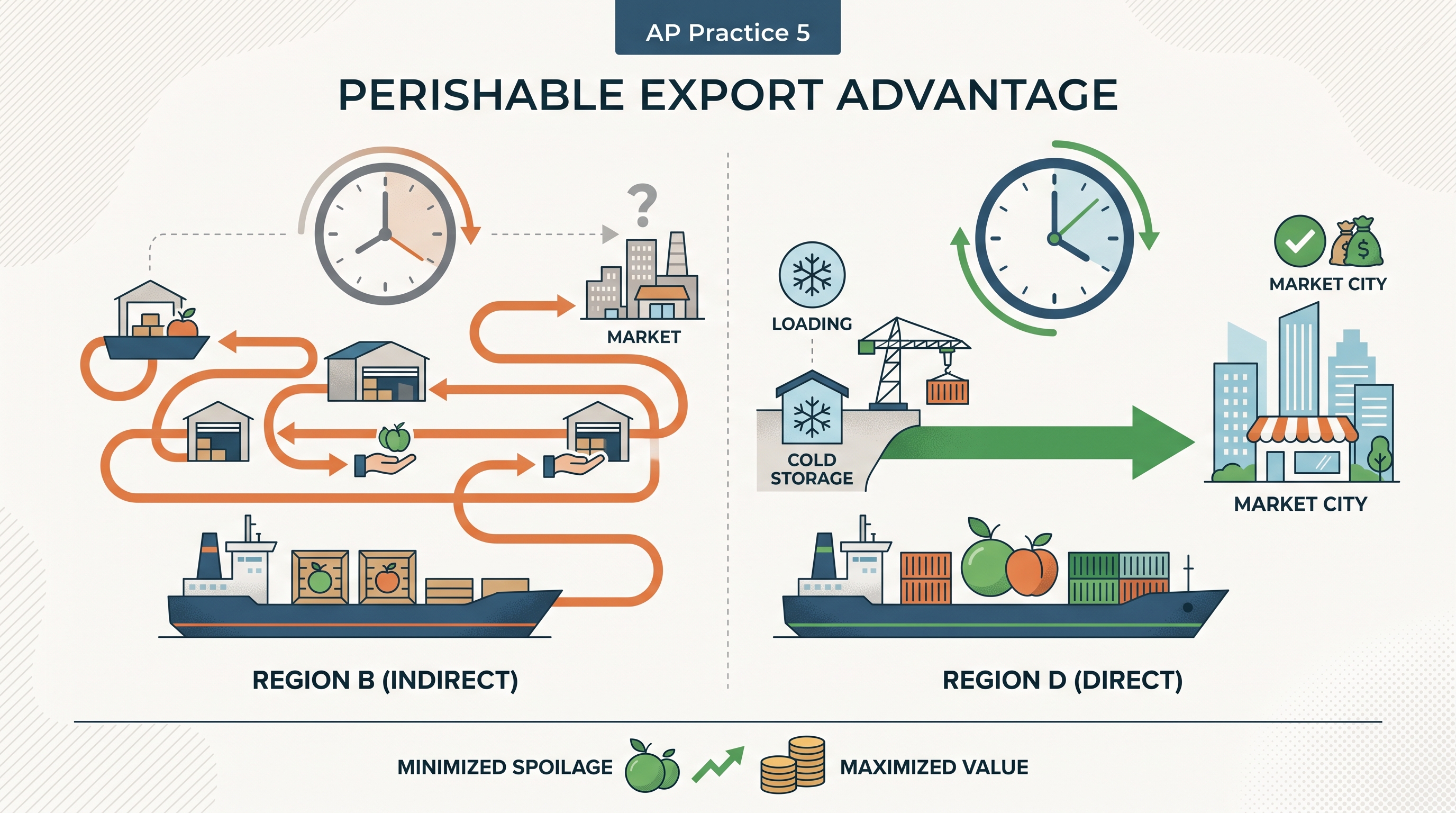
Region B is located farther from a major port than Region D, so transportation costs may be higher for Region B’s exported wheat and oilseeds. To remain profitable, producers may favor crops that are relatively durable, storable, and capable of being transported in bulk; alternatively, high transport costs may encourage processing closer to the production area.
The key geographic relationship is not simply “ports are good.” It is distance to market → transportation cost → crop choice, processing location, or land value. Region D’s proximity to a port makes it more feasible to export perishable fruit and dairy products, especially when cold storage or rapid shipping is available.
Rewardable reasoning: transportation cost changes with distance and affects the economic suitability of different agricultural activities.
Part (c): explain a consequence, not merely name one
Expanding irrigation could lower groundwater levels if farmers withdraw water faster than natural systems replenish it. This may produce a short-term increase in crop output but create long-term water scarcity, higher pumping costs, or conflict among agricultural, household, and industrial users.
Other valid consequences include soil salinization, waterlogging, reduced river flow, or damage to downstream ecosystems. The answer must include a mechanism. “Irrigation harms the environment” is too vague; “evaporation leaves dissolved salts in the soil, reducing future agricultural productivity” explains how the consequence occurs.
Rewardable reasoning: irrigation expansion → increased water withdrawal or altered drainage → a specific environmental effect.
Part (d): change the scale
At the national scale, Region C’s smallholder coffee production could generate export revenue and connect the country to global commodity chains. However, dependence on an export commodity may also expose the national economy to changing world prices, weather shocks, or decisions made by international buyers.
This answer works because it moves beyond the region itself. A local farming pattern becomes a national economic issue through trade, employment, tax revenue, or vulnerability to global markets. A response that merely repeats that Region C has small farms does not demonstrate Scale Analysis.
Rewardable reasoning: regional production pattern → national trade or economic outcome.
Rubric map: what earns credit
| Part | Core requirement | Common incomplete response |
|---|---|---|
| (a) | Correctly identify commercial agriculture and support it with table evidence | Gives a region without evidence |
| (b) | Link distance or market access to transportation costs and agricultural organization | Names distance but explains no effect |
| (c) | Identify a specific environmental consequence and explain its causal mechanism | Lists “pollution” or “water shortage” without explaining how |
| (d) | Apply the regional pattern at another geographic scale | Describes the same region without changing scale |
Misconception check: “commercial” does not mean “wealthy”
Commercial agriculture describes the purpose and market orientation of production, not whether every farmer is wealthy or whether a country is highly developed. A smallholder coffee farmer may participate in commercial agriculture by selling coffee for export while also growing food for household consumption.
Error-review routine
After completing the FRQ, mark each sentence as claim, evidence, or mechanism. If a part contains only a claim, add evidence. If it contains evidence but no mechanism, add the causal “because” sentence. Finally, underline every geographic scale named in part (d); if no scale changes, revise the response.
Retrieval check
Why might Region D be better suited than Region B for exporting perishable fruit? A complete answer should connect proximity to market, transportation costs, and the need for rapid or specialized distribution.
Source Materials
- AP Human Geography Course and Exam Description
- AP Human Geography Course and Exam Description Clarifications and Corrections
- AP Human Geography Course Overview
- AP Human Geography Course at a Glance
- AP Human Geography Course at a Glance Poster
- AP Human Geography
- AP Human Geography
- AP Human Geography Sample Syllabus 1
- AP Human Geography-AP Students-College board
- AP Human Geography Units: Complete Breakdown
- AP Human Geography-National Council for Geographic Foundation
- Free AP Human Geography Resources for 2026-Knowt