From the free course AP Human Geography on Lykke
6.7 Infrastructure
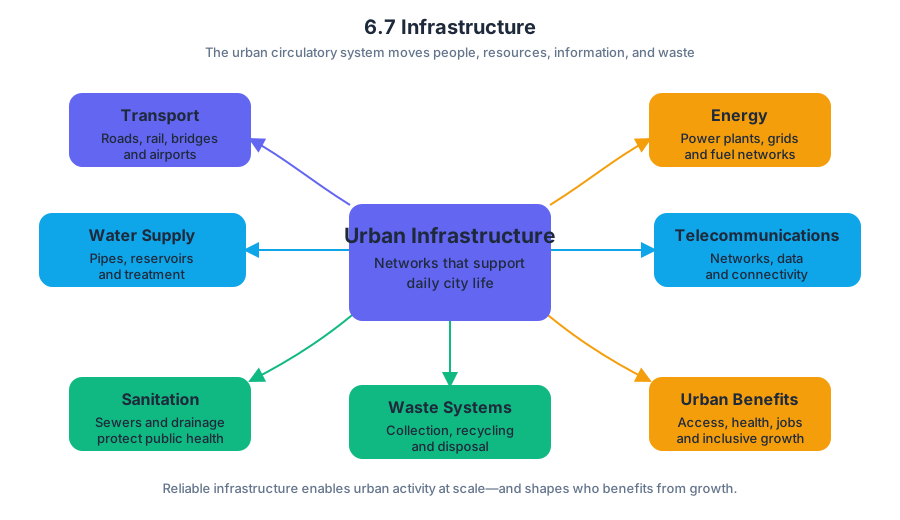
A city cannot function on buildings alone: it depends on infrastructure, the basic physical systems that move people, goods, energy, water, information, and waste through urban space.
6.7 Infrastructure
A city cannot function on buildings alone: it depends on infrastructure, the basic physical systems that move people, goods, energy, water, information, and waste through urban space. Roads, railways, bridges, water pipes, electrical grids, drainage systems, sewers, telecommunications, and airports form the “circulatory system” of a city.
Infrastructure matters because it makes urban activity possible at scale. A neighborhood may contain homes and businesses, but without reliable transportation workers cannot reach jobs, without water and sanitation public health declines, and without electricity or communication networks firms struggle to operate. Infrastructure therefore influences not only where development occurs, but also who benefits from urban growth.
Infrastructure as an urban system
Infrastructure works as an interconnected network rather than as a collection of separate objects. A new road can improve access to employment, but it may also increase traffic, encourage development along its route, and require expanded water, electricity, and waste services. A transit station can attract apartment buildings and shops, while a weak sewer system may limit how many people the surrounding area can support.
A useful way to trace infrastructure’s role is:
- Investment: A government or private organization builds or upgrades a system.
- Accessibility: Travel time, service availability, or communication capacity changes.
- Urban response: Households and firms adjust their locations.
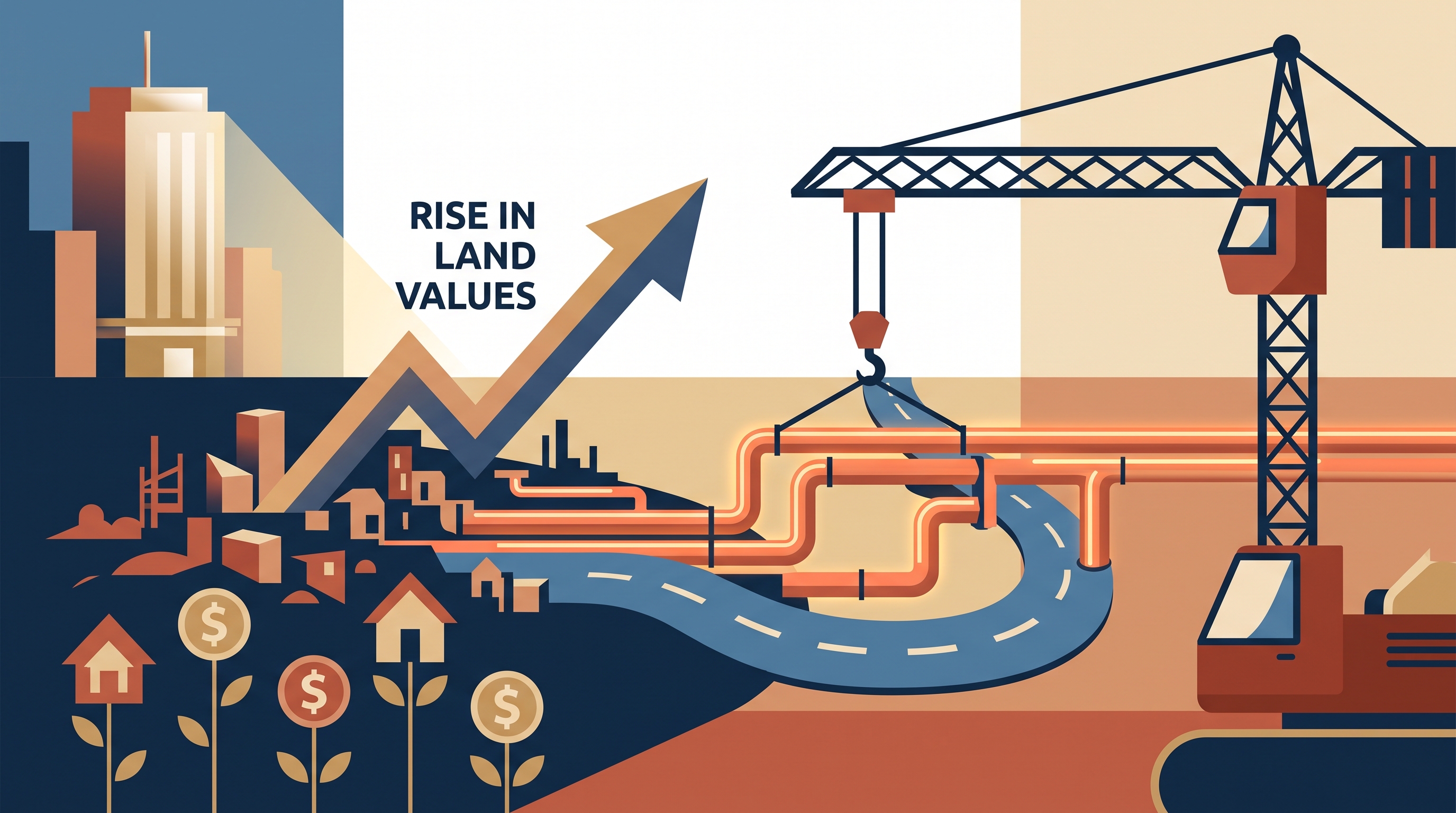
- Development pattern: Population, land values, employment, and services become redistributed.
- Uneven effects: Some areas gain access and investment while others remain underserved or experience displacement.
This chain connects infrastructure to the spatial patterns studied in Topic 6.6: changes in access can alter land use and residential location even when the physical size of the city does not change.
Major infrastructure categories
| Infrastructure system | What it does in a city | Likely urban effect |
|---|---|---|
| Transportation | Moves people and goods through roads, railways, ports, and airports | Expands commuting zones and connects markets |
| Water and sanitation | Supplies clean water and removes wastewater and solid waste | Supports public health and higher population concentrations |
| Energy | Delivers electricity, fuel, or other power sources | Enables homes, industry, commerce, and digital services |
| Communication | Carries telephone, internet, and data connections | Links firms, residents, and governments across distance |
| Drainage and flood control | Channels stormwater and reduces flood exposure | Protects property and supports development in vulnerable areas |
| Public facilities | Provides schools, hospitals, emergency services, and civic functions | Shapes quality of life and neighborhood attractiveness |
Worked example: a transit investment
Imagine a rapidly growing city whose central business district is separated from a large residential area by a congested highway. The city constructs a rapid-transit line with stations near the residential area, a university, and the downtown employment center.
The immediate effect is reduced travel time for residents who can reach the stations. Businesses gain access to a larger labor pool, students can travel more easily to the university, and land near stations may become more valuable because it offers better accessibility. Developers may respond by constructing apartments, offices, and retail near the stations.
However, the benefits are not automatically equal. If fares are high, routes bypass poorer neighborhoods, or rising land values displace existing residents, the new infrastructure can widen inequality. The correct geographic explanation must therefore identify both the infrastructure investment and its spatially uneven consequences.
Infrastructure and uneven urban development
Infrastructure often reveals political and economic priorities. Wealthier districts may receive dependable electricity, paved roads, frequent public transit, high-speed internet, and modern drainage, while informal settlements or peripheral neighborhoods may have intermittent services. This difference is called infrastructural inequality: unequal access to the systems required for safe and productive urban life.
Infrastructure can also produce a feedback effect. Areas with better services attract firms and residents, increasing tax revenue and investment; underserved areas may then lose opportunities, making it harder to finance improvements. A city can consequently display sharp contrasts between highly connected districts and neighborhoods only a short distance away.
AP skill focus: Skill 3.C
Topic 6.7 is assessed through Skill 3.C: Explain patterns and trends in maps, graphs, charts, and tables. For infrastructure questions, do more than identify that one area has “more roads” or “better access.” Explain the pattern by connecting the evidence to urban development.
For example, if a map shows higher population growth along a new rail corridor, a strong explanation would state that improved transportation accessibility reduces travel costs or commuting time, encouraging residential and commercial development near stations. The explanation must connect visual evidence → geographic process → urban outcome.
Misconception check
Misconception: Infrastructure always improves every part of a city.
Correction: Infrastructure increases capacity or accessibility, but its benefits depend on location, affordability, reliability, and political decisions. A highway may connect a city to regional markets while dividing neighborhoods; a transit line may improve mobility while raising nearby rents.
Retrieval check
A city extends clean-water pipes and paved roads to a peripheral settlement. Predict one demographic or economic change and explain the mechanism. A complete answer should name the infrastructure improvement, identify the resulting change in accessibility or service quality, and connect that change to development, population growth, land values, or employment.
Source Materials
- AP Human Geography Course and Exam Description
- AP Human Geography Course and Exam Description Clarifications and Corrections
- AP Human Geography Course Overview
- AP Human Geography Course at a Glance
- AP Human Geography Course at a Glance Poster
- AP Human Geography
- AP Human Geography
- AP Human Geography Sample Syllabus 1