From the free course AP Human Geography on Lykke
3.4 Types of Diffusion
Key concepts: Types of diffusion · Relocation diffusion · Hierarchical diffusion · Contagious diffusion · Stimulus diffusion · Blending of languages
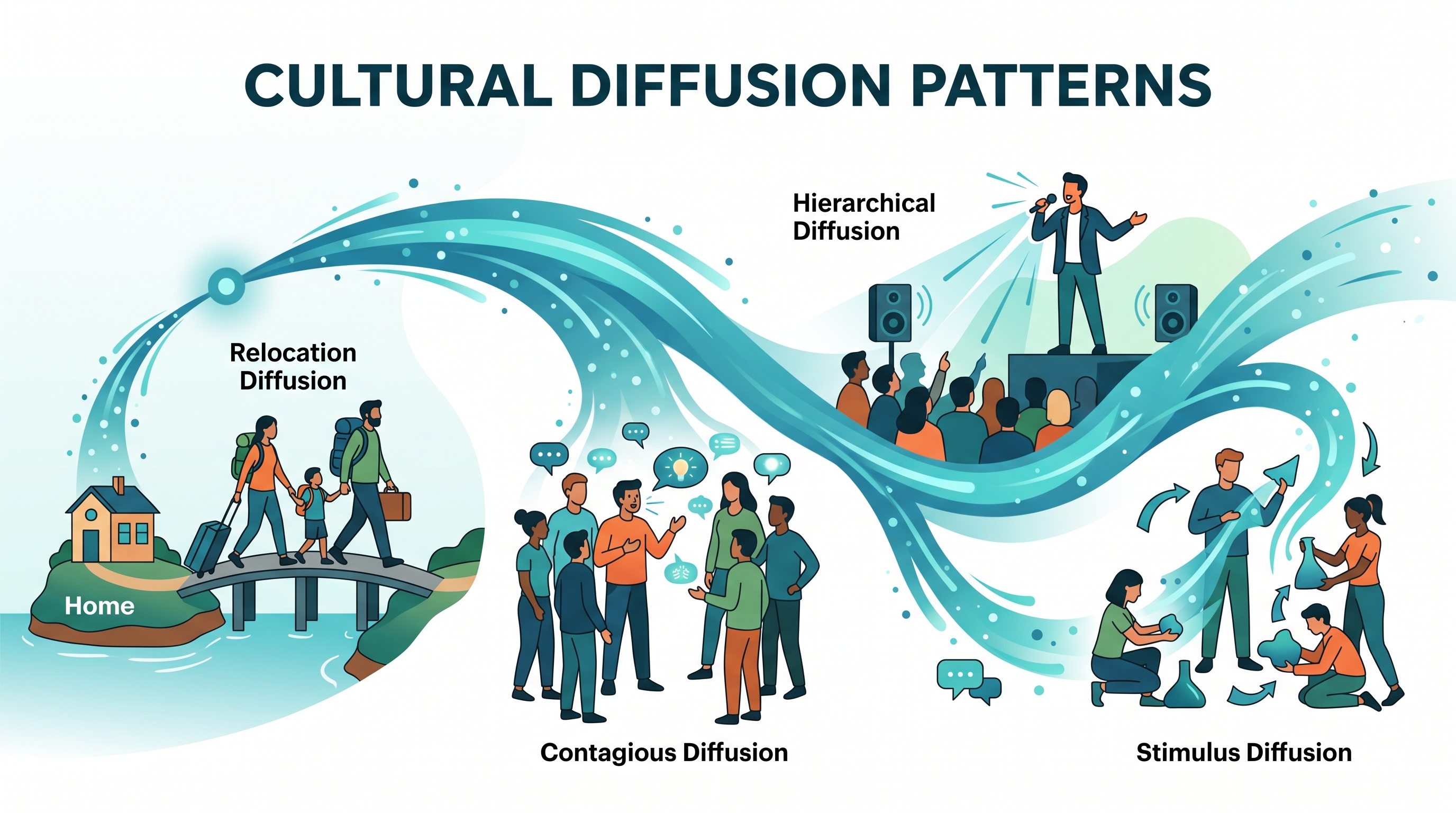
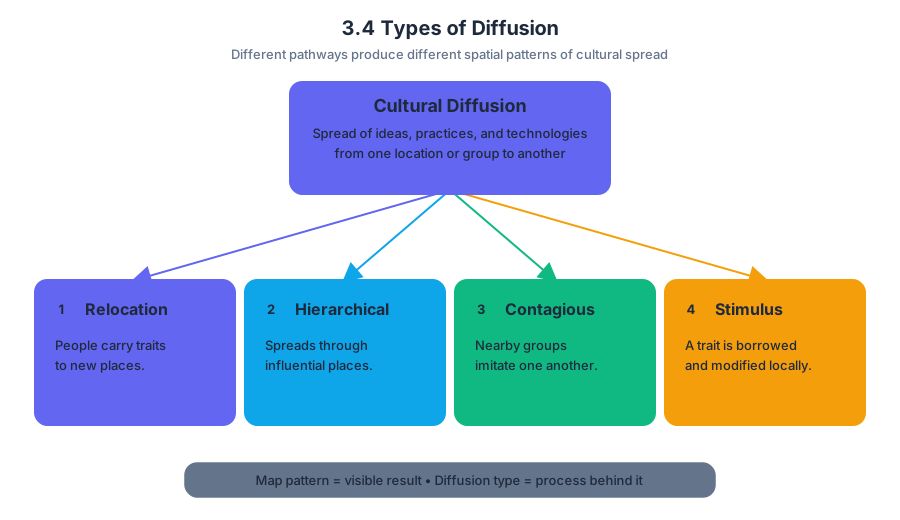
A cultural idea can cross space in several different ways: people may carry it with them, influential places may pass it onward, neighbors may imitate one another, or another culture may borrow and modify it.
3.4 Types of Diffusion
A cultural idea can cross space in several different ways: people may carry it with them, influential places may pass it onward, neighbors may imitate one another, or another culture may borrow and modify it. Cultural diffusion is the spread of ideas, practices, technologies, languages, or other cultural traits from one location or group to another.
The crucial question is not simply whether a trait spreads, but how its spatial pattern is produced. A map showing a trait’s distribution is the visible result; the type of diffusion identifies the process behind that pattern.
The five diffusion pathways
| Type of diffusion | How the spread occurs | Spatial clue |
|---|---|---|
| Relocation diffusion | People move and carry an idea or practice to a new location, often across a geographic barrier. | A new outpost appears far from the source |
| Expansion diffusion | A cultural trait spreads outward from its source area while remaining strong in the source area. | The original area and surrounding areas both show the trait |
| Hierarchical diffusion | An idea spreads from one important or significant city, community, and/or person to another. | Major centers or influential people adopt it first |
| Contagious diffusion | An idea spreads from person to person or along a transportation line. | A continuous, neighbor-to-neighbor pattern |
| Stimulus diffusion | An idea is borrowed from one culture and altered by the receiving culture. | The general concept spreads, but its form changes |
These categories can overlap. For example, a music style might reach a distant city through relocation diffusion, become popular among celebrities through hierarchical diffusion, and then spread through neighborhoods by contagious diffusion. If local musicians alter the rhythm or lyrics, the result also demonstrates stimulus diffusion.
Worked example: tracing a food trend
Imagine a vegetable-based street-food recipe developed in one coastal city.
- A chef moves to another country and opens a restaurant, carrying the recipe across a geographic barrier. This is relocation diffusion.
- Well-known chefs in several major cities feature the dish. Its movement between influential cities and people is hierarchical diffusion.
- Customers imitate the dish, and nearby restaurants begin selling it. This person-to-person and business-to-business spread is contagious diffusion.
- A local culture replaces one ingredient and changes the preparation method while retaining the basic idea. This is stimulus diffusion.
- The original city continues producing and consuming the dish while surrounding places adopt it. That outward spread is expansion diffusion.
The same cultural trait can therefore experience several diffusion processes at different moments. Exam questions often reward the explanation of the mechanism—not merely naming a popular example.
Language blending and creolization
Creolization is the development of a new language or form of communication through sustained contact between groups speaking different languages. It is a form of cultural blending: two or more languages converge, and the resulting language includes features from the original languages.
For example, when speakers of mutually unintelligible languages interact over time, they may combine vocabulary, pronunciation, grammar, and sentence patterns. A temporary contact language may develop first; with continued community use and transmission to new generations, a more stable language or dialect can emerge.
Key insight: Creolization does not mean that one language simply replaces another. It describes the creation of a new linguistic form containing selected features from multiple languages.
This process can be understood as stimulus diffusion because a cultural element—in this case, language—is borrowed and then altered by the receiving or interacting culture. It also reflects syncretism, the combination of cultural traits into a new form.
Misconception check: diffusion is not cultural copying
A common misconception is that diffusion always produces an identical cultural trait everywhere. In reality, stimulus diffusion specifically involves adaptation. A borrowed idea may retain its central function while changing its ingredients, design, vocabulary, meaning, or social use.
A second misconception is confusing relocation and expansion diffusion. If migrants carry a practice to a distant place, the defining mechanism is relocation diffusion. If the practice spreads outward while remaining established in its source area, the pattern is expansion diffusion.
AP skill connection
Topic 3.4 Types of Diffusion is anchored in the learning objective 3.4.A: Explain how culture spreads through diffusion. It most directly develops Skill 1.B: Explain geographic concepts, Skill 2.B: Explain spatial patterns, Skill 3.B: Explain spatial relationships, and Skill 6.B: Explain the spatial relationships at different scales. A strong response connects the named diffusion type to a visible pattern, the movement or interaction producing it, and the scale at which the process operates.
Retrieval check: A language spreads when migrants move across an ocean, local speakers modify its grammar, celebrities popularize it, and neighbors begin using it. Identify the diffusion type most clearly shown by each event: migrants carrying it, local modification, celebrity adoption, and neighbor-to-neighbor spread. The sequence is relocation, stimulus, hierarchical, and contagious diffusion.
Source Materials
- AP Human Geography Course and Exam Description
- AP Human Geography Course and Exam Description Clarifications and Corrections
- AP Human Geography Course Overview
- AP Human Geography Course at a Glance
- AP Human Geography Course at a Glance Poster
- AP Human Geography
- AP Human Geography
- AP Human Geography Sample Syllabus 1