From the free course AP Human Geography on Lykke
5.4 The Second Agricultural Revolution
Key concepts: Second Agricultural Revolution · Agricultural technological advancements · Impacts of technological change on agricultural practices · Carrying capacity of land · Green Revolution · High-yield seeds · Agricultural chemicals · Mechanized farming · Food supply in the developing world · Environmental consequences of the Green Revolution
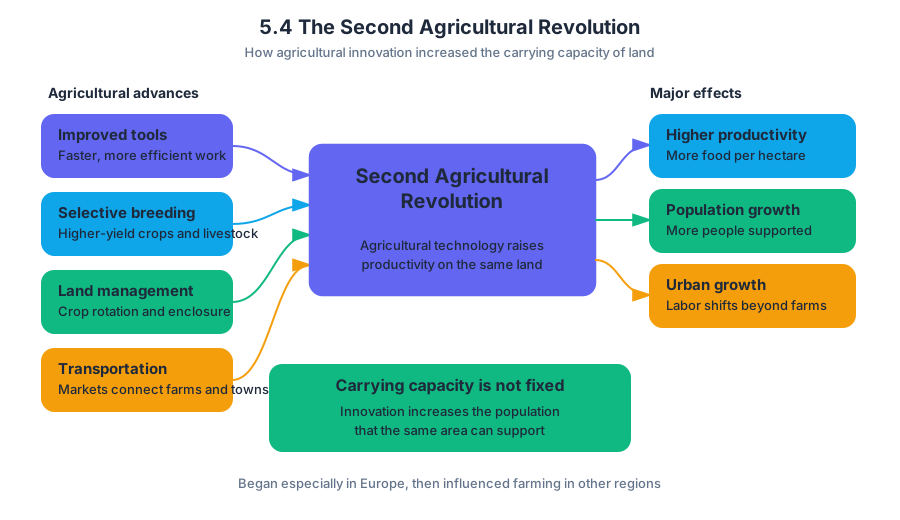
A farm’s carrying capacity is not fixed: when people improve tools, seeds, transportation, or land management, the same area can support a larger population. The Second Agricultural Revolution was the major period of agricultural technological advancement that increased productivity and transformed farming…
5.4 The Second Agricultural Revolution
A farm’s carrying capacity is not fixed: when people improve tools, seeds, transportation, or land management, the same area can support a larger population. The Second Agricultural Revolution was the major period of agricultural technological advancement that increased productivity and transformed farming practices, especially in Europe and later in other regions.
Learning Objective SPS-5.C: Explain how advances in agricultural technology may increase the carrying capacity of land.
From more land to more output
Carrying capacity means the largest population that a particular environment can support sustainably with the resources and technology available at a given time. Agricultural technology can raise carrying capacity by increasing the amount of food produced per unit of land, reducing losses, or making previously difficult land productive.
A simple chain shows the mechanism:
$$ \text{Technology} \rightarrow \text{higher yield or fewer losses} \rightarrow \text{greater food supply} \rightarrow \text{higher carrying capacity} $$
For example, suppose a farming region produces $2$ metric tons of wheat per hectare and supports a population using $1{,}000$ hectares. If improved drainage, crop rotation, and better tools raise production to $3$ metric tons per hectare, the region can produce $50%$ more food without expanding its cultivated area:
$$ \frac{3-2}{2}\times 100 = 50% $$
That increase does not automatically mean that population must grow, or that the environment can support the change forever. It means that, under the new technological conditions, the land has a greater potential food-producing capacity.
What changed during the Second Agricultural Revolution?
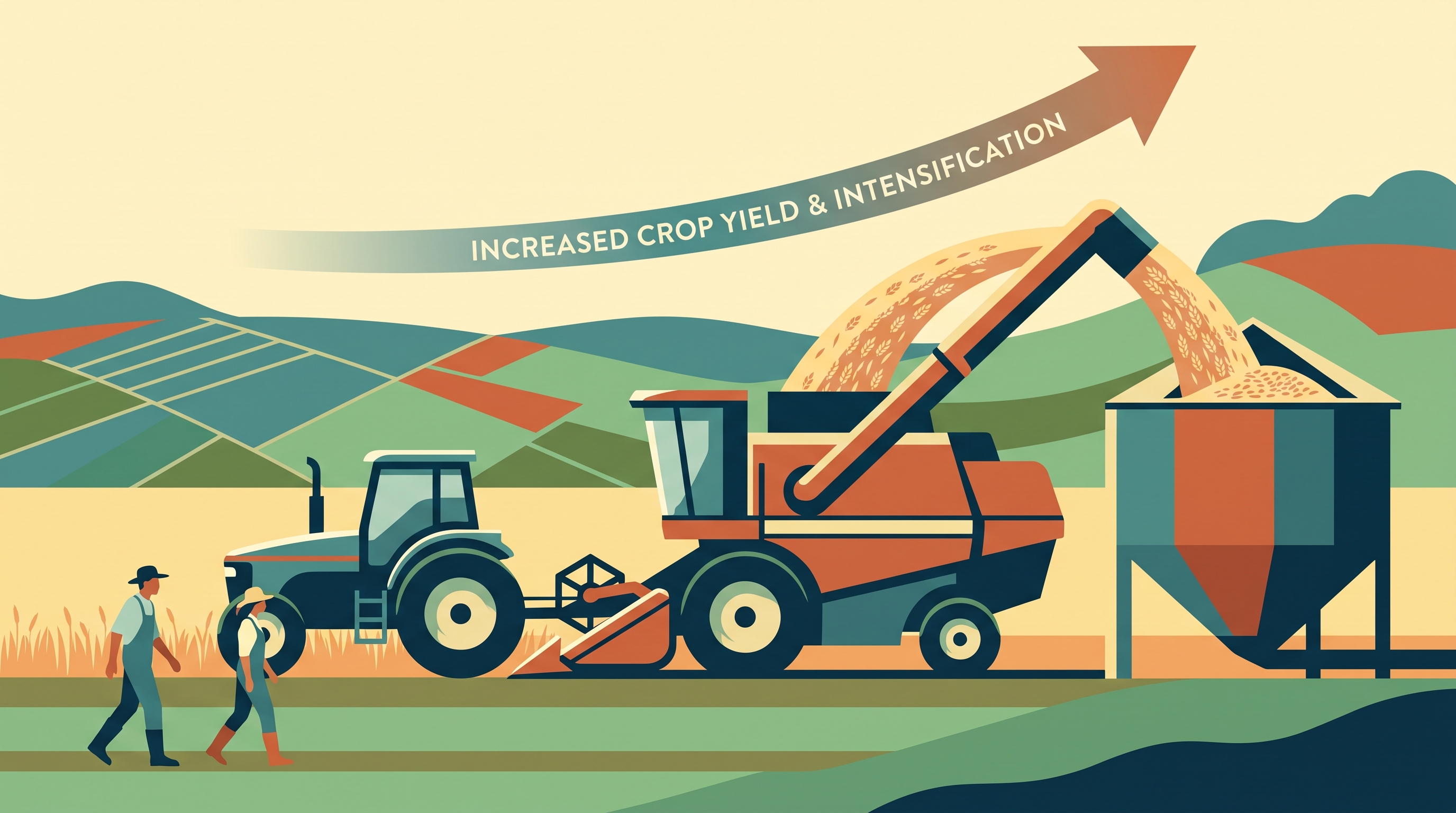
The Second Agricultural Revolution refers to a period of technological advancements that changed agricultural practices and increased agricultural productivity. It is associated especially with innovations such as improved tools and machinery, more systematic crop rotation, selective breeding, drainage, enclosure, and improved transportation connecting farms to markets.
These changes worked together rather than acting as isolated inventions. Better machinery allowed farmers to cultivate more land or complete tasks faster; crop rotation helped maintain soil fertility; drainage opened some wet areas to cultivation; selective breeding improved livestock and crops; and transportation made it easier to move agricultural products to urban consumers.
Positive impacts—and the trade-off
The central positive impact was increased agricultural productivity, meaning more output from a given quantity of land, labor, or time. Larger and more reliable food supplies supported population growth, helped supply expanding cities, encouraged commercial agriculture, and reduced the likelihood that a local harvest failure would immediately produce famine when transportation and markets could bring food from elsewhere.
Technological change could also release labor from agriculture. If machines performed tasks that once required many workers, some people could seek employment in manufacturing, transportation, or services. This helped connect agricultural change to industrialization and urbanization.
Why intensification can damage the environment
Agricultural intensification means producing more food through greater inputs or more intensive use of land. Although intensification can increase short-term yields, it may also create environmental costs: soil exhaustion, erosion, habitat loss, water depletion, and pollution from agricultural chemicals or runoff.
The key geographic relationship is conditional:
| Agricultural change | Possible productivity gain | Possible environmental cost |
|---|---|---|
| More irrigation | Reliable water during dry periods | Aquifer depletion or soil salinization |
| More machinery | Faster planting and harvesting | Fuel use, soil compaction, and pollution |
| Greater chemical use | More rapid plant growth or pest control | Water contamination and loss of soil organisms |
| Expanded cultivation | More land in production | Habitat destruction and erosion |
Misconception check — “Higher carrying capacity means unlimited growth.” A technological increase in carrying capacity is not a permanent escape from environmental limits. If farming degrades soil or exhausts water, the land’s future carrying capacity may decline even while current production rises.
Do not confuse SPS-5.C with SPS-5.D
SPS-5.C centers on the Second Agricultural Revolution and the mechanism by which agricultural technology increased productivity and the carrying capacity of land. SPS-5.D, the Green Revolution topic, focuses on a later technological shift—especially high-yield seeds, increased chemical use, and mechanized farming—and its consequences for food supply and the environment in the developing world.
The Green Revolution therefore connects to this topic but should not replace it. Its technologies included high-yield seeds, chemicals, irrigation, and mechanization; the detailed consequences of that later transformation belong to the next topic.
AP geographic reasoning
This topic most directly uses Skill 1.C: Explain geographic concepts, processes, and patterns, because a strong response explains how technology changes production and carrying capacity rather than merely naming an invention. It also uses Skill 2.B: Explain spatial patterns, Skill 3.C: Explain patterns and trends in geographic data, and Skill 5.C: Explain how the scale of analysis affects geographic understanding when comparing technological impacts across places or time periods.
Retrieval check: A region adopts improved drainage and crop rotation, increasing food production without expanding farmland. Which concept explains the change, and what is one possible long-term environmental risk if intensification is poorly managed?
Source Materials
- AP Human Geography Course and Exam Description
- AP Human Geography Course and Exam Description Clarifications and Corrections
- AP Human Geography Course Overview
- AP Human Geography Course at a Glance
- AP Human Geography Course at a Glance Poster
- AP Human Geography
- AP Human Geography
- AP Human Geography Sample Syllabus 1