From the free course AP Human Geography on Lykke
6.9 Urban Data
Key concepts: Urban housing affordability · High population density · Large or growing urban populations · Housing vacancies · Urban periphery · Distance from employment locations · Access to schools, transit, and services · Migrant housing difficulties
A city can grow faster than its housing supply, turning a population increase into higher rents, crowded neighborhoods, and long commutes. Urban data helps geographers connect these outcomes to measurable patterns such as population density, population growth, housing vacancies, and distance from employment locations.
6.9 Urban Data
A city can grow faster than its housing supply, turning a population increase into higher rents, crowded neighborhoods, and long commutes. Urban data helps geographers connect these outcomes to measurable patterns such as population density, population growth, housing vacancies, and distance from employment locations.
Investigative question: Why might migrants find housing difficult to obtain even when a city is expanding economically?
CED alignment: Topic 6.9 Urban Data; Learning Objective 6.9.A; Essential Knowledge 6.9.A.1. This topic primarily uses Skill 3: Data Analysis, especially 3.A Identify types of data presented in maps, charts, tables, diagrams, and images, 3.B Describe patterns and trends in data, and 3.C Explain patterns and trends in data. It also draws on Skill 2: Spatial Relationships, particularly 2.A Identify spatial patterns and processes, 2.B Describe spatial patterns and processes, and 2.C Explain spatial patterns and processes, plus Skill 5: Scale Analysis when the same urban pattern is examined at neighborhood, city, or metropolitan scales.
Housing pressure: density and population growth
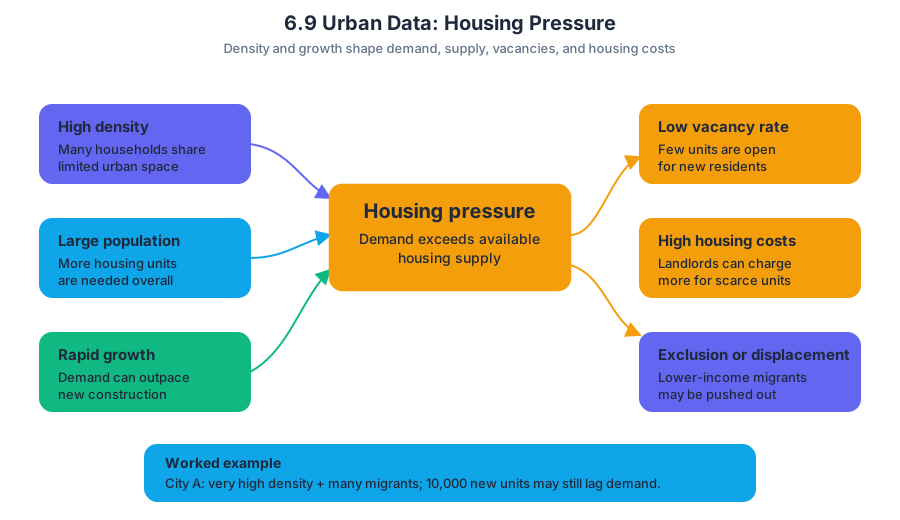
High population density means that many people occupy a relatively small amount of land. Density does not automatically produce a housing crisis, because high-density cities can build apartments efficiently; however, when demand for housing exceeds the available supply, density can contribute to high housing costs and few vacant units.
A large or growing urban population creates additional demand for housing. Migrants arriving for employment, education, or family reasons may compete with existing residents for apartments and rooms. If construction does not keep pace with the number of new households, landlords can charge more and available vacancies can disappear quickly.
The distinction between density and growth matters:
| Urban condition | Immediate housing effect |
|---|---|
| High population density | Many households compete for limited space |
| Large urban population | A large absolute number of housing units is needed |
| Rapid population growth | Demand may increase faster than construction |
| Low vacancy rate | Few units are available for new residents |
| High housing costs | Lower-income migrants may be excluded or displaced |
Worked example: Suppose City A already has very high population density and receives a large number of migrants each year. If builders add $10{,}000$ housing units but new and existing households need $15{,}000$ units, the shortfall is $5{,}000$ units. That shortage can produce rising rents, overcrowding, informal housing, or migration toward less central locations. The strongest geographic explanation links the data to a mechanism: population pressure increases competition for a limited housing supply.
Why new housing moves outward
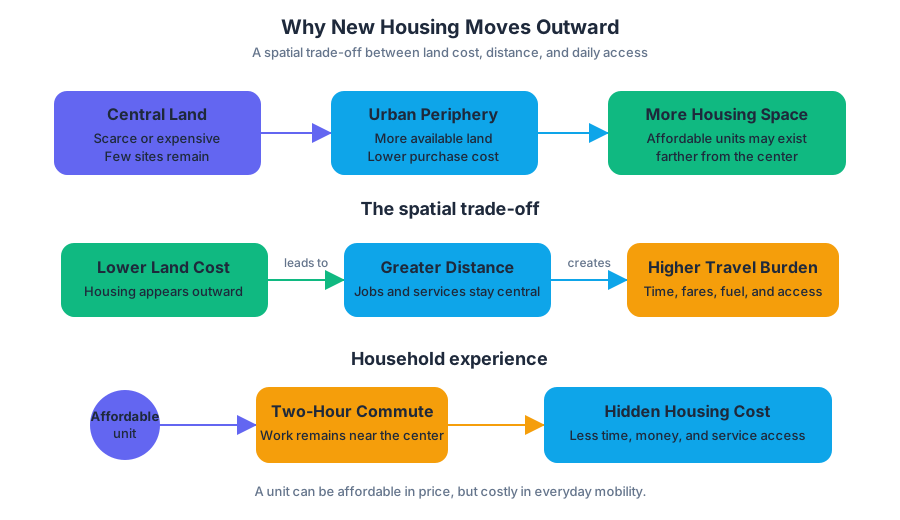
When centrally located land becomes scarce or expensive, available land for new housing may be found on the urban periphery, the outer edge of the built-up urban area. Peripheral housing may offer more space, but location creates a second problem: distance from employment locations, schools, transit, and service centers.
This produces a spatial trade-off:
$$ \text{Lower land cost} \longrightarrow \text{greater distance} \longrightarrow \text{higher travel time and transportation burden} $$
For example, a migrant household may find an affordable apartment on the urban edge but spend two hours traveling to work because employment remains concentrated near the city center or in major industrial and commercial districts. The unit is technically affordable, yet the household pays through time, transit fares, fuel costs, and reduced access to schools or health services.
Housing access is not only a supply problem
Housing access may also be controlled by a small number of owners or agents. These actors can set prices, require difficult documentation, restrict access to informal workers, or discriminate against migrants. Thus, two households with similar incomes may experience different housing opportunities because one faces exclusion in the rental or property market.
New housing may also be built in potentially hazardous areas, zones of disamenity—places with undesirable environmental or social conditions—or locations that are physically difficult to reach. Flood-prone land, steep slopes, polluted zones, and poorly connected peripheral settlements may be cheaper precisely because they carry greater risk or inconvenience.
Reading urban data correctly
A data-based explanation must do more than name two cities or repeat a percentage. First identify the pattern, then explain the relationship. For instance, if a table shows that cities with lower GDP per capita, such as Cairo or Dhaka, have higher percentage population growth, a valid explanation is that lower city GDP per capita corresponds with, or has an inverse relationship to, higher percentage population growth.
That relationship is an observed association, not proof that low GDP alone causes rapid growth. A careful explanation may connect the pattern to rural-to-urban migration, employment opportunities, natural increase, or differences in the timing of urbanization—but only when the available data support that interpretation.
Misconception check
Misconception: “High-density cities always have poor housing.” Density describes how concentrated people are; it does not by itself measure housing quality, affordability, or access. A high-density city may provide well-serviced apartments, while a lower-density city may have severe housing shortages if growth is rapid, land is poorly connected, or access is controlled by discriminatory owners.
Retrieval check
A city’s population grows rapidly, central vacancies fall, and new apartments appear on the outer edge of the metropolitan area. Give one housing consequence and one spatial consequence. A strong answer identifies high housing costs or few vacancies, then explains that peripheral housing increases distance from jobs, schools, transit, or service centers.

Source Materials
- AP Human Geography Course and Exam Description
- AP Human Geography Course and Exam Description Clarifications and Corrections
- AP Human Geography Course Overview
- AP Human Geography Course at a Glance
- AP Human Geography Course at a Glance Poster
- AP Human Geography
- AP Human Geography
- AP Human Geography Sample Syllabus 1