From the free course AP Human Geography on Lykke
2.2 Consequences of Population Distribution
Key concepts: Population distribution and its consequences · Mortality, fertility, and migration · Environmental, economic, cultural, and political influences on population change · Malthusian theory and critiques · Agricultural practices and their environmental and social impacts · Challenges of feeding a growing population · Green Revolution technologies and agricultural surplus · Core-periphery patterns in bilingual populations · Medical care and death rates · Pronatalist and antinatalist population policies
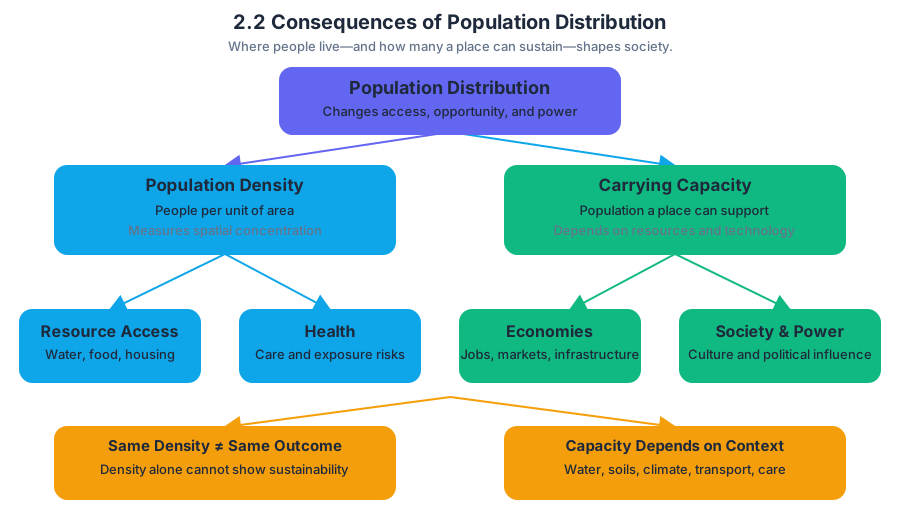
Population distribution changes society because the number of people a place can support—and the way those people are arranged—affects resources, health, economies, culture, and political power.
2.2 Consequences of Population Distribution
Population distribution changes society because the number of people a place can support—and the way those people are arranged—affects resources, health, economies, culture, and political power. Carrying capacity is the population size that a particular place can support with its available resources and technology.
Carrying capacity is not population density. Density measures how many people occupy a unit of area; carrying capacity asks whether the environment and human systems can sustain that population.
The same population density can produce very different outcomes. A densely settled region with reliable water, productive farmland, advanced infrastructure, and accessible medical care may support more people than a sparsely settled region with poor soils, limited transportation, or extreme climate.
Population change: three demographic forces
Population change results from mortality, fertility, and migration. Mortality is the occurrence of death; fertility refers to childbearing, especially the number of births in a population; migration is the movement of people from one place to another. Together, these processes determine whether a population grows, declines, or changes its spatial distribution.
$$ \text{Population change} = \text{births} - \text{deaths} + \text{immigration} - \text{emigration} $$
These forces respond to interacting environmental, economic, cultural, and political factors. Drought may reduce food supplies and encourage migration. Higher wages in a city may attract workers. Cultural expectations about family size may influence fertility. Government policy may encourage births, restrict them, or improve access to medical care, thereby reducing death rates.
| Force | Influences | Possible consequence |
|---|---|---|
| Mortality | Medical care, sanitation, nutrition, disease, conflict | Population decline or longer life expectancy |
| Fertility | Education, employment, contraception, cultural values, policy | Youthful or aging population |
| Migration | Jobs, safety, environmental conditions, family networks, political borders | Redistribution of population |
Worked example: Suppose a rural region experiences repeated droughts, falling farm income, and limited clinics. Mortality may rise if disease and malnutrition increase; fertility may decline as households face economic uncertainty; and working-age adults may migrate to cities. The region can therefore lose population through all three mechanisms at once, while the destination city gains workers and faces increased demand for housing, schools, transportation, and medical services.
Malthusian theory and its critiques
Under Malthusian theory, population tends to grow faster than food production. Thomas Malthus argued that unchecked population growth could create shortages, leading to “positive checks” such as famine, disease, and war, or “preventive checks” such as delayed marriage and lower fertility.
Malthusian theory remains useful as a warning about limits, but critics argue that it underestimates human innovation and the importance of distribution. New seeds, irrigation, fertilizers, mechanization, and improved transportation can increase food production. Hunger may also result from poverty, conflict, waste, or unequal access rather than from a global absence of food.
Named misconception: “More people automatically cause famine.” Population pressure can strain carrying capacity, but famine is not determined by population size alone. Technology, markets, political decisions, environmental conditions, and access to food all matter.
Agriculture, technology, and environmental consequences
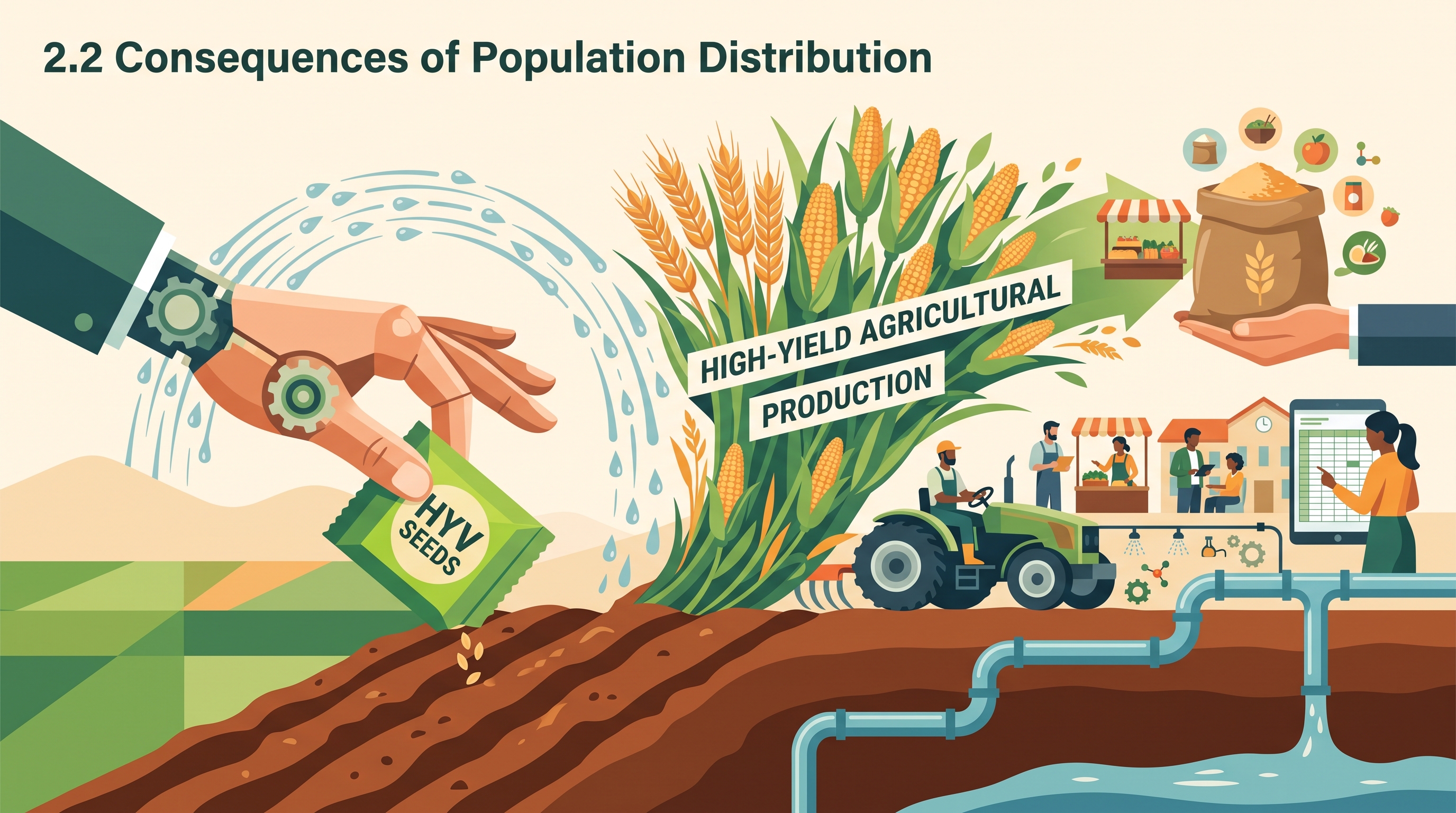
Feeding a growing population may require opening new agricultural land or developing technologies that overcome environmental constraints. The Green Revolution increased food production through high-yield seeds, irrigation, synthetic fertilizers, pesticides, and expanded mechanization. In many places, these practices created surpluses that changed global markets for local agricultural products.
The effects were mixed. Greater yields could reduce hunger and improve food security, but irrigation could deplete aquifers, fertilizers could pollute water, and pesticides could damage ecosystems. Large-scale commercial production could also make small farmers more dependent on purchased inputs and expose local producers to competition from imported food.
Agricultural change also influences the role of women. When farming becomes more commercialized or mechanized, women may lose traditional agricultural work—or gain new opportunities in wage labor, markets, education, and business. The outcome depends on land ownership, access to credit, technology, and local cultural expectations.
Cultural, political, and social consequences
Population distribution shapes cultural landscapes and political relationships. Bilingual populations in Canada are concentrated most strongly in core regions such as Quebec, Ontario, and New Brunswick, with lower concentrations in the northern territories. Linguistic patterns can be spatially uneven: English speakers are present in Quebec, while French speakers are present in Ontario, even though each language has a different regional concentration.
Migration can produce both cultural integration and separation. Integration may involve entering schools, workplaces, business associations, or attaining citizenship, and it may include settling outside ethnic enclaves. These processes can expand social networks, while concentrated enclaves may preserve language, religion, and cultural traditions.
Governments also use population policies to influence demographic outcomes. Pronatalist policies promote population growth through measures such as financial benefits or support for families. Antinatalist policies discourage population growth through limits, incentives, or expanded access to contraception. Policies can change fertility, but their effects depend on enforcement, economic conditions, cultural values, and individual choices.
AP skill connection and retrieval check
This topic develops Skill 1.A: Concepts and Processes by distinguishing carrying capacity from population density and applying demographic terms accurately. It also develops Skill 2.C: Explain a likely outcome in a geographic scenario using geographic concepts, processes, models, or theories: for example, predicting that improved medical care will lower death rates, or that drought and declining farm income may increase migration.
Retrieval check: A densely populated farming region adopts high-yield seeds and irrigation, but groundwater levels fall and fertilizer runoff increases. Identify one way the technology may raise carrying capacity, one environmental consequence, and one reason Malthusian critics would use this example against a simple shortage prediction.
Source Materials
- AP Human Geography Course and Exam Description
- AP Human Geography Course and Exam Description Clarifications and Corrections
- AP Human Geography Course Overview
- AP Human Geography Course at a Glance
- AP Human Geography Course at a Glance Poster
- AP Human Geography
- AP Human Geography
- AP Human Geography Sample Syllabus 1