From the free course AP Human Geography on Lykke
Course Framework, Skills and Reasoning Processes
Key concepts: AP Human Geography course framework · Industrial and Economic Development Patterns and Processes · Spatial relationships · Spatial processes and societal change · Scale analysis · Source analysis · Impacts and interactions · Progress Checks · AP Question Bank · Instructional model
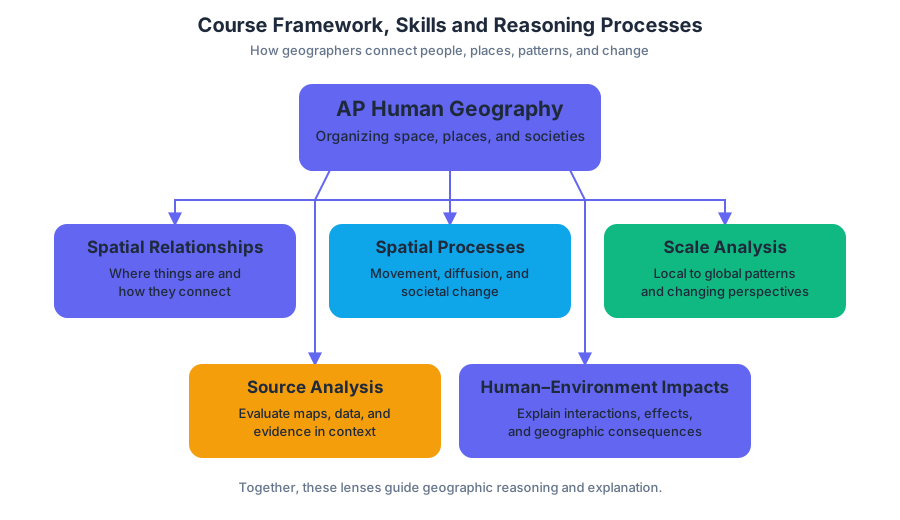
AP Human Geography studies how people organize space, change places, and produce geographic patterns through spatial relationships, spatial processes and societal change, scale analysis, source analysis, and the effects of human-environment impacts and interactions.
Course Framework, Skills and Reasoning Processes
AP Human Geography studies how people organize space, change places, and produce geographic patterns through spatial relationships, spatial processes and societal change, scale analysis, source analysis, and the effects of human-environment impacts and interactions.
The architecture: content, skills, and Big Ideas
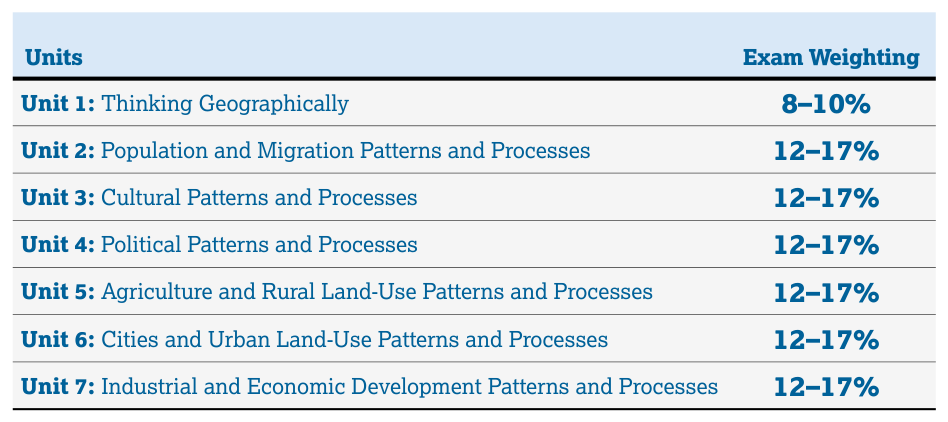
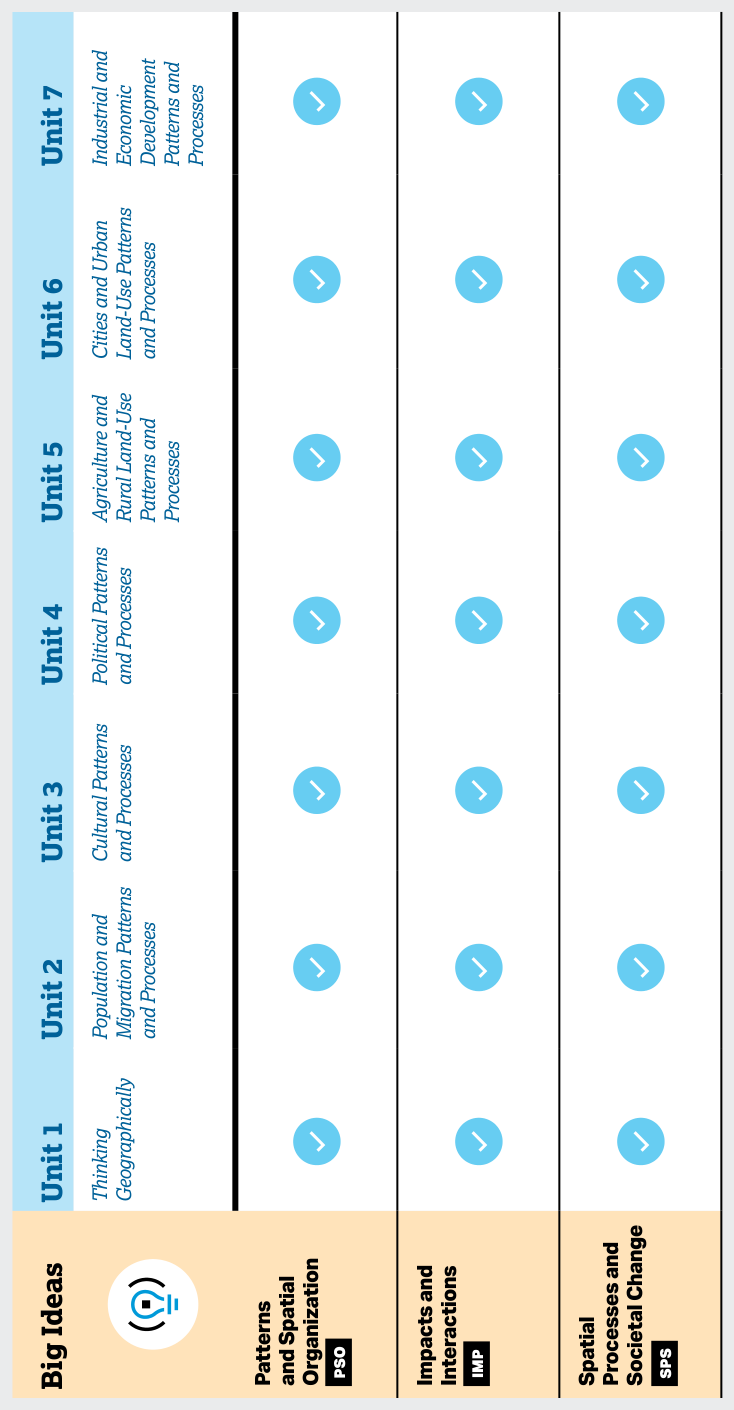
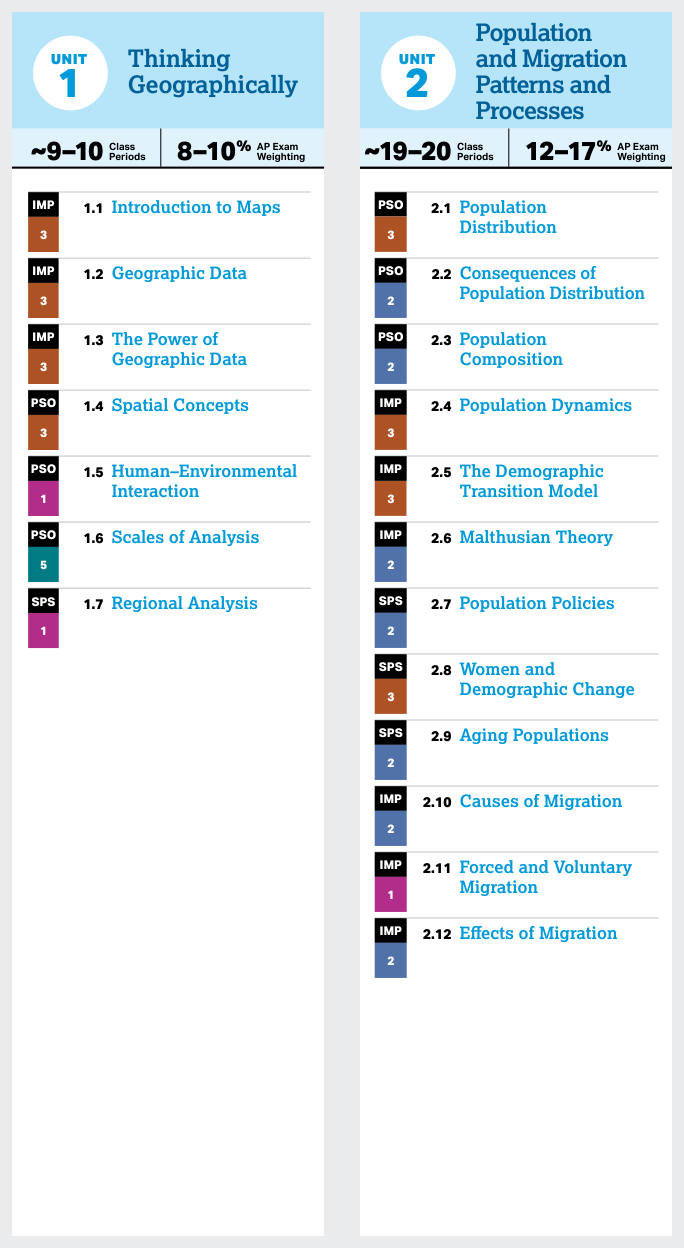
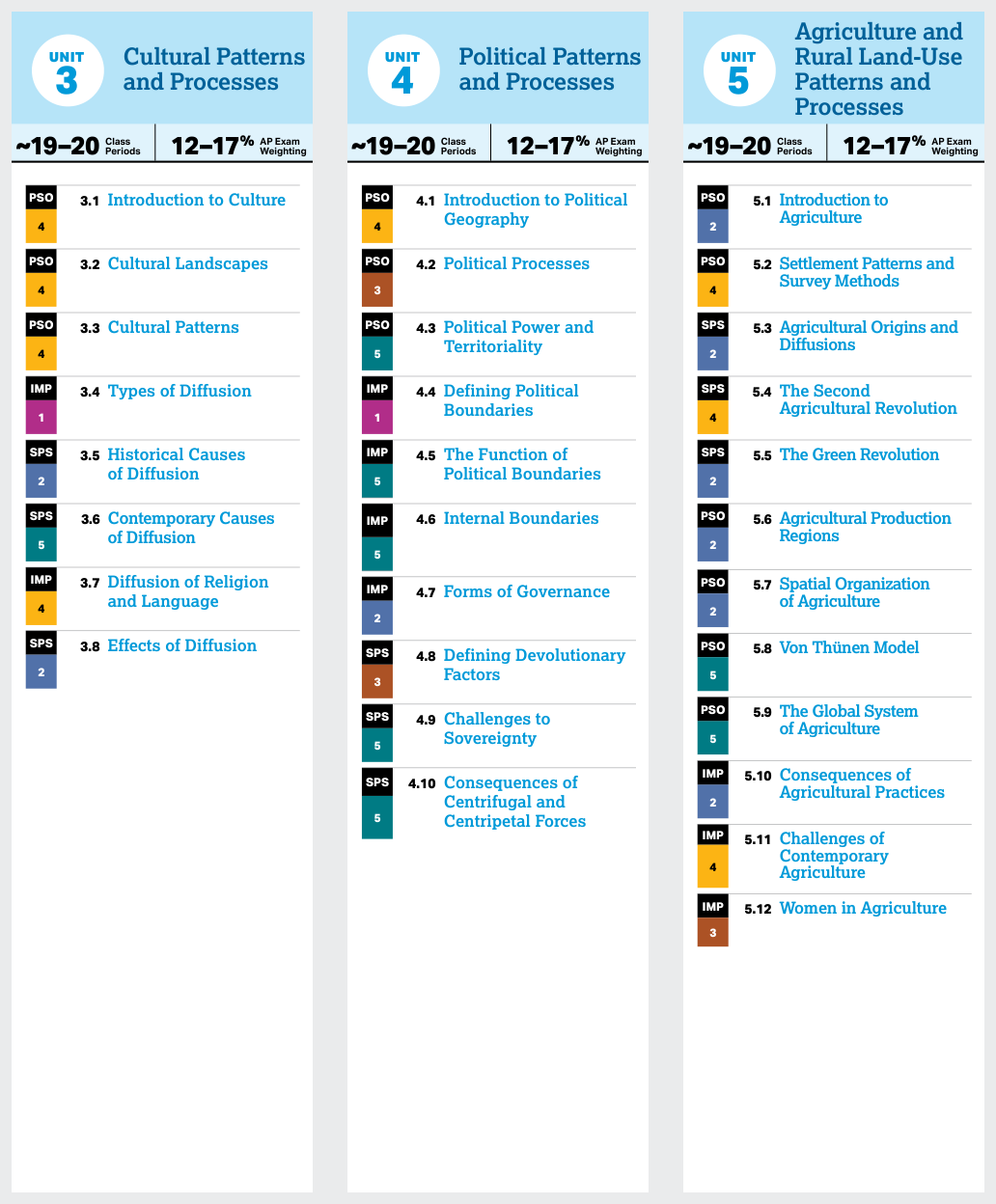
The Course Framework is the organizing structure for AP Human Geography. It divides the course into seven units, but the units are not isolated containers of vocabulary. Each topic combines geographic content with recurring skills and three Big Ideas:
| Big Idea | Meaning | Guiding question |
|---|---|---|
| Patterns and Spatial Organization [PSO] | Where things are located, how they are arranged, and why that arrangement matters | Why does economic and social development happen at different times and rates in different places? |
| Impacts and Interactions [IMP] | How people, places, environments, and economies affect one another | How might environmental problems stemming from industrialization be remedied through sustainable development strategies? |
| Spatial Processes and Societal Change [SPS] | How movement, technology, institutions, and human decisions transform places over time | How do processes operating across space produce societal change? |
A useful way to read any topic is to ask three questions in sequence: What pattern do I see? What process produced it? At what scale does the explanation change? For example, unequal development may appear as a global pattern, result from trade and industrialization processes, and look different when examined at the national, regional, or local scale.
Five geographic skill categories
The framework treats geography as an evidence-based discipline rather than a list of locations to memorize. Its five skill categories spiral through all seven units:
- Concepts and Processes: Use geographic concepts, models, and processes to explain why patterns occur. Topic materials connect this category to identifiers such as 1.D, 1.E, and 1.F.
- Spatial Relationships: Describe and explain how locations, distances, networks, and distributions relate to one another. 2.B is an example of this category.
- Data Analysis: Interpret quantitative information, identify trends, and recognize limitations in data. The framework explicitly connects this work to 3.F, which addresses limitations or problems in data.
- Source Analysis: Extract geographic information from maps, images, charts, graphs, and written sources, then compare patterns or trends. Examples include 4.A, 4.D, and 4.F.
- Scale Analysis: Explain how changing the geographic scale can reveal different relationships or conclusions. Examples include 5.B and 5.D.
A single task can require several categories at once. Suppose a map shows industrial employment concentrated near a major port. Source Analysis identifies the pattern, Spatial Relationships connects the port to transportation access, Concepts and Processes explains industrial location, and Scale Analysis asks whether the pattern remains true for the city, region, or country.
Key distinction: A geographic pattern is the observable arrangement of something in space; a geographic process is the mechanism that creates, maintains, or changes that arrangement.
Unit 7 as an integrated example
Unit 7: Industrial and Economic Development Patterns and Processes illustrates how the framework works. It carries a published AP Exam weighting of 12–17% and suggests approximately 19–20 class periods. Its sequence moves from the Industrial Revolution through economic sectors, industrialization, women and economic development, development theories, trade, changes produced by the world economy, and sustainable development.
The eight topics are connected by the Big Ideas rather than taught as unrelated entries. SPS-7 emphasizes changes produced by industrialization and economic systems; PSO-7 emphasizes the spatial organization of development and production; and IMP-7 emphasizes consequences, including environmental problems and possible sustainable responses. A visual source about factory locations, for instance, may assess Source Analysis through 4.D and 4.F, while also requiring Spatial Relationships through 2.B and Scale Analysis through 5.B.
Progress Checks: the framework’s feedback loop
Progress Checks are AP Classroom assessments assigned as part of the instructional sequence after a unit. They use AP-style multiple-choice and free-response work, often involving maps, charts, graphs, or written sources, to check both unit content and the geographic skills used to apply it.
Their purpose is diagnostic, not merely numerical. A teacher can examine results to determine whether students misunderstood a development theory, misread a spatial pattern, failed to support an explanation with evidence, or applied the wrong scale. Students can then revisit the specific concept or skill instead of simply repeating the entire unit.
Example feedback loop: Progress Check result → identify the missed content or skill → reteach with a map, dataset, or case study → attempt a new application → verify improvement.
Instructional sequence and professional responsibility
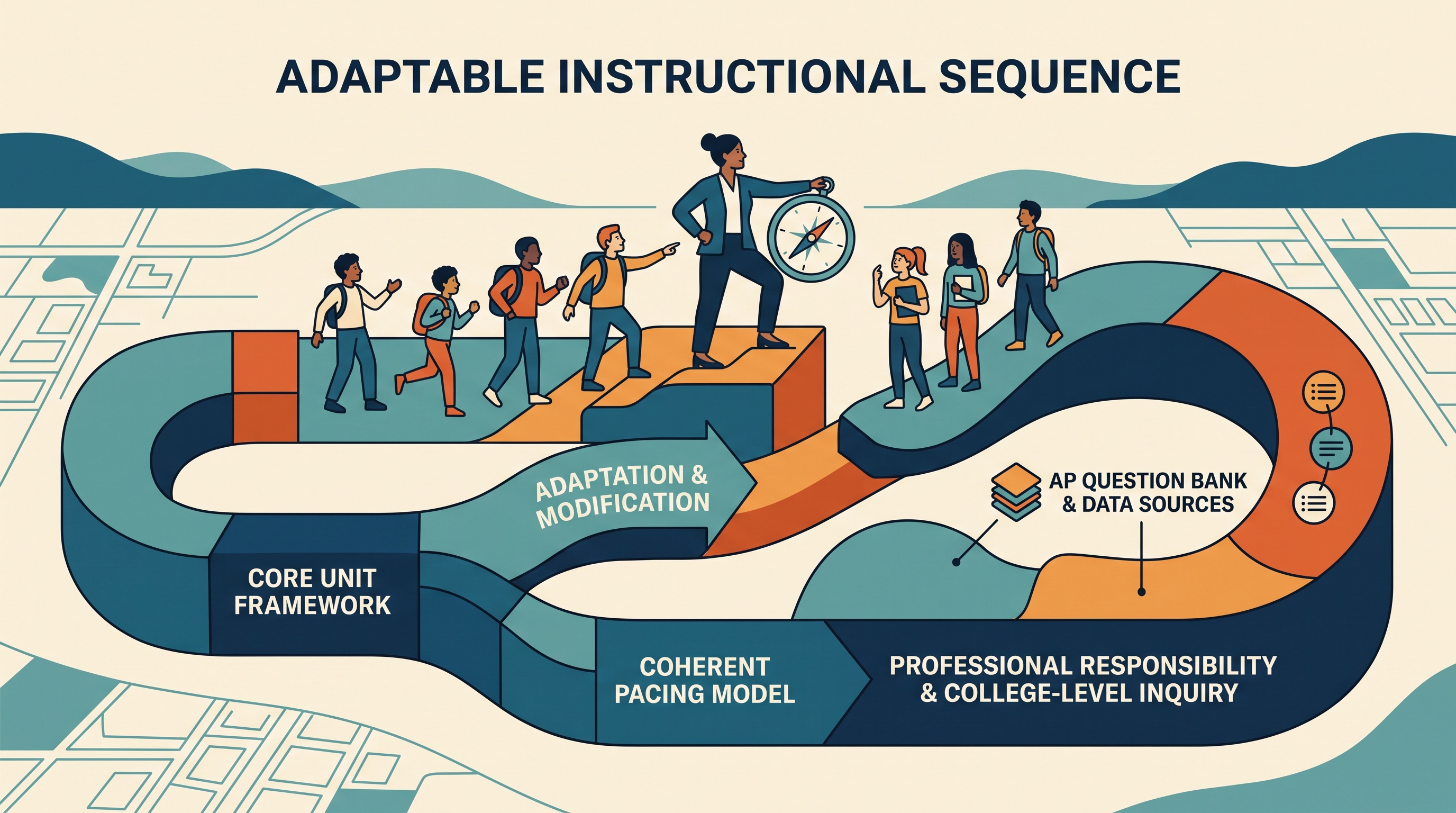
The unit structure was developed with extensive input from the AP Human Geography community. It gives new teachers a coherent sequence and pacing model they can adopt, while allowing experienced teachers to modify the order when their students, local context, or available resources make another sequence more effective.
That flexibility does not mean the framework’s expectations disappear. AP teachers should have confidence and clarity that families enrolling a student in an AP course have agreed to a classroom experience embodying stated AP principles: college-level inquiry, evidence-based reasoning, engagement with diverse cultures and perspectives, intellectual openness, and respectful discussion.
The AP Question Bank supports that work by providing real AP Exam questions indexed by course topics and skills for classroom use. Used alongside Progress Checks, maps, atlases, data sources, case studies, current events, and online mapping tools, it helps align daily instruction with the framework’s central demand: explain geographic patterns and processes with evidence, precision, and attention to scale.

Source Materials
- AP Human Geography Course and Exam Description
- AP Human Geography Course and Exam Description Clarifications and Corrections
- AP Human Geography Course Overview
- AP Human Geography Course at a Glance
- AP Human Geography Course at a Glance Poster
- AP Human Geography
- AP Human Geography
- AP Human Geography Sample Syllabus 1
- Figure — AP Human Geography Course and Exam Description (p. 1)
- Figure — AP Human Geography Course and Exam Description (p. 17)
- Figure — AP Human Geography Course and Exam Description (p. 23)
- Course Framework V.1 | 17 AP Human Geography Course and Exam Description