From the free course AP Human Geography on Lykke
4.7 Forms of Governance
Key concepts: Sovereignty · State self-rule · Noninterference by outside states and entities · International recognition of states · Requirements for defining sovereignty
Sovereignty is more than a government’s ability to make rules: it is a state’s authority to govern its territory and population without outside interference and with recognition from the international community.
4.7 Forms of Governance
Sovereignty is more than a government’s ability to make rules: it is a state’s authority to govern its territory and population without outside interference and with recognition from the international community.
Imagine a locked house. The residents decide what happens inside, outsiders cannot enter and rearrange the furniture without permission, and neighboring households recognize that the house belongs to those residents. A state’s sovereignty works similarly: self-rule, control within borders, noninterference, and international recognition must operate together.
Sovereignty: A state’s right and ability to rule itself, control what occurs inside its borders, remain free from interference by outside states and entities, and receive recognition as a state within the international community.
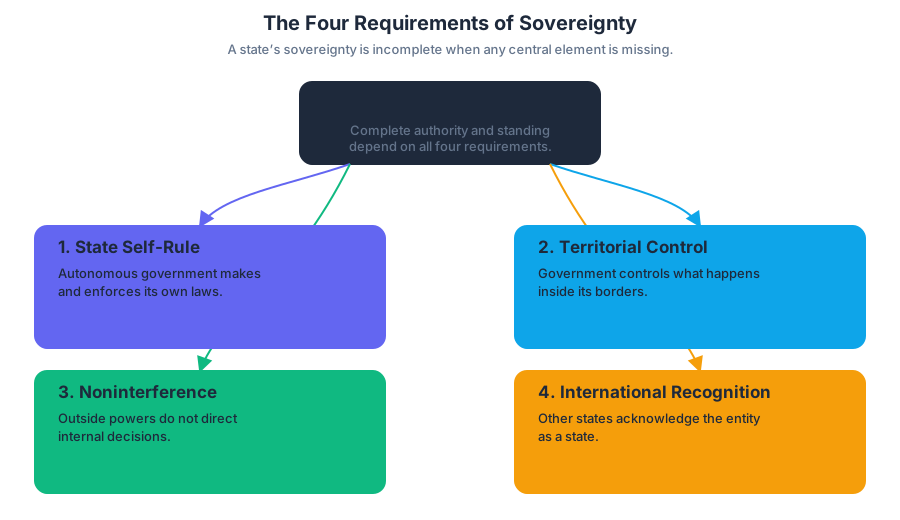
The four requirements of sovereignty
A state’s sovereignty is incomplete if any one of its central elements is missing or ignored.
| Requirement | Meaning | Diagnostic question |
|---|---|---|
| State self-rule | The state has an autonomous government that makes and enforces its own laws. | Who has the final authority to govern? |
| Territorial control | The state controls what happens inside its borders. | Can the government exercise authority throughout its territory? |
| Noninterference | Outside states and entities do not control the state’s internal decisions. | Is another power directing the government’s actions? |
| International recognition | Other states acknowledge the political entity as a state. | Is it treated as a state in international relations? |
The first two requirements describe sovereignty from the inside. A sovereign state governs itself and exercises authority over its territory. The latter two describe sovereignty in relation to the outside world: the state must be free from external control and recognized by the international community.
Why “self-rule” alone is not enough
A common misconception is that sovereignty simply means “the right to rule yourself.” That definition is incomplete. A response that mentions self-rule but omits freedom from outside interference or international recognition may fail to demonstrate the full geographic concept of sovereignty.
Exam-precision rule: Do not define sovereignty with only one phrase. Connect self-rule to control inside borders, freedom from outside interference, and international recognition.
For example, an autonomous government may make local laws, but if a foreign state controls its defense, economy, or political decisions, its sovereignty is limited. Likewise, a territory may claim independence but lack broad international recognition, making its status as a sovereign state contested.
Unitary and federal governance
Forms of governance also describe how authority is organized across a state’s territory. The key comparison is between unitary states, in which authority is concentrated in a central government, and federal states, in which constitutional arrangements divide authority between national and regional governments.
| Form of governance | Territorial organization of power | Typical relationship between levels of government |
|---|---|---|
| Unitary state | Political power is concentrated at the national level. | Regional or local governments exercise powers delegated by the central government. |
| Federal state | Political power is divided between national and regional governments. | Regional governments possess constitutionally protected powers that the national government cannot simply remove. |
Calling a unitary state “top-down” is only half of a comparison. A complete explanation must also state that a federal state distributes authority between national and regional levels. This distinction concerns the territorial organization of government, not whether a state is sovereign: both unitary and federal states can be sovereign.
Worked example: comparing governance
Suppose a country’s national government can redraw the powers of provinces whenever it chooses. The country is organized in a unitary manner because regional authority depends primarily on the central government. In a different country, the constitution reserves certain powers for states or provinces, so both national and regional governments possess recognized authority; that is a federal arrangement.
The two countries may both control their borders, make laws, and participate in international relations. Their difference lies in where governmental power is located within the territory, not in whether either country possesses sovereignty.
AP alignment and reasoning
This topic is tied directly to IMP-4.C.1 and IMP-4.D.1, which address the territorial organization of governance in unitary and federal states.
The most relevant AP skills are Skill 1.A: Describe geographic concepts, processes, models, and theories, used when identifying sovereignty, unitary governance, or federal governance; Skill 1.B: Explain geographic concepts, processes, models, and theories, used when showing how authority is organized; and Skill 2.C: Explain spatial relationships, used when connecting political power to national, regional, and local territories.
A strong free-response explanation uses a relationship rather than a label: Because a unitary state concentrates authority in the central government, regional governments generally have powers delegated from the center; because a federal state constitutionally divides authority, regional governments retain protected powers.
Misconception check
Misconception: “Federal” means weaker sovereignty. Federalism changes how power is distributed internally; it does not automatically reduce a state’s sovereignty. A federal state can still control its territory, conduct foreign affairs, resist outside interference, and receive international recognition.
Retrieval check
A territory has its own local government, but a neighboring country directs its foreign policy and many internal decisions. Does it fully meet the definition of sovereignty? No. It may have self-rule in a limited sense, but external control violates the requirement of noninterference. A complete definition must also consider territorial control and international recognition.

Source Materials
- AP Human Geography Course and Exam Description
- AP Human Geography Course and Exam Description Clarifications and Corrections
- AP Human Geography Course Overview
- AP Human Geography Course at a Glance
- AP Human Geography Course at a Glance Poster
- AP Human Geography
- AP Human Geography
- AP Human Geography Sample Syllabus 1
- Source: United States Census Bureau International Database