From the free course AP Human Geography on Lykke
4.8 Defining Devolutionary Factors
Key concepts: Devolution · Devolutionary factors · State sovereignty · Challenges to sovereignty · Supranationalism · Unitary systems · Centralization · Urban and rural populations · Rural natural increase (RNI) · Political, economic, cultural, and technological change
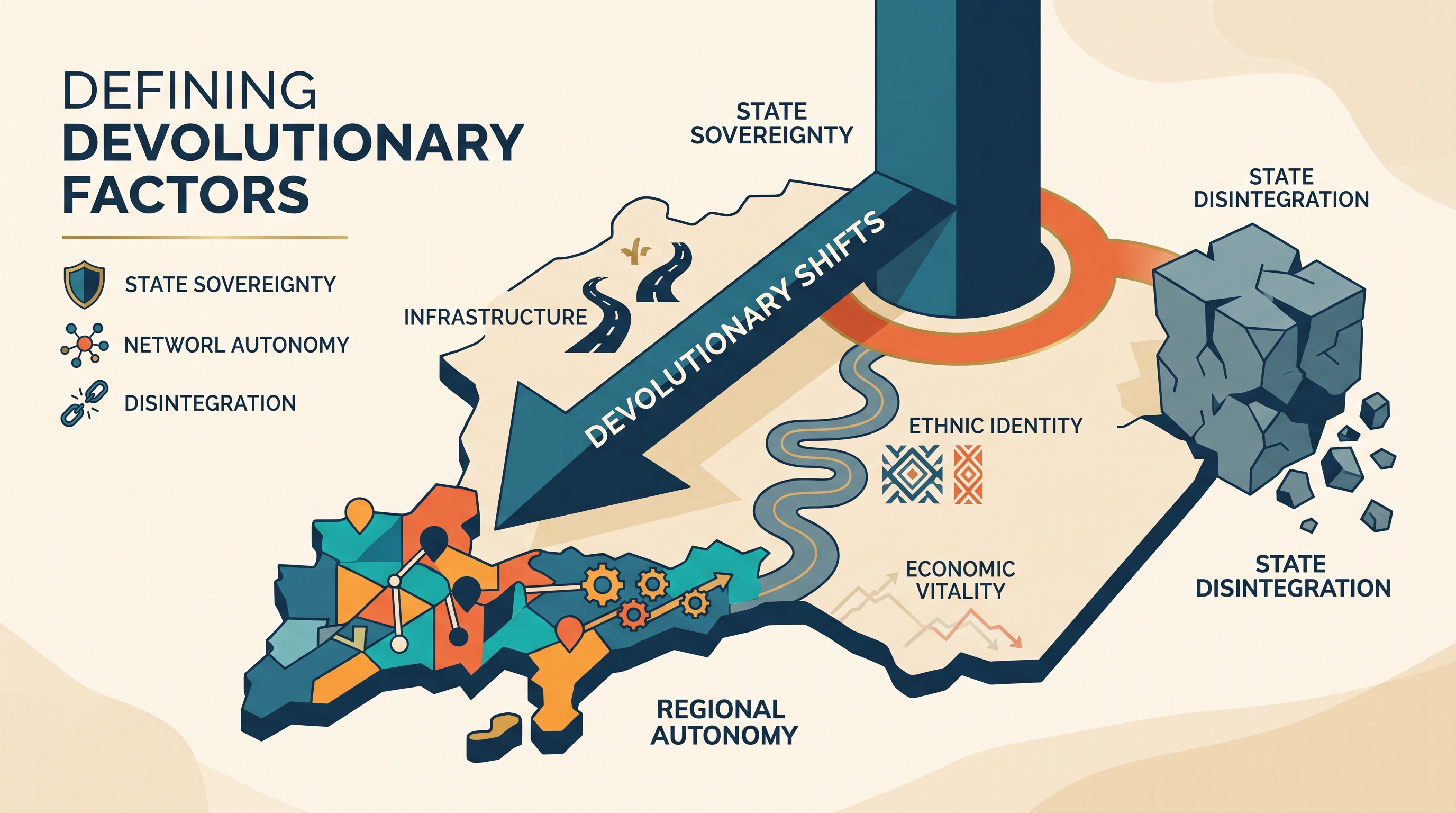
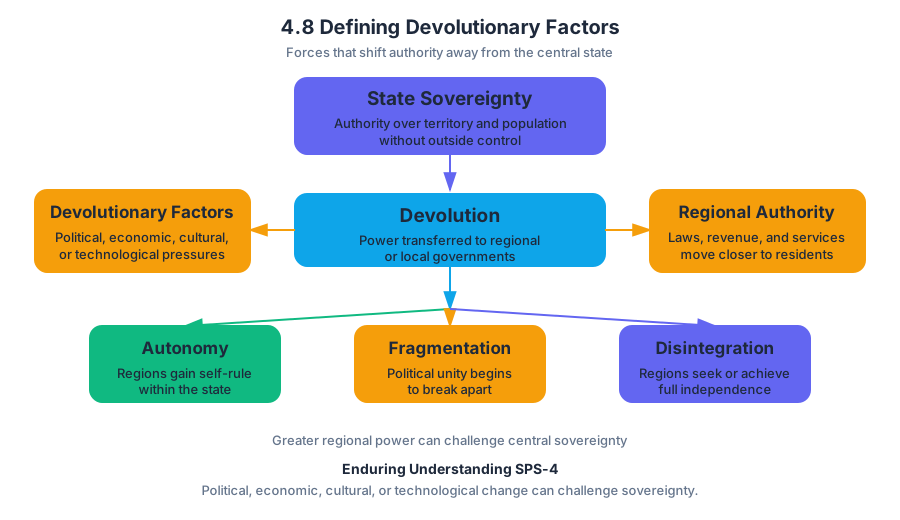
A state can look unified on a political map while containing powerful forces pulling it apart. Devolution is the transfer of power from a central government to regional or local governments; in more extreme cases, devolution may produce autonomous regions, the fragmentation of a state, or complete state disintegration.
4.8 Defining Devolutionary Factors
A state can look unified on a political map while containing powerful forces pulling it apart. Devolution is the transfer of power from a central government to regional or local governments; in more extreme cases, devolution may produce autonomous regions, the fragmentation of a state, or complete state disintegration.
Enduring Understanding SPS-4: Political, economic, cultural, or technological changes can challenge state sovereignty.
State sovereignty means a state’s authority to govern its territory and population without another government controlling its internal or external affairs. Devolution challenges sovereignty because regional governments may gain enough authority to make their own laws, collect revenue, control services, or demand independence.
The spatial logic of devolution
Imagine political power as water in a reservoir. In a highly centralized system, most power remains in the national reservoir. Devolution opens channels that move some of that power outward to provinces, territories, or municipalities.
Unitary systems concentrate political power in a central government through centralization. A national government may still delegate responsibilities to local governments, but it can usually redefine or withdraw those powers. Devolution in a unitary state therefore represents a meaningful shift away from the traditional concentration of authority.
| Political arrangement | Where authority is concentrated | Spatial pattern |
|---|---|---|
| Centralized unitary system | National government | Power flows mainly from the center outward |
| Devolved state | National and regional governments | Power is redistributed across territorial scales |
| Disintegrating state | Competing regional authorities | National control weakens or breaks apart |
Factors that contribute to devolution
Learning Objective SPS-4.A: Define factors that lead to the devolution of states. The CED identifies several devolutionary factors: division by physical geography, ethnic separatism, ethnic cleansing, terrorism, economic and social problems, and irredentism.
- Physical geography can divide populations through mountains, deserts, islands, or difficult transportation corridors. Distance and rugged terrain make communication with the national capital harder and can reinforce regional identities.
- Ethnic separatism occurs when an ethnic group seeks greater autonomy or its own state rather than remaining governed by the national majority.
- Ethnic cleansing—the forced removal of an ethnic group from a territory—can intensify territorial conflict and destroy political cohesion.
- Terrorism can weaken state authority by making regions difficult to govern and by provoking conflict between central authorities and local populations.
- Economic and social problems include uneven development, unemployment, unequal access to infrastructure, and perceptions that one region subsidizes another without receiving fair benefits.
- Irredentism is the desire to acquire territory inhabited by people who share a particular ethnic or national identity, often across an international boundary.
Essential Knowledge SPS-4.A.1: Devolution can occur when states fragment into autonomous regions or subnational political-territorial units, as in Spain, Belgium, Canada, and Nigeria. It can also occur through state disintegration, as happened in Sudan and the former Soviet Union.
Worked geographic example: why scale matters
Consider a hypothetical country with a mountainous western region. The region contains $70%$ of the country’s mineral exports but receives only $35%$ of national infrastructure spending. Its population speaks a distinct language, and the capital is separated from the region by a mountain chain with few roads.
At the state scale, the country may appear economically productive but politically unstable. At the regional scale, residents may see a pattern of resource extraction, underinvestment, and cultural marginalization. These spatial relationships can generate demands for local control over taxation, language policy, and development planning.
This is an example of Skill 5.C: Compare geographic characteristics and processes at various scales. A strong explanation does not merely state that “the region wants independence.” It connects a measurable regional pattern—such as infrastructure spending, resource production, or linguistic concentration—to the political challenge at the state scale.
Rural–urban differences can also shape political pressures. Rate of natural increase (RNI) is calculated as the crude birth rate minus the crude death rate, commonly expressed as a percentage:
$$ \text{RNI} = \frac{\text{birth rate} - \text{death rate}}{10} $$
Rural populations typically have a higher RNI than urban populations. Higher rural fertility can produce a younger, faster-growing population, while cities often have lower fertility because of later marriage, higher living costs, greater access to education, and wider access to family planning. If public services and political representation do not keep pace with rural growth, economic and social grievances may deepen.
Technology and supranationalism
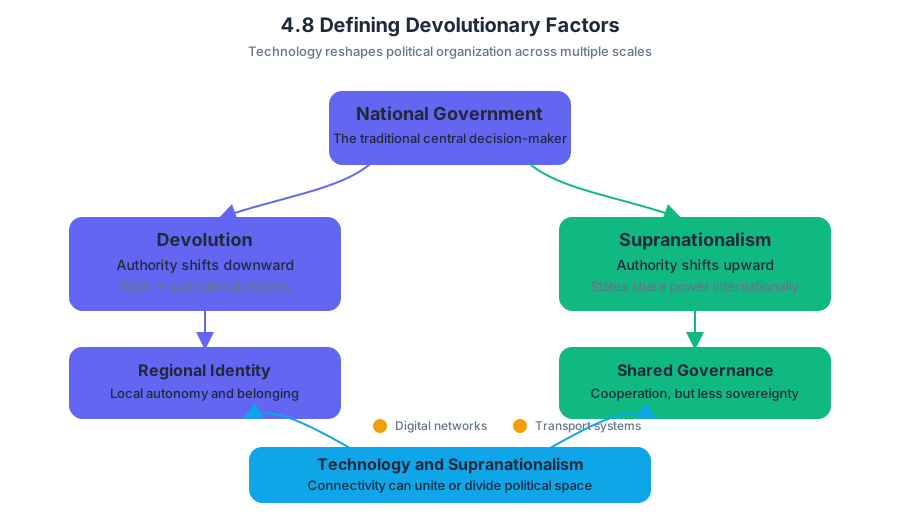
Modern communication and transportation technologies can produce two opposite political effects. Digital networks may strengthen a regional identity by allowing separatist movements to organize across distance, while the same technologies help governments monitor territory and coordinate national services.
Supranationalism is cooperation in which states transfer or share some authority with a larger international organization. States may join such organizations to address environmental problems, security threats, trade, or economic development, but shared decision-making can limit individual state sovereignty.
The scale contrast is essential: devolution shifts authority downward from the state to subnational regions, whereas supranationalism shifts or shares authority upward with international institutions. Both challenge the idea that the national government is the only important political decision-maker.
Misconception check
Misconception: “Devolution always means a country breaks apart.” Devolution may stop at regional autonomy, as with subnational units receiving expanded powers. State disintegration is a more extreme outcome in which the existing state loses territorial and political unity.
Retrieval check: A region has a distinct ethnic identity, poor transportation links to the capital, high unemployment, and lower infrastructure investment than the national average. Identify two devolutionary factors and explain how one could challenge state sovereignty.
Source Materials
- AP Human Geography Course and Exam Description
- AP Human Geography Course and Exam Description Clarifications and Corrections
- AP Human Geography Course Overview
- AP Human Geography Course at a Glance
- AP Human Geography Course at a Glance Poster
- AP Human Geography
- AP Human Geography
- AP Human Geography Sample Syllabus 1