From the free course AP Human Geography on Lykke
7.4 Women and Economic Development
Key concepts: Women’s roles change as countries develop economically · Women’s participation in the workforce · Gender inequality in wages · Inequality in employment opportunities · Microloans · Small local businesses created by women · Improved standards of living · Gender parity · Government initiatives at different scales · Using quantitative and geospatial data to draw conclusions
Economic development can expand women’s economic choices without automatically producing gender equality. As economies change, women often move into paid employment and entrepreneurship, yet wage gaps and unequal access to desirable jobs may persist.
7.4 Women and Economic Development
Economic development can expand women’s economic choices without automatically producing gender equality. As economies change, women often move into paid employment and entrepreneurship, yet wage gaps and unequal access to desirable jobs may persist.
SPS-7.D — Learning Objective: Explain how and to what extent changes in economic development have contributed to gender parity.
This topic belongs to SPS-7, the enduring understanding that industrialization has improved standards of living but has also produced geographically uneven development. Gender parity means a condition in which women and men have comparable access to rights, resources, opportunities, and decision-making power. Economic development can move societies toward parity, but the result is neither automatic nor evenly distributed.
Changing Roles as Economies Develop
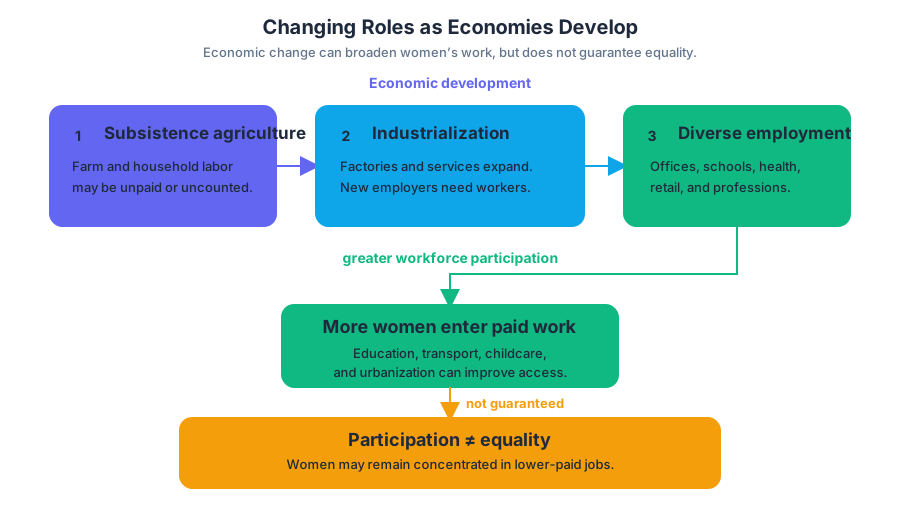
SPS-7.D.1 — The roles of women change as countries develop economically. In economies based heavily on subsistence agriculture, women may perform essential agricultural and household labor without receiving formal wages or being counted fully in employment statistics. As industrialization and service-sector growth expand, more women may enter factories, offices, schools, health systems, retail businesses, and professional occupations.
A useful pattern is:
$$ \text{economic development} \rightarrow \text{more diverse employment} \rightarrow \text{greater workforce participation} $$
But the next step is not guaranteed:
$$ \text{greater workforce participation} \not\Rightarrow \text{equal wages or equal opportunities} $$
For example, a country may experience economic growth as manufacturing and service industries expand. Women’s labor-force participation may rise because new employers need workers and because education, transportation, childcare, or urbanization make paid employment more accessible. However, women may still be concentrated in lower-paid occupations, excluded from senior management, or expected to perform unpaid domestic work in addition to paid employment.
Participation Is Not the Same as Equity
SPS-7.D.2 — Although there are more women in the workforce, they do not have equity in wages or employment opportunities. Workforce participation measures whether women work or seek work; it does not measure whether they receive the same pay, occupy the same types of jobs, or have equal chances for promotion.
| Indicator | What it measures | What it cannot prove by itself |
|---|---|---|
| Women’s labor-force participation | The share of women working or seeking work | Equal wages or leadership access |
| Gender wage gap | Difference in average earnings between women and men | The full causes of the difference |
| Share of women in management | Representation in higher-level positions | Equality in every occupation |
| Employment rate | The share of a population with jobs | Whether jobs are secure, fairly paid, or voluntary |
Named misconception — “More women working means gender parity has been achieved.” This is incorrect. A country can show rising female employment while women remain underpaid, concentrated in informal or insecure work, blocked from certain occupations, or responsible for disproportionate unpaid household labor.
Microloans and Women-Owned Businesses
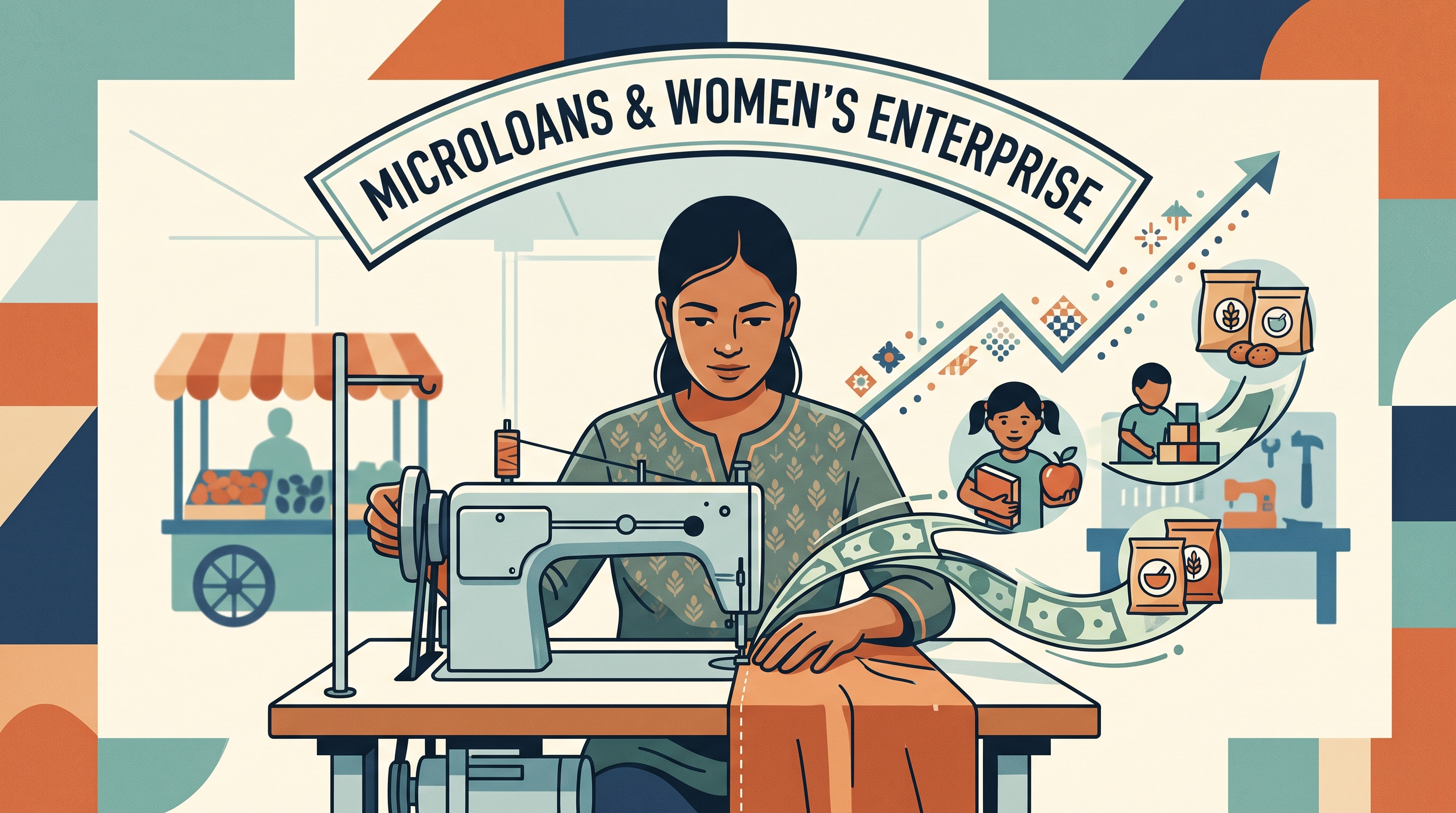
SPS-7.D.3 — Microloans have provided opportunities for women to create small local businesses, which have improved standards of living. A microloan is a small loan designed for people who may lack conventional collateral or access to commercial banking. For a woman in a low-income community, a microloan can provide start-up capital for a food stall, tailoring service, market garden, repair shop, or other small enterprise.
The development pathway is local and cumulative:
$$ \text{microloan} \rightarrow \text{business investment} \rightarrow \text{income} \rightarrow \text{household spending on food, health, or education} $$
Consider a woman who borrows a small amount to purchase sewing equipment. She sells clothing locally, repays the loan, and earns income that may improve household nutrition, school attendance, housing, or access to health care. The business can also create employment for relatives or neighbors, so its effect extends beyond the borrower.
Microloans are not a universal solution. Interest costs, unstable markets, limited infrastructure, household responsibilities, or discrimination can restrict their benefits. Their significance is that they may give women greater control over income and create an economic role outside unpaid household labor.
Government Action and Uneven Progress
Government initiatives at the local, regional, national, and international scales may affect women’s economic opportunities. Policies such as equal-pay rules, anti-discrimination protections, parental-leave provisions, childcare support, transportation investment, education programs, business credit, and legal recognition of property rights can reduce barriers to employment and entrepreneurship.
The geographic outcome depends on implementation. A national policy may exist on paper while rural communities lack banks, transportation, schools, or enforcement agencies. Therefore, development can produce uneven progress among urban and rural women, regions, income groups, and ethnic populations.
Data Analysis: Measuring the Pattern
The suggested skill is Data Analysis (3.D): Compare patterns and trends in maps and in quantitative and geospatial data to draw conclusions. A strong analysis compares at least two variables rather than treating one statistic as a complete explanation.
Suppose a map shows higher female workforce participation in a country’s industrialized coastal cities, while a second dataset shows that women in those cities still earn less than men on average. The conclusion should be precise: economic development has increased women’s participation in paid work, but it has contributed only partially to gender parity because wage inequality remains.
Retrieval check: If women’s workforce participation rises from $40%$ to $60%$, but women’s average wages remain below men’s and women remain underrepresented in management, has gender parity been achieved? Explain using SPS-7.D.1, SPS-7.D.2, and one piece of quantitative or geospatial evidence.
Source Materials
- AP Human Geography Course and Exam Description
- AP Human Geography Course and Exam Description Clarifications and Corrections
- AP Human Geography Course Overview
- AP Human Geography Course at a Glance
- AP Human Geography Course at a Glance Poster
- AP Human Geography
- AP Human Geography
- AP Human Geography Sample Syllabus 1
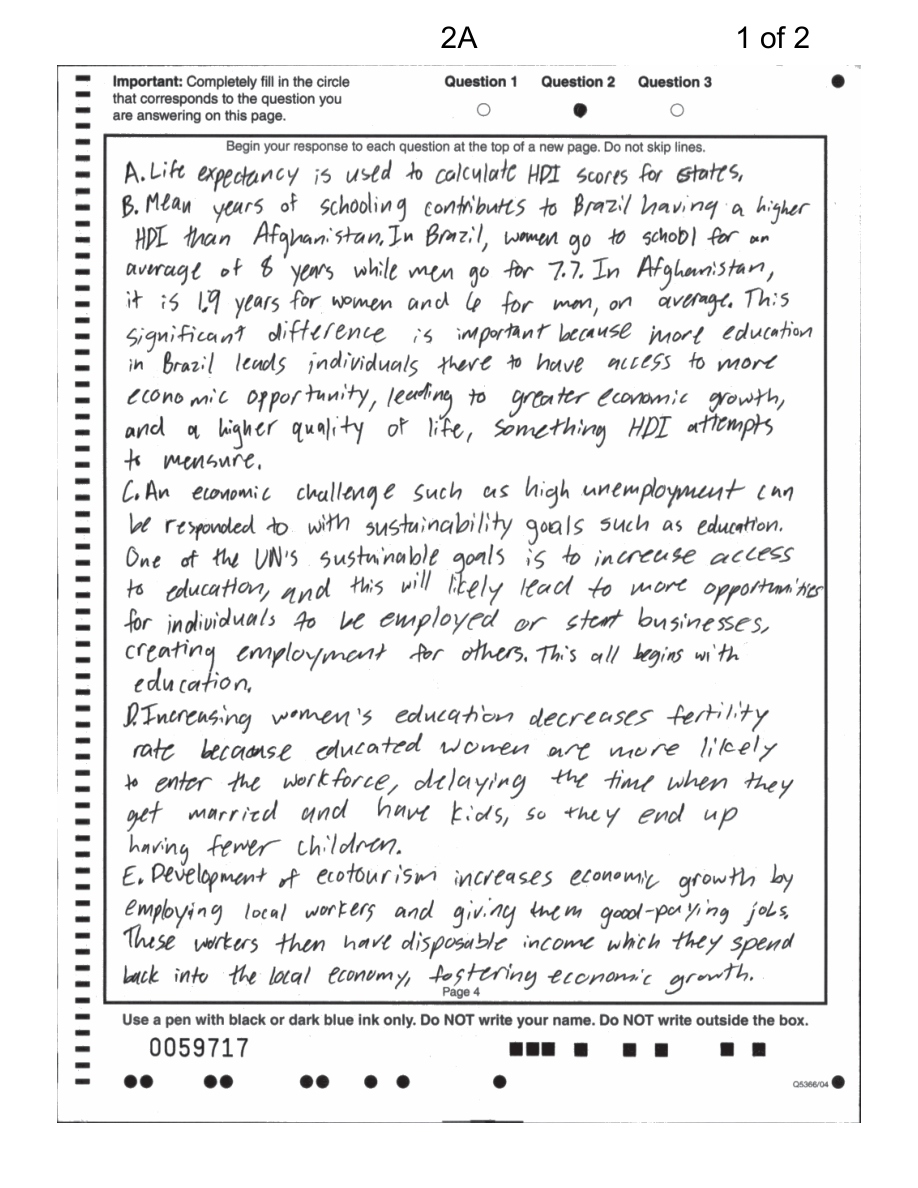
- Figure — Sample Responses Q2 - Set 2 (p. 6)
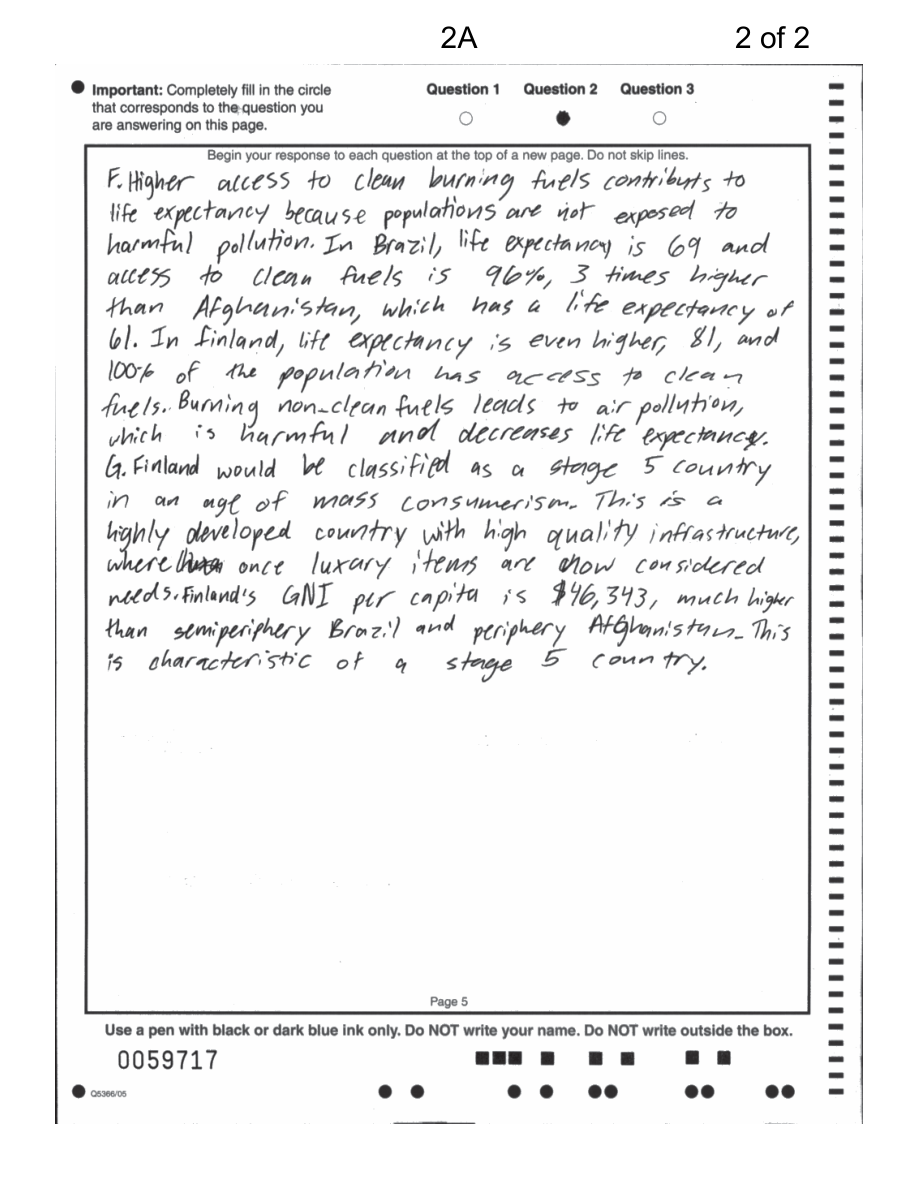
- Figure — Sample Responses Q2 - Set 2 (p. 7)
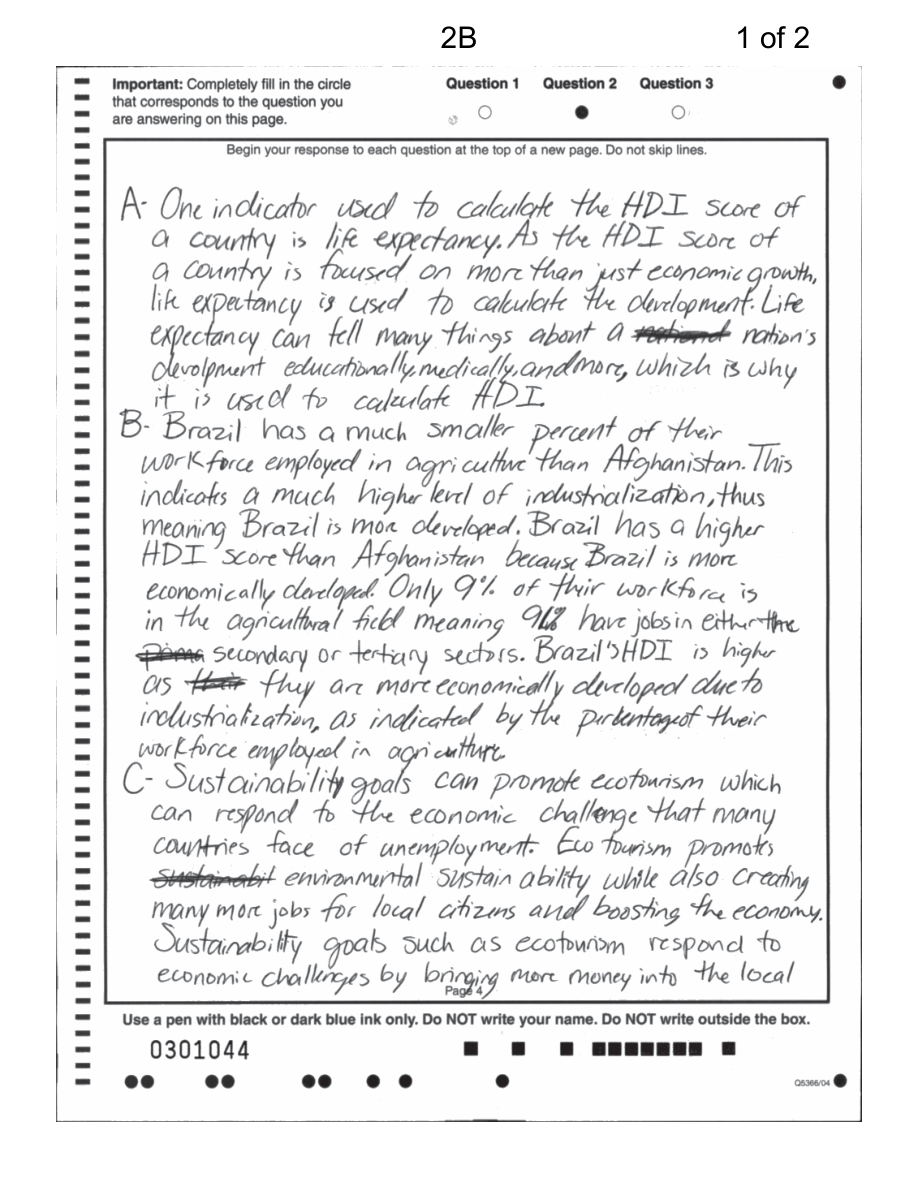
- Figure — Sample Responses Q2 - Set 2 (p. 8)
- Figure — Sample Responses Q2 - Set 2 (p. 9)