From the free course AP Human Geography on Lykke
1.1 Introduction to Maps
Key concepts: maps · spatial patterns · cow’s milk production · Africa · clustered or concentrated distributions · language as a cultural trait · comparing maps
A map turns “where?” into evidence. A list may tell you how much cow’s milk Africa produces, but only a map can reveal whether production is spread evenly, concentrated in a few regions, or clustered in neighboring countries.
1.1 Introduction to Maps
A map turns “where?” into evidence. A list may tell you how much cow’s milk Africa produces, but only a map can reveal whether production is spread evenly, concentrated in a few regions, or clustered in neighboring countries. In human geography, that spatial arrangement often matters as much as the total amount.
Learning Objective 1.A — Explain the geographical concepts of maps and spatial patterns.
Essential Knowledge 1.A.1 — Maps are representations of spatial information. A map is a visual representation of Earth’s surface, or part of it, designed to show the location, distribution, or relationship of geographic phenomena. The mapped phenomenon may be physical, such as elevation, or human, such as language, religion, population, or agricultural production.
A map does not merely show places; it shows a spatial relationship that can be interpreted.
Reading a spatial pattern
A spatial pattern is the way a geographic phenomenon is arranged across space. Three useful descriptions are:
- Clustered or concentrated: observations gather in particular areas rather than appearing randomly or evenly.
- Dispersed: observations are separated across space, with relatively large gaps between them.
- Uniform: observations are distributed at relatively regular intervals.
These descriptions are not interchangeable with production levels. A strong answer must identify where the values occur and, when relevant, what levels are found there. Saying that production is “clustered in certain areas” is incomplete because it does not identify the areas or explain whether those areas have low, medium, or high production.
Worked map comparison: cow’s milk and pork in Asia
Imagine two maps of Asia. Map 1 displays cow’s milk production; Map 2 displays pork production. To compare them, use the same geographic frame for both maps: identify where each product has high, medium, or low production, then state a clear similarity or difference.
A precise comparison would be: cow’s milk is produced at medium or high volumes across most Asian countries, whereas pork production is concentrated at high or medium volumes in East Asia and parts of Southeast Asia. Pork production is relatively low in South Asia and Southwest Asia. China is especially useful as a comparison point because it appears on both maps, allowing the two patterns to be evaluated in the same location.
The key reasoning is comparative rather than descriptive:
$$ \text{Map 1: broad distribution across Asia} \quad \neq \quad \text{Map 2: stronger East and Southeast Asian concentration} $$
A response that discusses only cow’s milk has not completed a comparison. A response that names both products but does not describe their locations has also missed the central geographic task.
Worked pattern description: cow’s milk in Africa
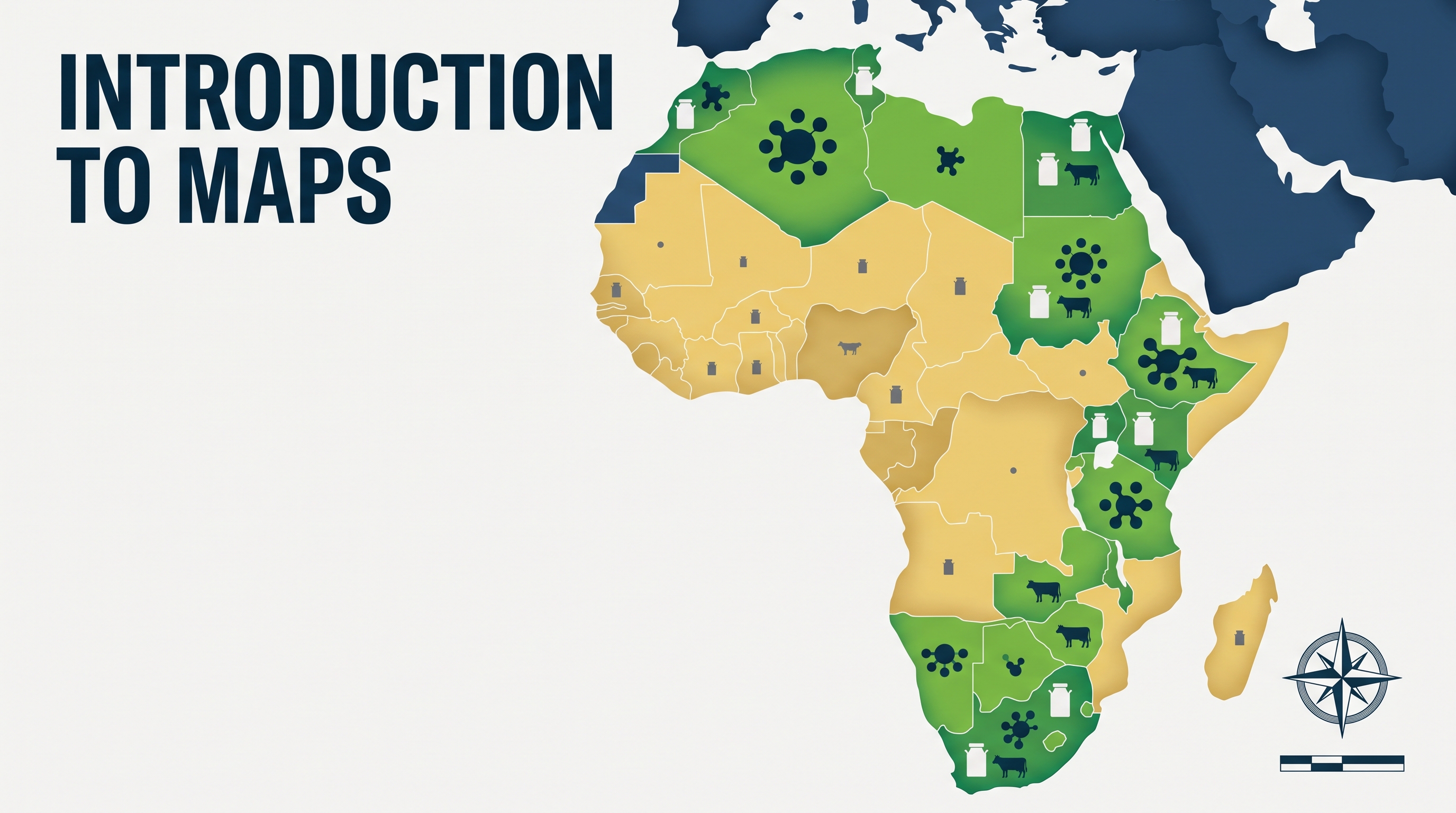
For Africa, the relevant pattern is a contrast between production levels and regions. Medium and/or high amounts of cow’s milk production are concentrated in northern, eastern, and/or southern Africa. Lower amounts are concentrated in western, central, and/or southwestern Africa.
A full description might read: “Cow’s milk production in Africa is clustered, with medium and high production concentrated in the north, east, and south, while low production is concentrated in the west, center, and southwest.” Notice the four required moves: identify the pattern, name the locations, identify the production levels, and distinguish the higher-production areas from the lower-production areas.
Maps show culture as well as commodities
Maps can represent culture traits, or identifiable elements of a group’s culture. Language is a culture trait, just as religion, food preferences, clothing, architecture, music, and land use can be. A language map may reveal a clustered distribution, a regional boundary, or a pattern shaped by migration and historical interaction.
This connection matters because human geography asks not only where things are, but why their locations and patterns differ. Cow’s milk, pork, and language are different kinds of phenomena, yet all can be analyzed through spatial distribution.
AP skills in action
This topic most directly develops the official AP skills Skill 1.A — Identify geographic concepts, processes, models, and theories, Skill 2.A — Describe spatial patterns, Skill 3.A — Identify the characteristics of spatial patterns shown on maps, and Skill 5.A — Describe spatial relationships across different scales. On a map-based prompt, these skills require careful observation before explanation: read the legend, locate the regions, compare categories, and use geographic language precisely.
Named misconception — “Clustered” means “high.” A clustered pattern can contain low, medium, or high values. “Clustered” describes arrangement; “high” describes magnitude. Another misconception is that a map comparison means describing two maps separately. Comparison requires a relationship—such as “whereas,” “in contrast,” or “both”—that connects the maps.
Retrieval check
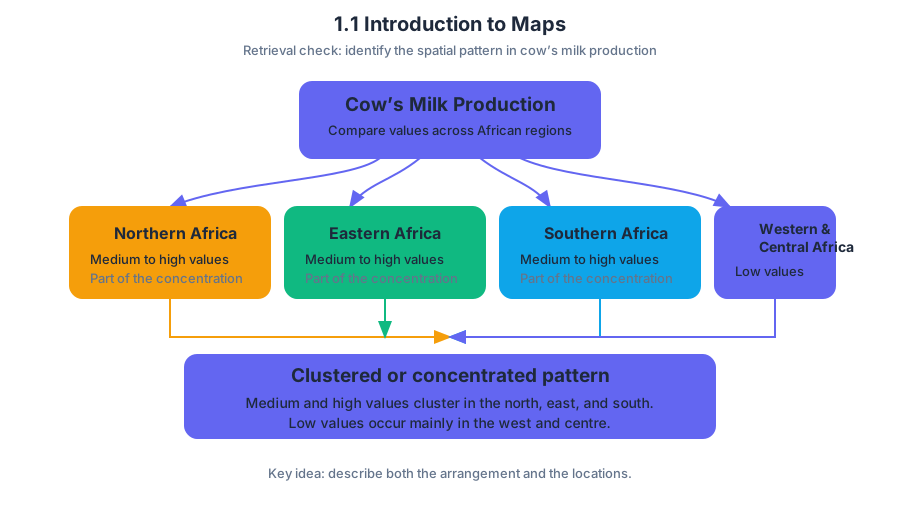
A map shows medium and high cow’s milk production in northern, eastern, and southern Africa, with low production in western and central Africa. What is the best description of the pattern?
Answer: Production is clustered or concentrated: medium and high values occur mainly in northern, eastern, and southern Africa, while low values occur mainly in western and central Africa. The answer earns precision by stating both the spatial arrangement and the locations of the different production levels.
Source Materials
- AP Human Geography Course and Exam Description
- AP Human Geography Course and Exam Description Clarifications and Corrections
- AP Human Geography Course Overview
- AP Human Geography Course at a Glance
- AP Human Geography Course at a Glance Poster
- AP Human Geography
- AP Human Geography
- AP Human Geography Sample Syllabus 1
- AP Human Geography-AP Students-College board
- AP Human Geography Units: Complete Breakdown
- AP Human Geography-National Council for Geographic Foundation
- Free AP Human Geography Resources for 2026-Knowt