From the free course AP Human Geography on Lykke
2.10 Causes of Migration
Key concepts: Seasonal migration · Transhumance · Pastoral nomadism · Resource availability · Grazing plants · Water access · Arid environments · Sahel region · Seasonal environmental conditions · Migration routes
In the Sahel, a herd cannot graze in one place indefinitely because rainfall, grazing plants, and water access shift across space and through the seasons.
2.10 Causes of Migration
In the Sahel, a herd cannot graze in one place indefinitely because rainfall, grazing plants, and water access shift across space and through the seasons. Migration is therefore often an environmental strategy: people move livestock toward temporarily available resources and away from areas that have become dry or depleted.
Learning Objective 2.10.A: Explain the causes and effects of migration.
Essential Knowledge 2.10.A.1: Push and pull factors influence migration.
Essential Knowledge 2.10.A.2: Environmental factors, including climate and natural disasters, can cause migration.
Seasonal movement in an arid environment
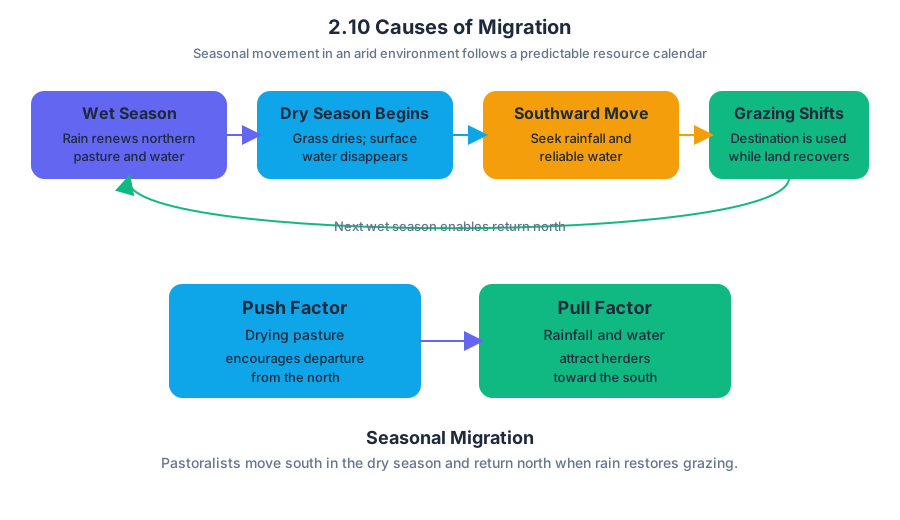
Seasonal migration is movement that occurs at a particular time of year in response to predictable conditions. In the Sahel, pastoralists may move south during the dry season, where rainfall and vegetation may be more available, and then return north during the wet season as rain renews grazing resources.
The pattern is not random. It follows a resource calendar:
- Wet season: Rainfall supports new vegetation and replenishes water sources farther north.
- Dry season begins: Grass dries, surface water disappears, and herders move toward areas with greater rainfall or more reliable water.
- Grazing pressure shifts: Livestock use plants in the destination area while the previous grazing area recovers.
- Next wet season: Renewed rainfall makes return movement possible.
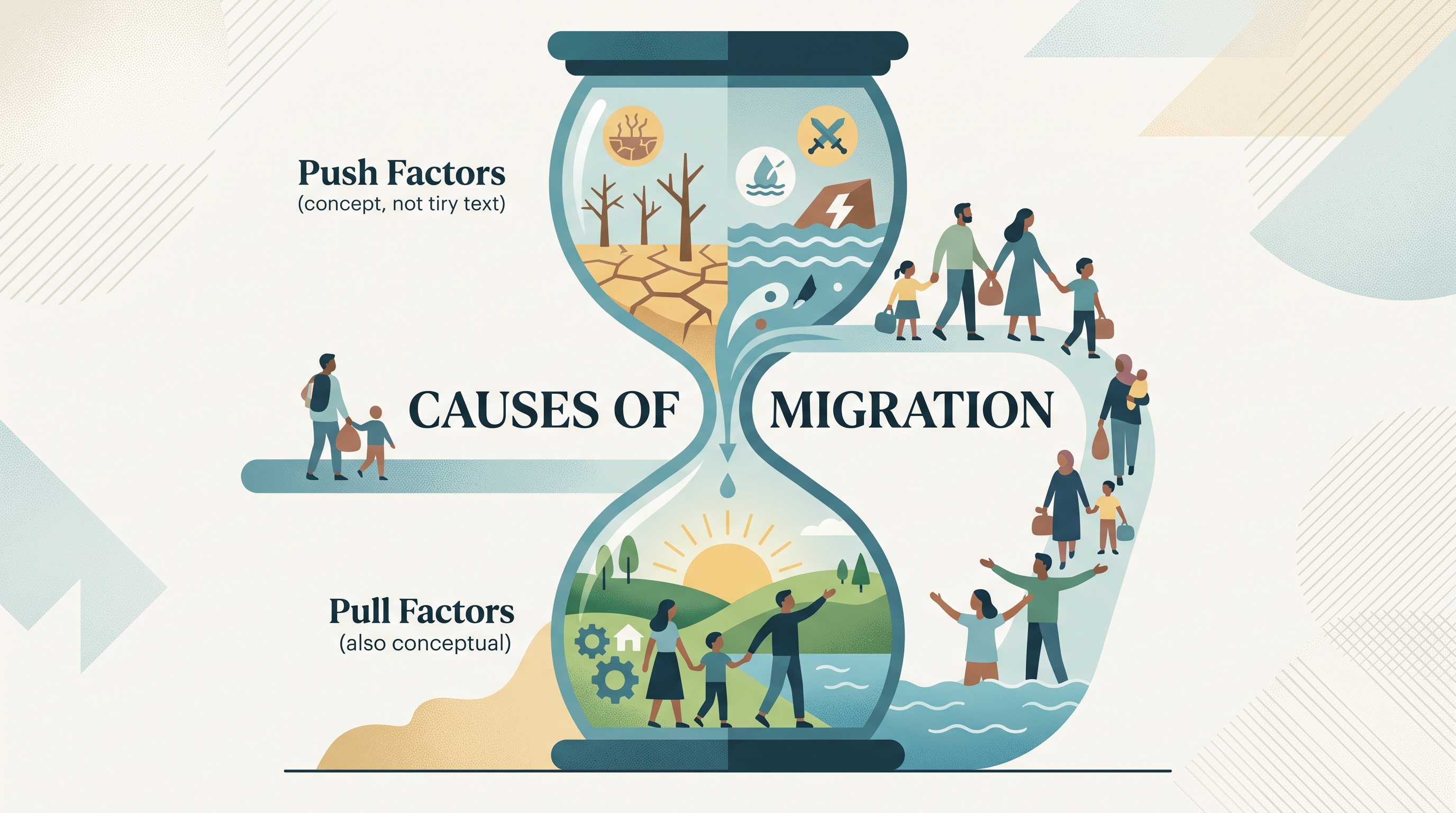
This is a geographic example of a push factor—a condition encouraging departure, such as drying pasture—and a pull factor—a condition attracting movement, such as fresh grazing plants or accessible water. The same location can change from a pull factor during the wet season to a push factor during the dry season.
Transhumance and pastoral nomadism
Pastoralists are people whose livelihoods depend substantially on raising livestock. Transhumance is the specific, recurring seasonal movement of livestock and pastoralists between established grazing areas, often between wet-season and dry-season pastures.
Pastoral nomadism is a livelihood based on moving herds between temporary grazing and watering areas, often by following seasonal resource availability. The distinction matters: transhumance emphasizes a predictable cyclical route between known areas, while pastoral nomadism is a broader mobile way of life in which movement may be more flexible as resource conditions change.
| Term | What it emphasizes | Sahel example |
|---|---|---|
| Pastoralist | Livelihood based on livestock | A herder raising cattle, goats, sheep, or camels |
| Transhumance | Regular seasonal movement | Moving south in the dry season and north in the wet season |
| Pastoral nomadism | Mobile livestock-based livelihood | Moving herds among temporary pasture and watering sites |
The movement protects the herd and manages land. If livestock remain in one area year-round, they may remove too much grass cover, compact soil, and exhaust water sources. Moving allows previously used grazing resources to recover or be renewed before animals return.
Worked example: explaining a migration map
Suppose a map shows herders moving south during the dry season and north during the wet season. A complete explanation would connect direction, season, and resources:
During the dry season, pastoralists move south toward areas with greater rainfall and more available grazing plants and water. During the wet season, they move north as rainfall renews vegetation and water sources there. This seasonal movement also prevents year-round grazing from exhausting one location.
Notice what makes the explanation geographic: it does not merely say “people move because of climate.” It identifies the physical environmental condition—seasonally distributed rainfall—and links it to the spatial distribution of vegetation, water, livestock grazing, and human movement.
Resource access and changing routes
Migration routes depend on access, not only on climate. A newly restricted protected area, for example, may close a traditional passage to a watering site or grazing plants. That restriction reduces the resources available along the old route, so herders may be forced to reroute, shorten the movement cycle, or stop moving through the area altogether.
This can create pressure elsewhere: livestock concentrated on fewer accessible pastures may increase competition for grazing plants and water and may contribute to overgrazing. Thus, a change in land management can alter a migration pattern by changing the resource geography on which that pattern depends.
Misconception check
Misconception: “All migration is permanent relocation.” Seasonal movement in the Sahel is often temporary and repeated. The purpose is not necessarily to abandon one place, but to follow changing resources and maintain access to pasture and water over an annual cycle.
AP skill connection — Skill Category 2: Spatial Relationships, especially 2.A Describe spatial patterns and 2.B Explain spatial relationships: A strong response describes the direction and season of movement, then explains the relationship between rainfall, vegetation, water access, and grazing. It also applies Skill Category 1: Concepts and Processes by using terms such as transhumance, pastoral nomadism, push factors, and pull factors precisely.
Retrieval check
A map shows livestock moving north after several months of rainfall. What resource-based explanation best fits the pattern? Answer in one sentence using seasonal migration, grazing plants, and water access.
Source Materials
- AP Human Geography Course and Exam Description
- AP Human Geography Course and Exam Description Clarifications and Corrections
- AP Human Geography Course Overview
- AP Human Geography Course at a Glance
- AP Human Geography Course at a Glance Poster
- AP Human Geography
- AP Human Geography
- AP Human Geography Sample Syllabus 1