From the free course AP Human Geography on Lykke
5.5 The Green Revolution
Key concepts: Green Revolution · Cultural diffusion · Agricultural technology · Comparative advantage · Carrying capacity · Food supply and food security · Malthusian theory · Agricultural specialization and monocropping
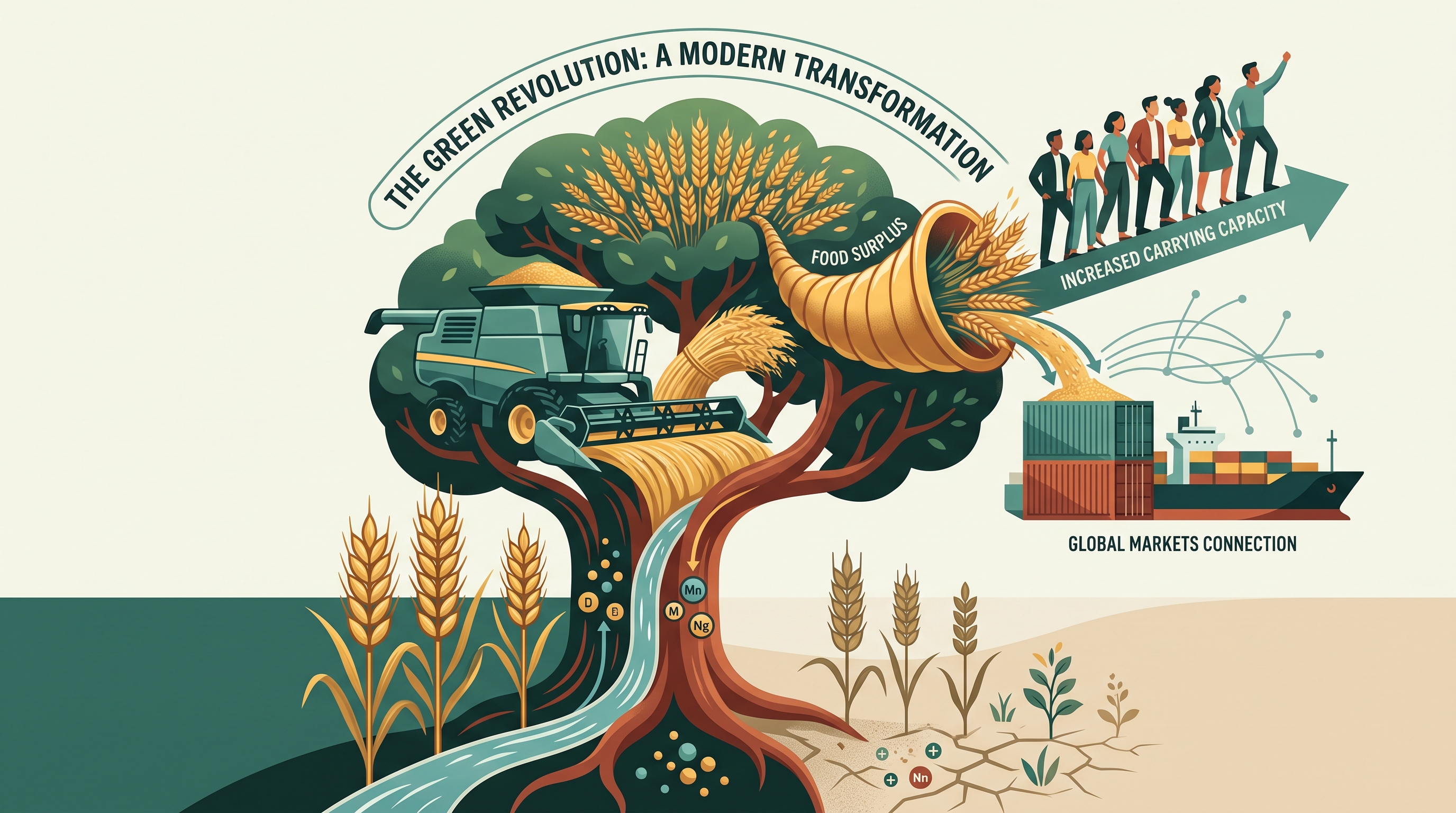
The Green Revolution transformed agriculture by combining new biological, chemical, water-management, and mechanical technologies to raise crop productivity. Its central geographic question is not simply “Did food production increase?” but rather: How did higher productivity change population support, trade, rural…
5.5 The Green Revolution
The Green Revolution transformed agriculture by combining new biological, chemical, water-management, and mechanical technologies to raise crop productivity. Its central geographic question is not simply “Did food production increase?” but rather: How did higher productivity change population support, trade, rural communities, and environmental sustainability?
CED alignment: Learning Objective 5.5.A — Explain the consequences of the Green Revolution. This topic draws especially on Essential Knowledge 5.5.A.1, the use of high-yield seeds and agricultural inputs; Essential Knowledge 5.5.A.2, increased agricultural productivity and food supplies in developing countries; and Essential Knowledge 5.5.A.3, the economic, social, and environmental consequences of intensive agricultural production.
A technology package, not one invention
The Green Revolution spread through cultural diffusion, meaning the movement of an idea, practice, or technology from one place to another. Governments, scientists, agricultural institutions, and farmers adapted technologies developed in one region to local farming systems in developing countries.
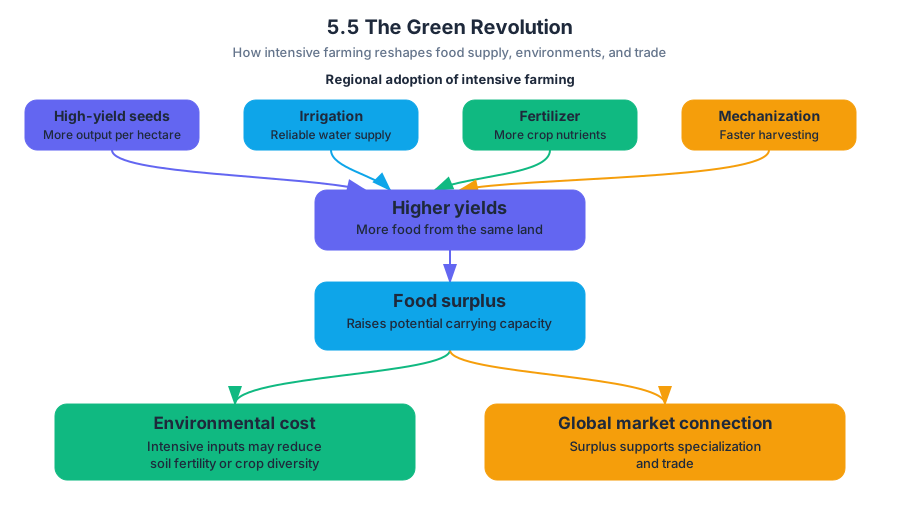
Its technologies commonly include:
- High-yield seeds, bred to produce more grain under favorable conditions
- Irrigation, which supplies water when rainfall is insufficient or unreliable
- Fertilizers, which add nutrients such as nitrogen, phosphorus, and potassium
- Pesticides and herbicides, which reduce crop losses from insects, weeds, and disease
- Mechanization, using machines for planting, harvesting, processing, and transportation
These technologies work as a package. A high-yield seed may produce little additional food without adequate water and nutrients; irrigation may be less effective if farmers lack fertilizer, machinery, or access to markets. The result was a major increase in food supplies in many developing countries.
Carrying capacity and food security
Carrying capacity is the largest population that a particular environment can support indefinitely with available resources and technology. Agricultural technology can increase the carrying capacity of land by raising productivity: if the same area produces a larger and more reliable food surplus, it can support more people.
Food security means reliable physical and economic access to sufficient, safe, nutritious food. The Green Revolution generally increased the potential supply of food, but higher production did not automatically guarantee equal access. Poverty, conflict, unequal landownership, transportation problems, and market prices can leave people food insecure even when a country produces substantial food.
Worked example: from technology to carrying capacity
Suppose a farming region previously harvested $2$ metric tons of grain per hectare and could support $10{,}000$ residents through local production. Improved seeds, irrigation, and fertilizer raise productivity to $4$ metric tons per hectare. If population demand remains similar per person, the region now has approximately twice as much food-producing capacity.
The geographic chain of reasoning is:
- Agricultural technology raises yield per hectare.
- Total food production increases.
- A larger surplus becomes available for consumption, storage, or trade.
- The land can support a larger population, so its carrying capacity increases.
- The surplus may also connect the region to national or global markets.
Misconception check — “Carrying capacity is a permanent physical limit.” Carrying capacity is not fixed solely by soil and climate. Technology, infrastructure, management practices, and resource availability can raise or lower it; however, a technological increase may be temporary if it damages the soil or depletes water supplies.
Comparative advantage and agricultural trade
Comparative advantage is the ability of an individual, business, or country to produce a good or service more efficiently or at a lower opportunity cost than another producer. Opportunity cost is what must be given up to produce one additional unit of something else.
A country does not need to be the best at producing every product to benefit from trade. Countries may specialize in products they can produce most efficiently, then trade for other goods. Green Revolution technologies can create larger surpluses, allowing a country to export crops or redirect land and labor toward other products.
For example, if Country X can produce meat, dairy, and seafood relatively efficiently while Country Y produces grains, fruits, and vegetables at a lower opportunity cost, both countries may specialize and exchange products. Export data can reveal interdependence, but exports between only two countries do not by themselves measure a country’s entire level of economic development.
Costs of intensive production
The same practices that increase yields can create long-term problems. Monocropping, the cultivation of one crop over a large area, can reduce crop diversity and make farms more vulnerable to pests, disease, and market price changes. Heavy fertilizer and pesticide use can degrade soil and contaminate water, while irrigation can contribute to salinization or groundwater depletion.
Mechanization and economies of scale can also contribute to a decline in small farms. Large commercial farms may afford machinery, improved seeds, irrigation systems, and chemical inputs more easily than smallholders. As production becomes more specialized, the types of food produced may shift from diverse local crops toward export crops or a narrower set of high-yield commodities.
Key tension: The Green Revolution can increase short-term food supply and carrying capacity while reducing soil fertility, crop diversity, and long-term sustainability if inputs are poorly managed.
AP skills in action
This topic most directly develops Skill Category 1: Concepts and Processes, especially 1.A Identify geographic concepts, 1.B Describe geographic concepts, and 1.C Explain geographic concepts. A strong response defines carrying capacity or comparative advantage accurately and then connects the definition to a specific agricultural process.
It also develops Skill Category 2: Spatial Relationships, especially 2.A Describe spatial patterns, 2.B Explain spatial patterns, and 2.C Explain spatial relationships; Skill Category 3: Data Analysis, especially 3.A Identify types of data, 3.B Describe spatial patterns, and 3.C Explain patterns and trends; and Skill Category 5: Scale Analysis, especially 5.A Identify scales of analysis and 5.B Explain scales of analysis. For example, a response might connect a farm-level technology to national food supplies and then to global trade.
Retrieval check
A region adopts high-yield seeds, irrigation, fertilizer, and mechanized harvesting. State one effect on carrying capacity, one possible environmental cost, and one reason the region might become more connected to global markets. The strongest answer uses a causal chain: higher yields increase food surplus and potential carrying capacity; intensive inputs may reduce soil fertility or crop diversity; and surplus production can support specialization and trade.
Source Materials
- AP Human Geography Course and Exam Description
- AP Human Geography Course and Exam Description Clarifications and Corrections
- AP Human Geography Course Overview
- AP Human Geography Course at a Glance
- AP Human Geography Course at a Glance Poster
- AP Human Geography
- AP Human Geography
- AP Human Geography Sample Syllabus 1
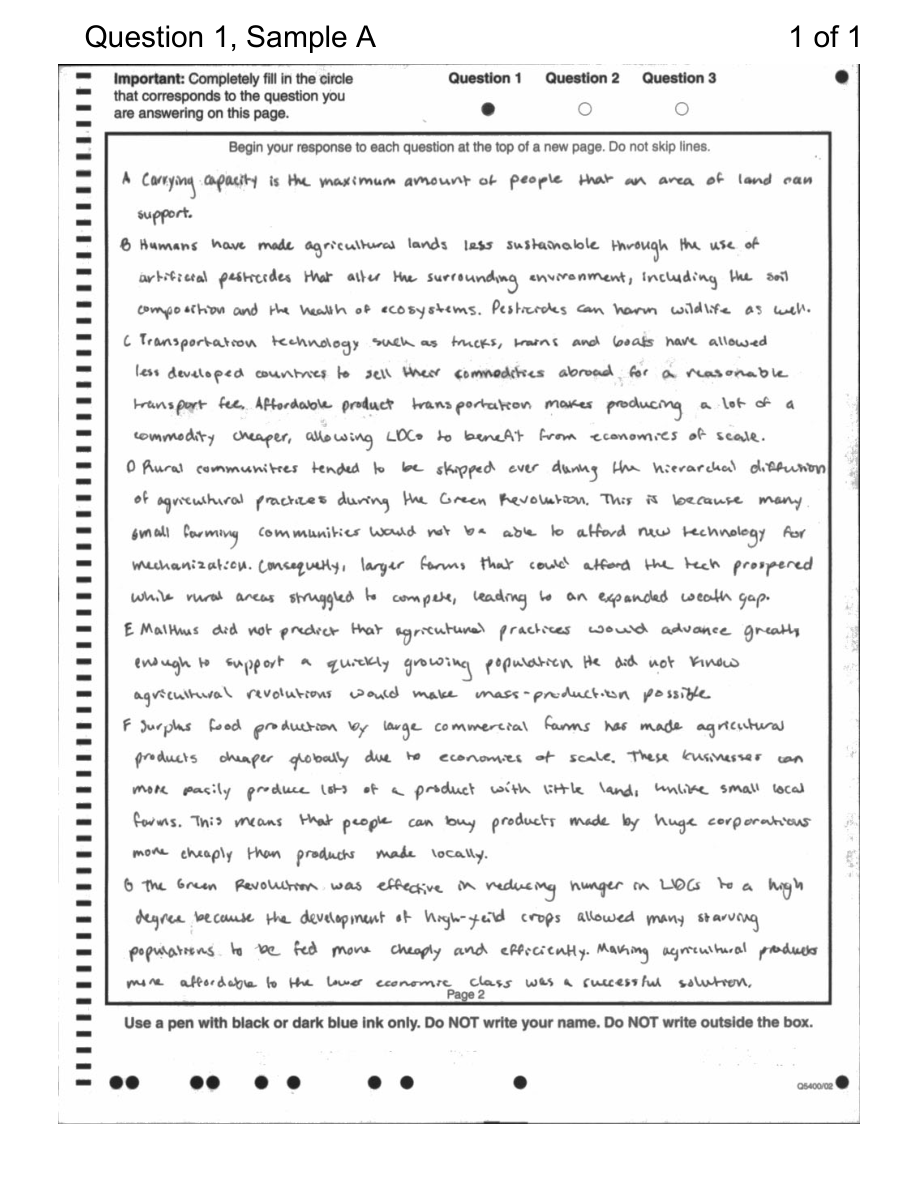
- Figure — Sample Responses Q1 - Set 1 (p. 6)
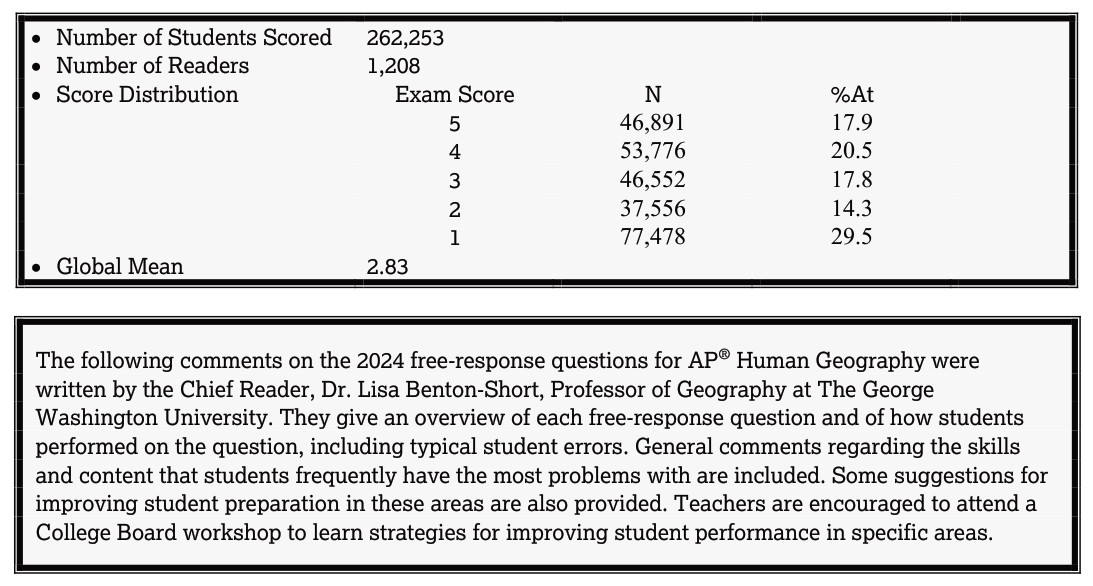
- Figure — Chief Reader Report – Set 1 (p. 1)
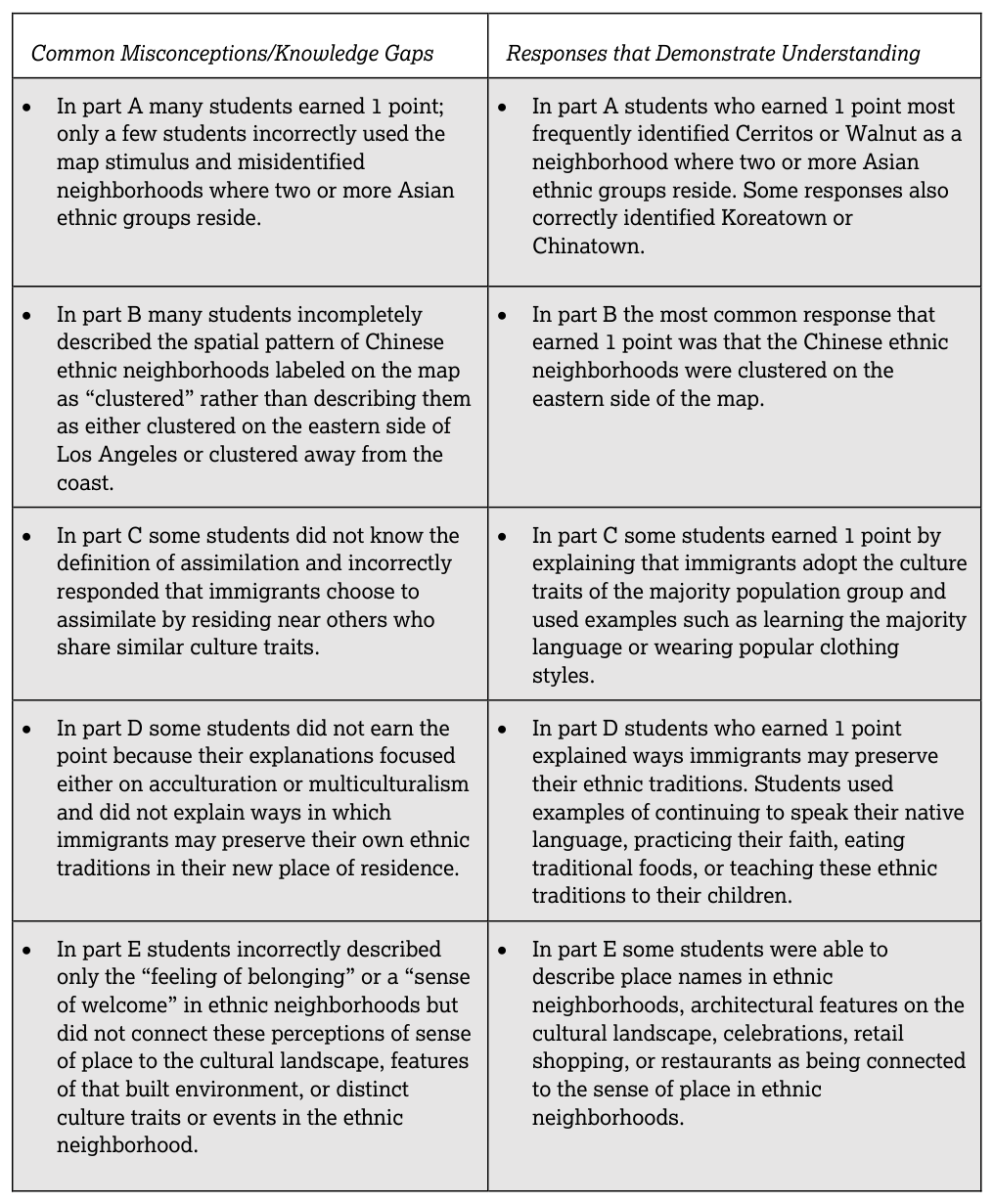
- Figure — Chief Reader Report – Set 1 (p. 10)
- Figure — Chief Reader Report – Set 1 (p. 13)