From the free course AP Human Geography on Lykke
2.12 Effects of Migration
Key concepts: In-migration · Out-migration · Labor force · Entrepreneurship · Economic development · Employment and wages · Tax revenues · City infrastructure · Quality of life · Social development
A city can gain workers, businesses, and tax revenue when people move in—but it can also face housing and infrastructure pressure. When people move out, the same city may lose employees, customers, investment, and public revenue.
2.12 Effects of Migration
A city can gain workers, businesses, and tax revenue when people move in—but it can also face housing and infrastructure pressure. When people move out, the same city may lose employees, customers, investment, and public revenue. The effects of migration are therefore measured through changes in employment, wages, businesses, unemployment, tax revenues, infrastructure, and quality of life.
CED alignment: Learning Objective 2.12.A: Explain the effects of migration. Essential Knowledge identifiers: 2.12.A.1 and 2.12.A.2.
In-migration and the urban economy
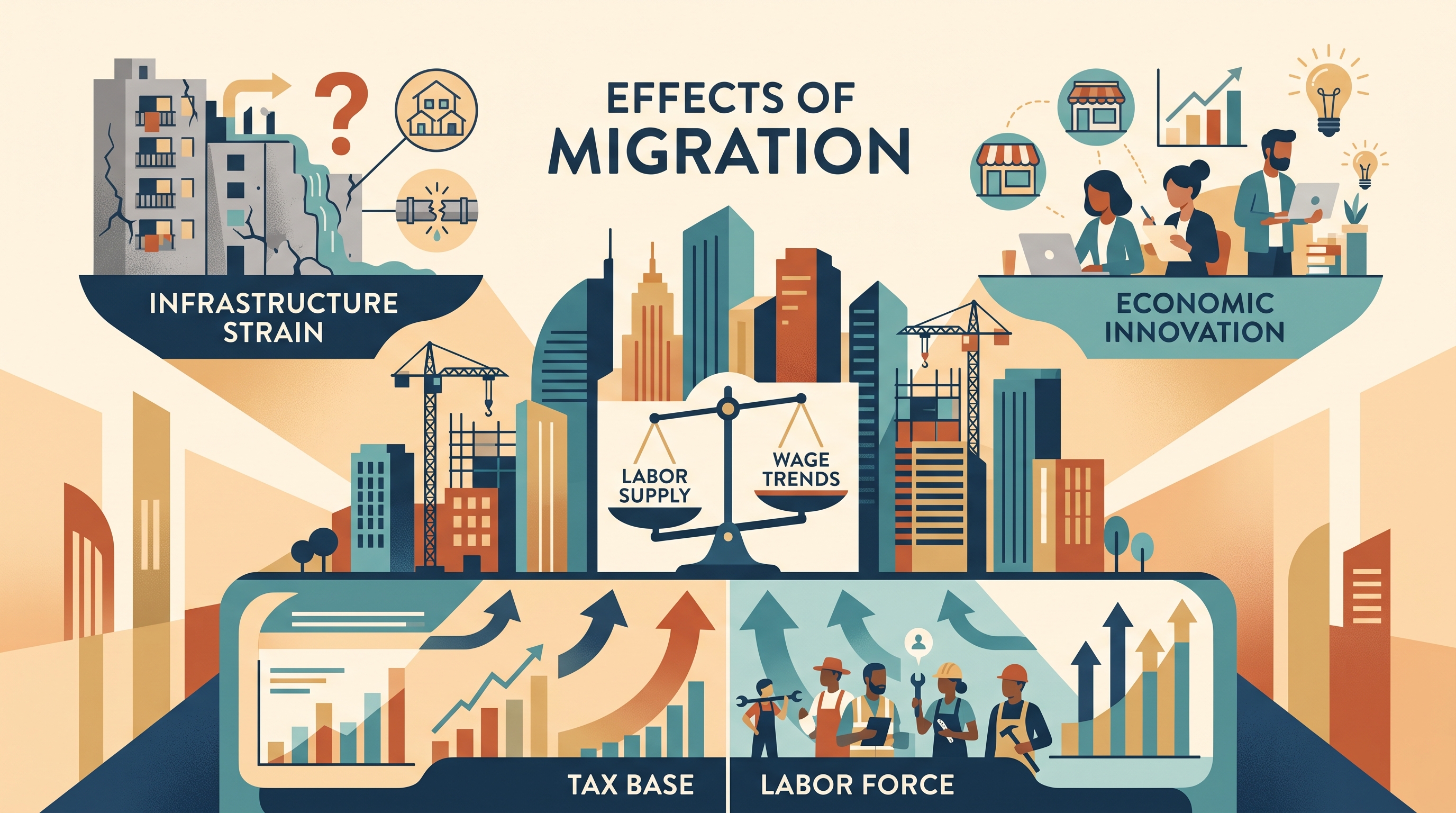
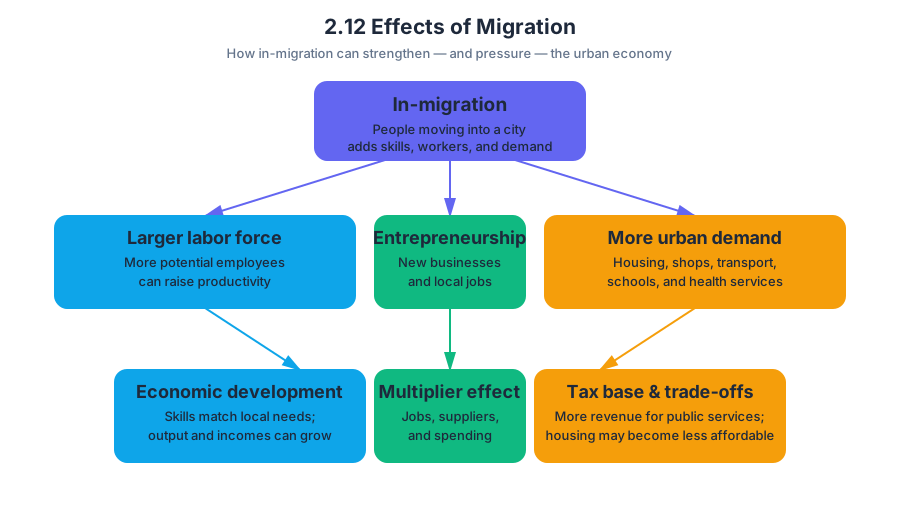
In-migration is movement into a place. Migrants can enlarge a city’s labor force, meaning the people available to work, and can increase economic productivity when their skills match local needs. A growing workforce can support economic development because businesses have more potential employees, while the larger population creates demand for shops, housing, transportation, education, and health services.
Migration can also produce entrepreneurship, the creation or expansion of businesses. A migrant who opens a restaurant, repairs homes, or develops a technology company does more than earn personal income: the business may employ other residents, purchase supplies, attract customers, and generate additional local spending. This chain of related economic activity is a multiplier effect.
A larger population may expand a city’s tax base, the people and property from which government collects revenue. New residents may contribute sales, income, and property taxes, helping fund transportation, schools, sanitation, health care, and other public programs. Migration may also increase demand for residential and commercial property, raising real-estate values—but higher demand can make housing less affordable if construction and infrastructure do not keep pace.
Employment and wages
Migration does not produce one universal wage outcome. In-migration increases the supply of workers, so wages may grow more slowly—or temporarily fall—in occupations where many qualified workers compete for the same jobs. However, if migrants fill severe labor shortages, businesses may expand, remain open, or become more productive; strong demand for scarce skills can raise wages in those occupations.
Out-migration can have the reverse effects. When workers leave, labor shortages may push wages upward for workers who remain in some sectors. Yet out-migration can also weaken the wider economy: businesses may close, customers disappear, investment declines, and unemployment may rise when people lose manufacturing jobs or cannot find similarly paid work in another sector. Higher unemployment can reduce tax revenues and further limit public services.
Out-migration and financial health
Out-migration is movement away from a place. A city experiencing out-migration may lose part of its labor force, customer base, tax base, and local investment. Fewer workers can reduce production; fewer residents can reduce sales and property-tax collections; and vacant homes or commercial buildings can lower property values. These interconnected losses are sometimes described as backwash effects.
Both in-migration and out-migration can create public-spending challenges. In-migration may require governments to expand housing, schools, transportation, utilities, and health care. Out-migration may leave governments with fewer taxpayers while they still must maintain roads, water systems, schools, and other infrastructure designed for a larger population.
Infrastructure and quality of life
High-quality infrastructure—including public utilities, transportation, housing, schools, commercial buildings, and health care—can improve residents’ quality of life. Reliable water, sewage, electricity, and medical services support public health and sanitation, while transportation and communications connect people to jobs, education, goods, and services.
Insufficient infrastructure can create housing shortages, inadequate public utilities, pollution, and poor sanitation. These conditions may inhibit social development because residents have less reliable access to health care, education, employment, and safe living conditions.
Worked example: tracing the effects
Suppose a manufacturing city loses factories and many residents leave to search for similarly paid employment. The immediate change is out-migration: the labor force and consumer population shrink. Businesses lose customers, property values may weaken, unemployment may increase among workers who remain, and reduced sales, income, and property taxes can limit funding for infrastructure. The result is a reinforcing cycle of economic decline rather than a single isolated effect.
Named misconception — “More migrants always help or always hurt.” The outcome depends on conditions. Migrants may strengthen a city when they fill labor shortages, start businesses, and expand the tax base; the same city may experience strain when housing, utilities, schools, and health services cannot accommodate rapid population growth. Strong answers explain the mechanism, not merely label migration as positive or negative.
AP skills in action
This topic most directly uses Skill 1.B: Describe geographic concepts, processes, and models, by accurately distinguishing in-migration, out-migration, labor force, and tax base; Skill 2.B: Explain spatial relationships, by connecting migration to employment, businesses, infrastructure, and city finances; and Skill 3.C: Explain patterns and trends in geographical data, when interpreting changes in population, unemployment, wages, or tax revenue. At different scales, Skill 5.B: Describe the scale of analysis, helps distinguish effects on a household, city, region, or national economy.
Retrieval check
A city receives many new workers, but its housing supply and sewage system do not expand. Identify one likely economic benefit, one likely infrastructure problem, and one possible wage effect. A strong response might state: the labor force and tax base may grow; housing shortages and poor sanitation may result; and wages may moderate in occupations with abundant workers but rise where migrants fill labor shortages.
Source Materials
- AP Human Geography Course and Exam Description
- AP Human Geography Course and Exam Description Clarifications and Corrections
- AP Human Geography Course Overview
- AP Human Geography Course at a Glance
- AP Human Geography Course at a Glance Poster
- AP Human Geography
- AP Human Geography
- AP Human Geography Sample Syllabus 1