From the free course AP Human Geography on Lykke
5.3 Agricultural Origins and Diffusions
Key concepts: Agricultural origins and diffusions · Agriculture and rural land-use patterns and processes · Interdependence among agricultural production regions · Comparative advantage · Trade relationships · Global food distribution networks · Types of diffusion · Source analysis
A crop’s birthplace and its modern center of production are often thousands of kilometers apart. Maize originated in Mesoamerica, yet it is now grown extensively across the United States, China, Brazil, and many other regions because domesticated species spread through cultural diffusion—the movement of ideas,…
5.3 Agricultural Origins and Diffusions
A crop’s birthplace and its modern center of production are often thousands of kilometers apart. Maize originated in Mesoamerica, yet it is now grown extensively across the United States, China, Brazil, and many other regions because domesticated species spread through cultural diffusion—the movement of ideas, practices, plants, animals, and technologies from one place to another.
SPS-5: Agriculture has changed over time because of cultural diffusion and advances in technology.
Major centers of domestication
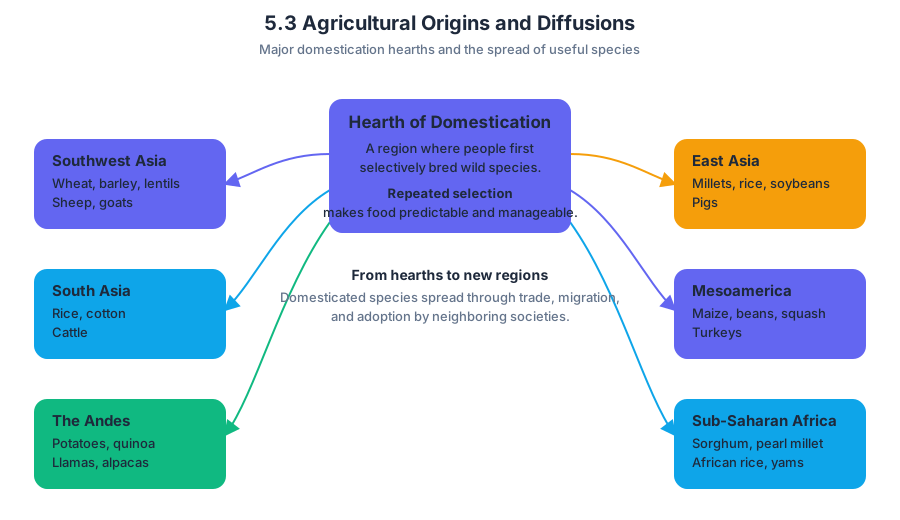
A hearth of domestication is a major region where humans first selectively bred wild plants or animals for useful traits. Domestication is not simply “finding” a plant; it is a long process in which repeated human selection changes a species so that it becomes more productive, predictable, or manageable.
| Major domestication hearth | Representative domesticated plants or animals |
|---|---|
| Southwest Asia | Wheat, barley, lentils, sheep, goats |
| East Asia | Millets, rice, soybeans, pigs |
| South Asia | Rice, cotton, cattle |
| Mesoamerica | Maize, beans, squash, turkeys |
| The Andes | Potatoes, quinoa, llamas, alpacas |
| Sub-Saharan Africa | Sorghum, pearl millet, African rice, yams |
These hearths developed where environmental conditions and human experimentation made domestication possible. Once domesticated, species could be carried into new regions, exchanged through trade, or adopted by neighboring societies. The original hearth therefore remained historically important even when another region later became the dominant producer.
From hearth to global crop
The SPS-5.A learning objective requires identifying major centers of domestication, while SPS-5.B requires explaining how plants and animals diffused globally. Two diffusion processes are especially important:
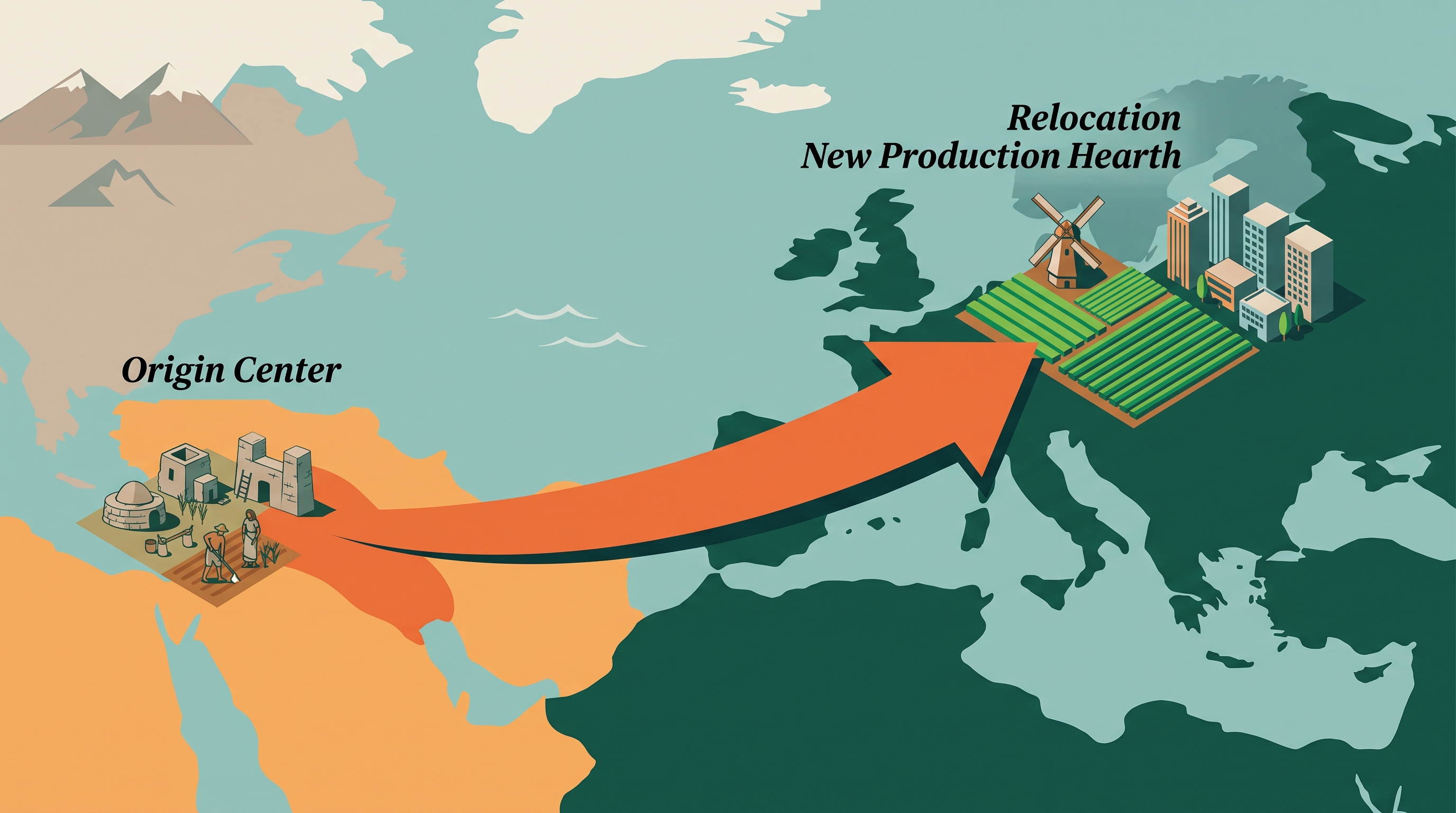
- Relocation diffusion occurs when people physically carry a crop, animal, or agricultural practice to a new location. Migrants, traders, soldiers, and colonists can all transport domesticated species.
- Expansion diffusion occurs when an agricultural practice or species spreads outward from its source while remaining strong in the source region. Neighboring farmers may adopt a crop through interaction, observation, or economic pressure.
For example, pigs domesticated in East Asia did not remain confined to that hearth. Their movement with migrating and trading populations demonstrates relocation diffusion; their subsequent adoption by nearby communities can produce expansion diffusion. When interpreting a map, do not merely say that pigs “spread.” Identify the source hearth, describe the spatial pattern, and connect the pattern to a diffusion process.
Exam-ready chain: hearth of domestication → movement or adoption → new production region → visible spatial pattern.
Why agricultural regions become interdependent
Interdependence means that places rely on one another because no region efficiently produces everything it needs. Agricultural interdependence develops when regions differ in climate, soils, water availability, labor costs, technology, land, capital, or consumer demand.
A region has a comparative advantage when it can produce a particular good at a lower opportunity cost than another region. Comparative advantage does not mean that a place is absolutely best at producing everything; it means that specializing in certain goods and trading for others can benefit both regions.
Worked example: Suppose Region A has a cool, wet climate suited to wheat, while Region B has a warm climate suited to coffee. Region A specializes in wheat and exports its surplus to Region B. Region B specializes in coffee and exports coffee to Region A. Even if both regions grow small amounts of both crops, climate-based specialization makes them mutually dependent on trade.
Trade relationships connect agricultural production regions to consumers, processors, ports, financial institutions, and one another. A crop may be grown in one country, processed in a second, packaged in a third, and sold in a fourth. This creates a global food distribution network: a linked system of farms, transportation routes, storage facilities, markets, and consumers.
The network increases interdependence because a disruption in one location can affect distant places. A drought can reduce exports, a port closure can delay shipments, and a rise in fertilizer prices can increase food costs far from the farm. At the same time, global networks can improve food access by allowing regions to obtain products that local environments cannot support year-round.
Source analysis: reading agricultural maps
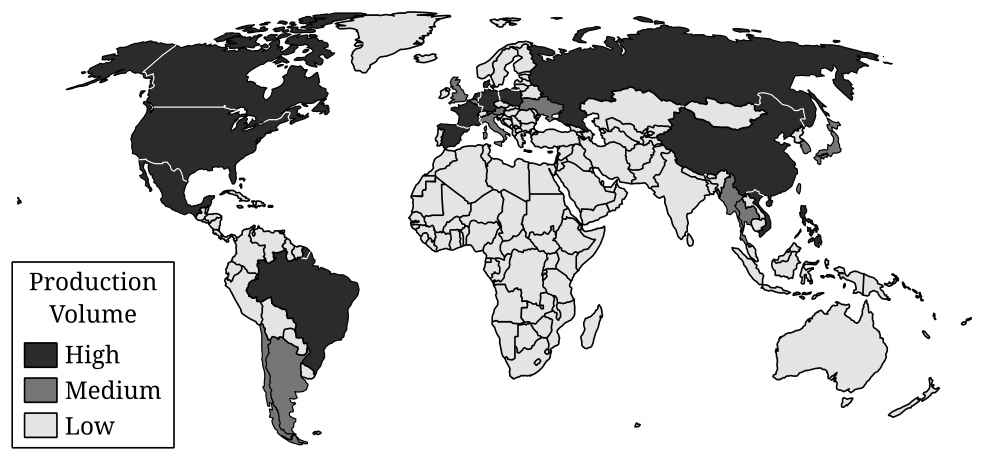
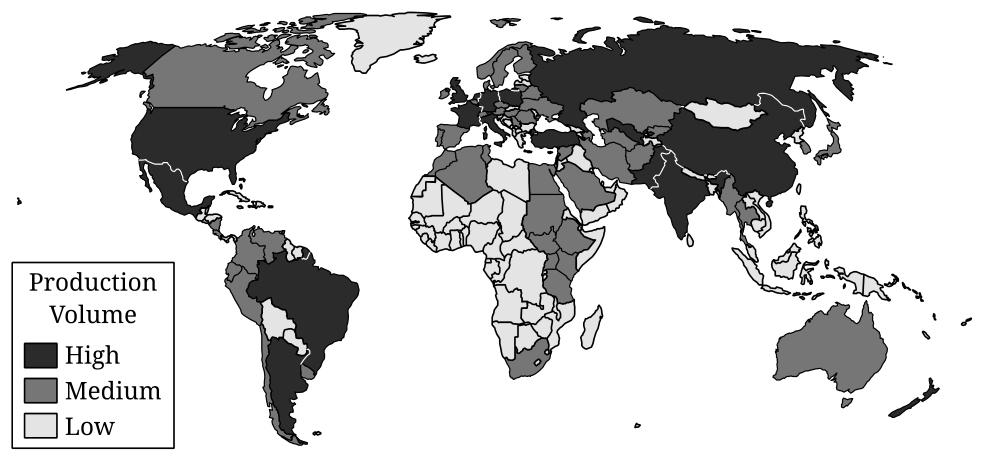
Skill 4.C: Source Analysis asks students to explain the significance of geographic information in a source. For a map showing agricultural production, use a three-step method:
- Describe the pattern precisely: identify clusters, gaps, gradients, or regional contrasts.
- Locate the likely production hearths, environmental conditions, or economic centers.
- Explain the pattern through domestication, diffusion, comparative advantage, trade, or distribution networks.
A strong response distinguishes description from explanation. “High production occurs in eastern and southern regions” describes a pattern; “those regions may have suitable climates, established livestock traditions, and access to markets” explains it. Avoid assuming that high production means high consumption or that a crop’s current location is its origin.
Common misconception — origin equals dominance: A domestication hearth is where a species was first developed, not necessarily where it is most widely produced today.
Retrieval check
A map shows a crop concentrated far from its known domestication hearth. What evidence would support the claim that relocation diffusion created the pattern, and how could comparative advantage make the new production region interdependent with other regions? A complete answer should name the hearth, identify the movement of the crop or farming population, describe the mapped pattern, and explain what the region exports and imports.
Source Materials
- AP Human Geography Course and Exam Description
- AP Human Geography Course and Exam Description Clarifications and Corrections
- AP Human Geography Course Overview
- AP Human Geography Course at a Glance
- AP Human Geography Course at a Glance Poster
- AP Human Geography
- AP Human Geography
- AP Human Geography Sample Syllabus 1
- Source: Food and Agriculture Organization
- Source: Food and Agriculture Organization
- Source: Food and Agriculture Organization