From the free course AP Human Geography on Lykke
5.10 Consequences of Agricultural Practices
Key concepts: Environmental effects of agricultural land use · Pollution from agricultural practices · Agricultural land-cover change · Desertification · Soil salinization · Conservation efforts · Slash-and-burn agriculture · Terrace farming · Irrigation and water-resource use · Sustainable agricultural practices
Agriculture does not simply use landscapes; it actively reshapes them. A field may produce food while also changing vegetation, soil chemistry, water supplies, and local ecosystems.
5.10 Consequences of Agricultural Practices
Agriculture does not simply use landscapes; it actively reshapes them. A field may produce food while also changing vegetation, soil chemistry, water supplies, and local ecosystems. The central question is: when does agricultural production become environmental damage, and how can farming remain productive without exhausting the resources it depends on?
Learning Objective IMP-5.A: Explain how agricultural practices have environmental and societal consequences.
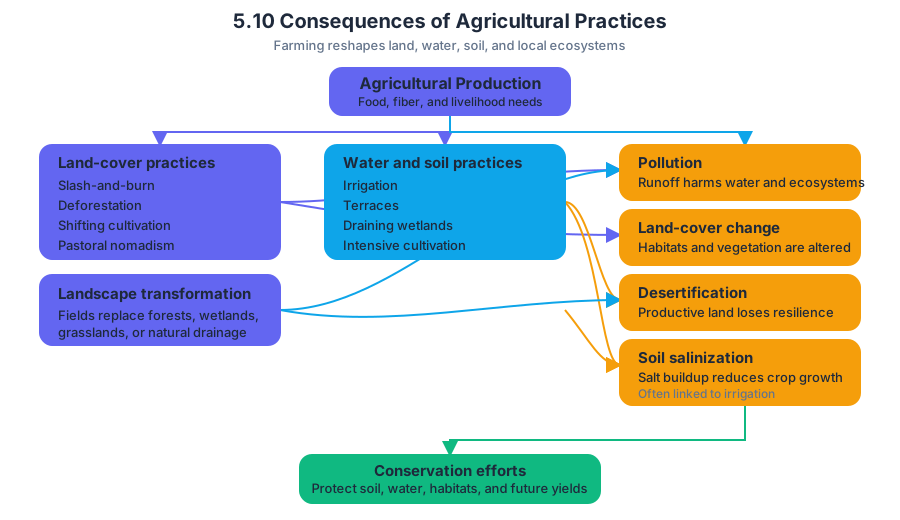
Essential Knowledge IMP-5.A.1: Environmental effects of agricultural land use include pollution, land-cover change, desertification, soil salinization, and conservation efforts. Essential Knowledge IMP-5.A.2: Agricultural practices—including slash-and-burn, terraces, irrigation, deforestation, draining wetlands, shifting cultivation, and pastoral nomadism—alter the landscape.
How agricultural practices alter environments
Agricultural impacts often follow a chain: a farming method changes land or water, that change affects an environmental process, and the process creates consequences for people and ecosystems.
Worked example: irrigation and soil salinization
- Farmers divert river water or pump groundwater to irrigate crops.
- Some of the irrigation water evaporates, especially in hot, dry environments.
- The water leaves behind dissolved salts in the upper soil.
- Salt concentrations rise until crops have difficulty absorbing water.
- Soil fertility and agricultural productivity decline.
This process is called soil salinization, the accumulation of salts in soil that can reduce its ability to support crops. Irrigation can therefore increase food production in the short term while undermining future production if drainage and water management are inadequate.
Environmental effects: a visual comparison
| Agricultural practice | Immediate purpose | Environmental consequence |
|---|---|---|
| Slash-and-burn agriculture | Clear land and release nutrients from vegetation ash | Deforestation, smoke pollution, and possible soil degradation when fallow periods become too short |
| Terrace farming | Create level planting surfaces on steep slopes | Can reduce erosion, but construction alters slopes and drainage |
| Irrigation | Supply crops with water | Water depletion and soil salinization |
| Deforestation | Expand farmland or pasture | Habitat loss, land-cover change, and increased erosion |
| Draining wetlands | Create fields or settlements | Loss of wetland habitat and reduced natural water storage |
| Shifting cultivation | Move cultivation as soil fertility declines | Can be sustainable with adequate fallow periods, but damaging when population pressure shortens the cycle |
| Pastoral nomadism | Move livestock between grazing areas | Can fit variable environments, but overgrazing may contribute to vegetation loss and desertification |
Desertification is the degradation of dryland environments so that land becomes less biologically productive. Overgrazing, removal of vegetation, drought, and poorly managed cultivation can expose soil to wind and water erosion. Desertification is not simply “a desert expanding”; it is a decline in the land’s capacity to support plants, animals, and people.
Pollution and land-cover change
Agriculture can pollute water, soil, and air. Chemical fertilizers and pesticides may enter streams through runoff, while animal operations can release waste into surrounding water systems. Smoke from slash-and-burn clearing affects air quality. These effects are spatial: pollution may begin on one farm but spread downstream or downwind.
Land-cover change occurs when one type of surface—such as forest, wetland, or grassland—is replaced by cropland or pasture. The change can increase food production, but it may also reduce biodiversity, alter water flow, and remove habitats. A map showing agricultural expansion is therefore not merely showing where farms are located; it may also reveal where ecological systems have been transformed.
Conservation and environmental sustainability
Environmental sustainability means meeting present needs while maintaining the resources and ecological conditions required in the future. Sustainable agriculture does not mean eliminating all environmental effects. It means reducing long-term damage while preserving productive capacity.
Several practices support this goal:
- Crop rotation varies crops across fields and can maintain soil fertility, interrupt pest cycles, and avoid large-scale environmental damage.
- Fallowing leaves farmland uncultivated temporarily so soil can recover.
- Erosion control—such as maintaining vegetation or using carefully designed terraces—helps conserve topsoil.
- Decreased irrigation reduces water demand and lowers the risk of salinization.
- Extracting less water from aquifers or groundwater resources helps protect local water supplies.
- Restoring environmentally damaged areas through sustainable agricultural practices can rebuild soil, vegetation, and local resource systems.
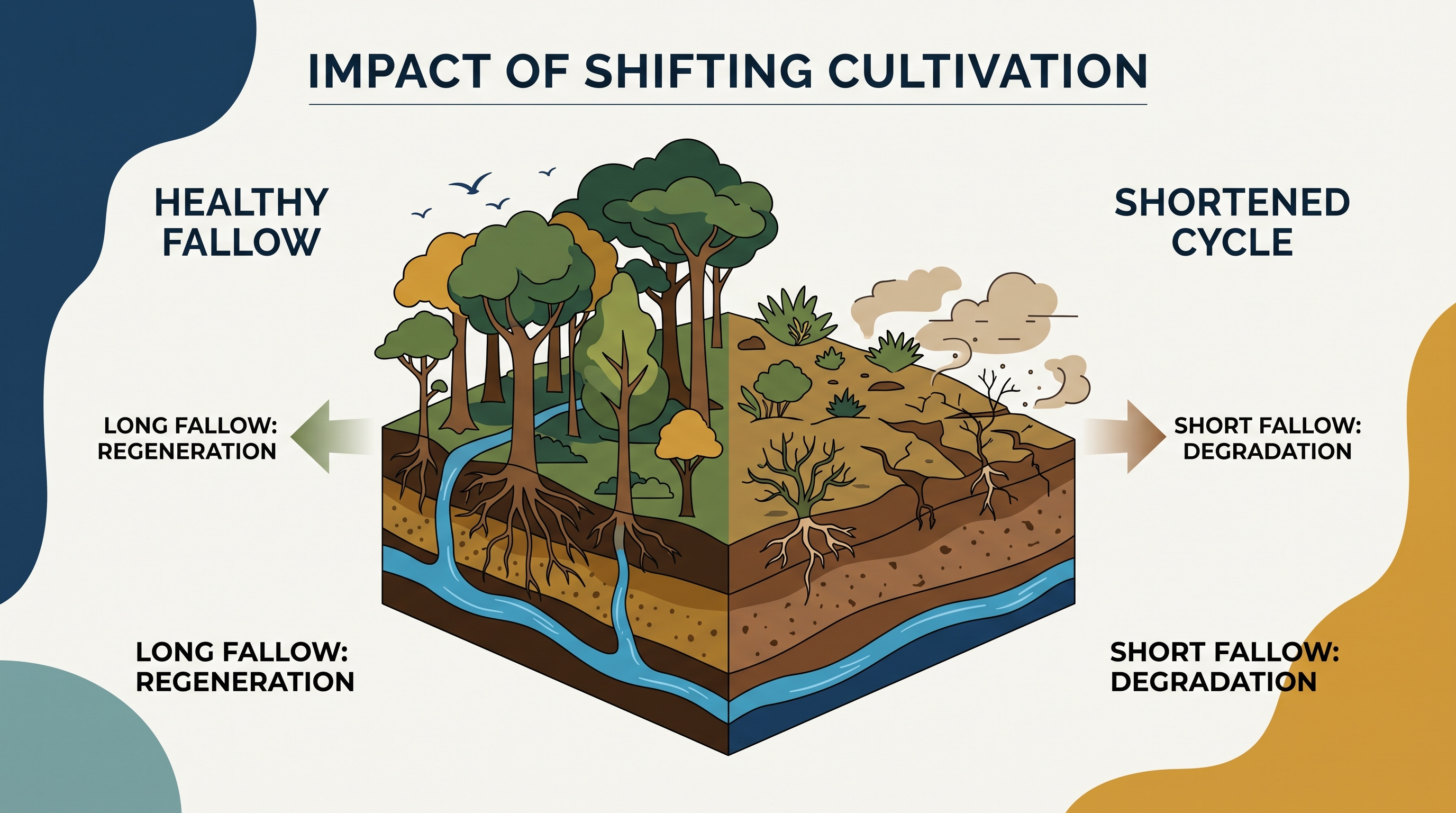
A common misconception is that shifting cultivation is automatically destructive. In reality, its environmental effects depend on the length of the fallow period and the pressure placed on the land. A long recovery period can allow vegetation and soil nutrients to regenerate; a shortened cycle may produce deforestation, erosion, and declining fertility.
Skill connection — 2.E Spatial Relationships: Explain how an agricultural practice changes a landscape and how that change produces environmental consequences. Strong geographic reasoning connects practice → process → outcome, rather than merely naming “pollution” or “desertification.”
Retrieval check: A dry region experiences falling crop yields after years of intensive irrigation. Identify the likely environmental process and explain the mechanism in one sentence. Then name one practice that could improve sustainability.
Answer: The process is soil salinization: evaporation leaves salts behind in the soil, reducing crop productivity. Decreasing irrigation, extracting less groundwater, improving drainage, rotating crops, fallowing, or controlling erosion could improve sustainability.
Source Materials
- AP Human Geography Course and Exam Description
- AP Human Geography Course and Exam Description Clarifications and Corrections
- AP Human Geography Course Overview
- AP Human Geography Course at a Glance
- AP Human Geography Course at a Glance Poster
- AP Human Geography
- AP Human Geography
- AP Human Geography Sample Syllabus 1