From the free course AP Human Geography on Lykke
5.7 Spatial Organization of Agriculture
Key concepts: Spatial organization of agriculture · Availability of resources and cultural practices · Agricultural practices and land-use patterns · Economies of scale in agriculture · Carrying capacity of land · Agricultural technology and productivity · Hearths of domestication and crop diffusion · Food supply chains linking production and consumption · Scale analysis and spatial relationships · Conflicts between nomadic herders, conservation organizations, and governments
A farm’s location and size are shaped not only by soil and climate, but also by technology, culture, markets, transportation, and political rules. The same agricultural landscape can therefore produce very different results depending on who controls resources, what consumers prefer, and how efficiently products…
5.7 Spatial Organization of Agriculture
A farm’s location and size are shaped not only by soil and climate, but also by technology, culture, markets, transportation, and political rules. The same agricultural landscape can therefore produce very different results depending on who controls resources, what consumers prefer, and how efficiently products move from field to table.
Enduring Understanding PSO-5: “Availability of resources and cultural practices influence agricultural practices and land-use patterns.”
Learning Objective PSO-5.C: “Explain how economic forces influence agricultural practices.”
Essential Knowledge PSO-5.C.3: Large-scale commercial agricultural operations are replacing small family farms.
PSO-5.C.4: Complex commodity chains link production and consumption of agricultural products.
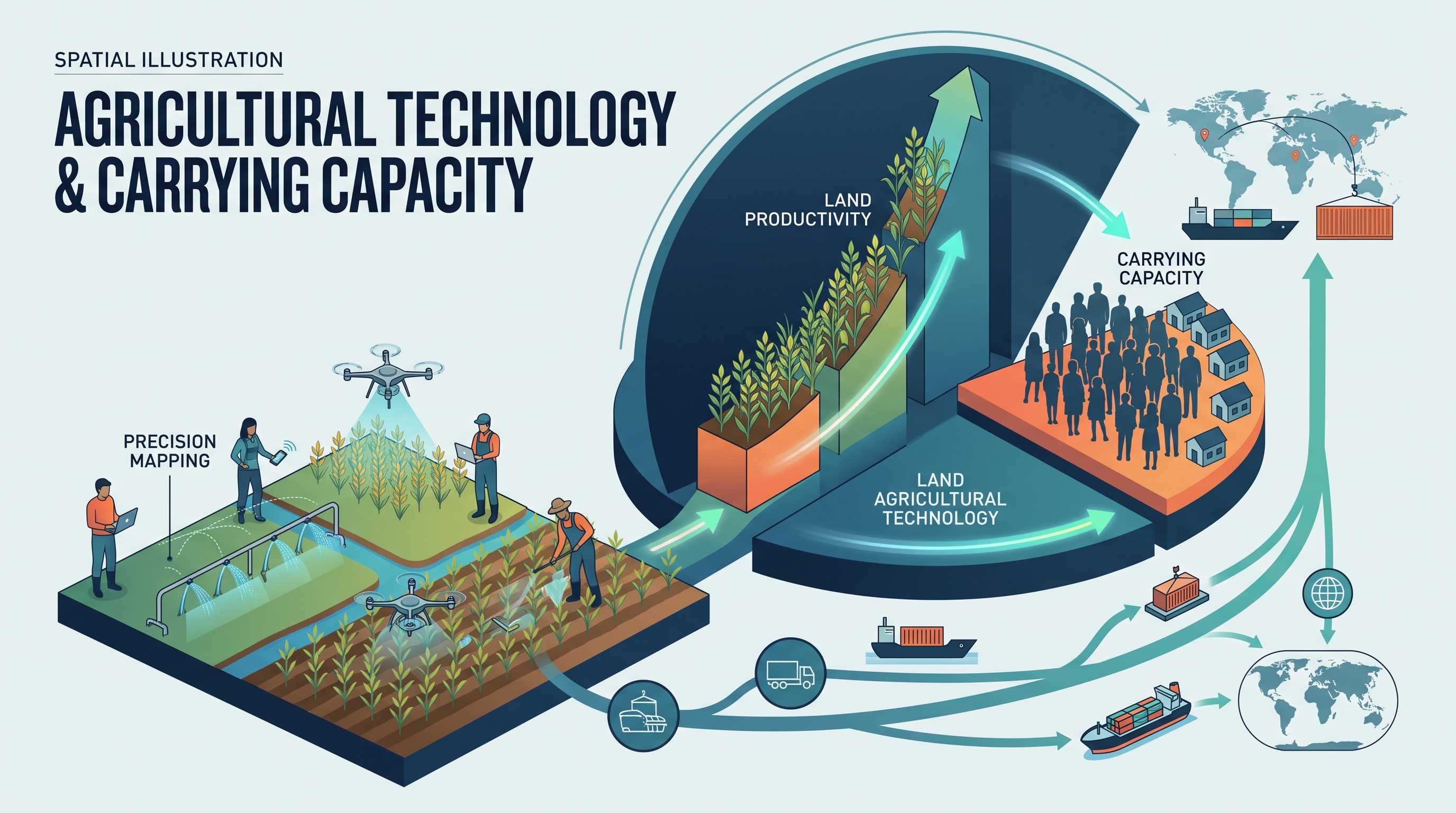
PSO-5.C.5: Technology has increased economies of scale in the agricultural sector and the carrying capacity of the land.
From resources and culture to land-use patterns
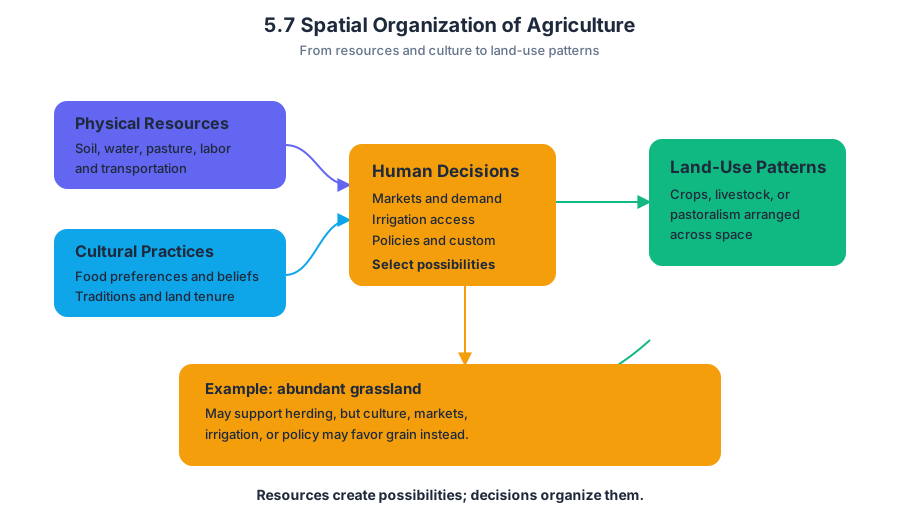
Spatial organization of agriculture means the way agricultural activities are arranged across space. Resource availability—such as fertile soil, water, pasture, labor, and transportation—creates opportunities and limits. Cultural practices then influence which opportunities people use: food preferences, religious restrictions, inherited farming traditions, and customary land-tenure systems all affect what is grown, raised, or avoided.
For example, a region with abundant grassland may support livestock herding, but that does not guarantee that every household will raise cattle. Cultural food preferences, market demand, access to irrigation, and government policies may instead encourage grain production or a different form of pastoralism. Physical resources create possibilities; economic and cultural decisions organize those possibilities.
Economies of scale and the changing farm
Economies of scale occur when the average cost of producing each unit falls as the size of an operation increases. A large commercial farm can spread the cost of tractors, irrigation systems, storage facilities, data systems, and processing contracts across many hectares or many units of output. Technology has strengthened this advantage through mechanized planting and harvesting, satellite-guided equipment, improved seeds, chemical inputs, and large-scale irrigation.
A simplified comparison shows the logic:
| Operation | Fixed technology cost | Output | Fixed cost per unit |
|---|---|---|---|
| Small farm | $100,000$ | $10,000$ units | $10$ per unit |
| Large farm | $400,000$ | $100,000$ units | $4$ per unit |
The large farm spends more overall, but its cost per unit is lower. That economic advantage can encourage consolidation: large-scale commercial operations may replace small family farms, especially when farms must compete in national or global markets. However, economies of scale do not mean that large farms are automatically more sustainable, equitable, or productive in every environment.
Technology, productivity, and carrying capacity
Agricultural productivity is the amount of agricultural output produced from a given quantity of inputs, especially land. Advances in agricultural technology can increase the resources produced by a fixed area through higher-yield seeds, irrigation, fertilizers, pest control, machinery, and improved management.
Carrying capacity is the largest population that an environment can support with its available resources and technology. If a hectare produces more food, the same area can support more people—at least while water, soil nutrients, infrastructure, and ecological conditions remain adequate.
Worked example: A valley initially produces enough food for $1{,}000$ residents. A new irrigation system and higher-yield crop increase output by $50%$. If food distribution and other resources keep pace, the valley’s potential carrying capacity may rise to roughly $1{,}500$ residents. The key chain is:
$$ \text{technology} \rightarrow \text{higher productivity} \rightarrow \text{more resources from the same land} \rightarrow \text{higher carrying capacity} $$
Named misconception — “Carrying capacity is fixed.” Carrying capacity is not a permanent biological number. It changes with technology, resource management, consumption levels, and environmental degradation. Technology can raise carrying capacity, but overuse may later reduce it through erosion, salinization, groundwater depletion, or habitat loss.
Commodity chains connect distant places
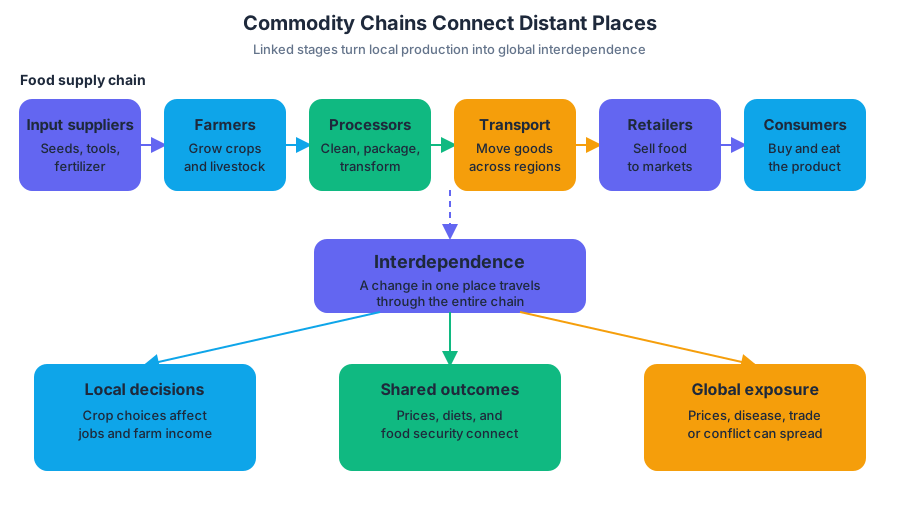
Agricultural products move through food supply chains, or linked stages connecting production and consumption. A product may involve farmers, input suppliers, processors, wholesalers, transport companies, retailers, and consumers located in different regions or countries.
This creates interdependence: production decisions in one place can affect prices, employment, diets, and food security elsewhere. A country that depends heavily on one or more export commodities may gain foreign income but also become vulnerable to price changes, crop disease, trade restrictions, or political conflict.
Diffusion from hearths of domestication
A hearth of domestication is an origin area from which crops or domesticated animals diffuse. Diffusion does not occur equally for every crop. Climate requirements, cultural preferences, transportation, disease resistance, and the availability of suitable land determine how widely a crop spreads.
A classic interpretation task asks which listed crop diffused the least from its hearth of domestication. In the cited comparison, the correct crop was the yam. The reasoning is not merely “identify the smallest symbol”; it is: locate the crop’s hearth, compare its production area with that origin, and select the crop showing the least spatial expansion.
Conflict over pastoral land
Nomadic herding can produce conflicts because herders depend on seasonal movement across grazing areas. Conservation organizations may oppose grazing in protected areas when livestock contribute to habitat degradation. Governments may also regulate or restrict cross-border migration, even though herders’ traditional routes may cross modern political boundaries.
The competing perspectives are spatially different: conservation groups emphasize habitat protection, governments emphasize territorial regulation, and herders emphasize livelihood and access to pasture. A strong geographic explanation identifies the resource, the spatial practice, and the institution affected.
AP skills in action
- Skill 2.C (Spatial Relationships): Explain how agricultural technology connects land productivity to carrying capacity.
- Skill 2.D (Spatial Relationships): Use the spatial organization of farms and supply chains to explain how economic forces produce geographic effects.
- Skill 3.A (Data Analysis): Identify the type of data shown when comparing crop diffusion or agricultural production.
- Skill 4.D (Source Analysis): Compare patterns and trends in visual sources to draw conclusions.
- Skill 5.D (Scale Analysis): Explain how agricultural relationships operate from the local farm scale to the global supply-chain scale.
Retrieval check: If irrigation allows the same area of land to produce twice as much food, which two concepts explain the likely population increase? Answer: higher agricultural productivity and increased carrying capacity. Why might the result still be temporary? Resource depletion or environmental degradation could later reduce the land’s capacity to support that population.
Source Materials
- AP Human Geography Course and Exam Description
- AP Human Geography Course and Exam Description Clarifications and Corrections
- AP Human Geography Course Overview
- AP Human Geography Course at a Glance
- AP Human Geography Course at a Glance Poster
- AP Human Geography
- AP Human Geography
- AP Human Geography Sample Syllabus 1