From the free course AP Human Geography on Lykke
4.10 Consequences of Centrifugal and Centripetal Forces
Key concepts: Centrifugal forces · Centripetal forces · State sovereignty · State failure and state stability · Uneven economic development · Stateless nations · Ethnic nationalism and separatist movements · Devolution and autonomous regions · National identity and cultural unity · Language, ethnicity, and religion as political forces
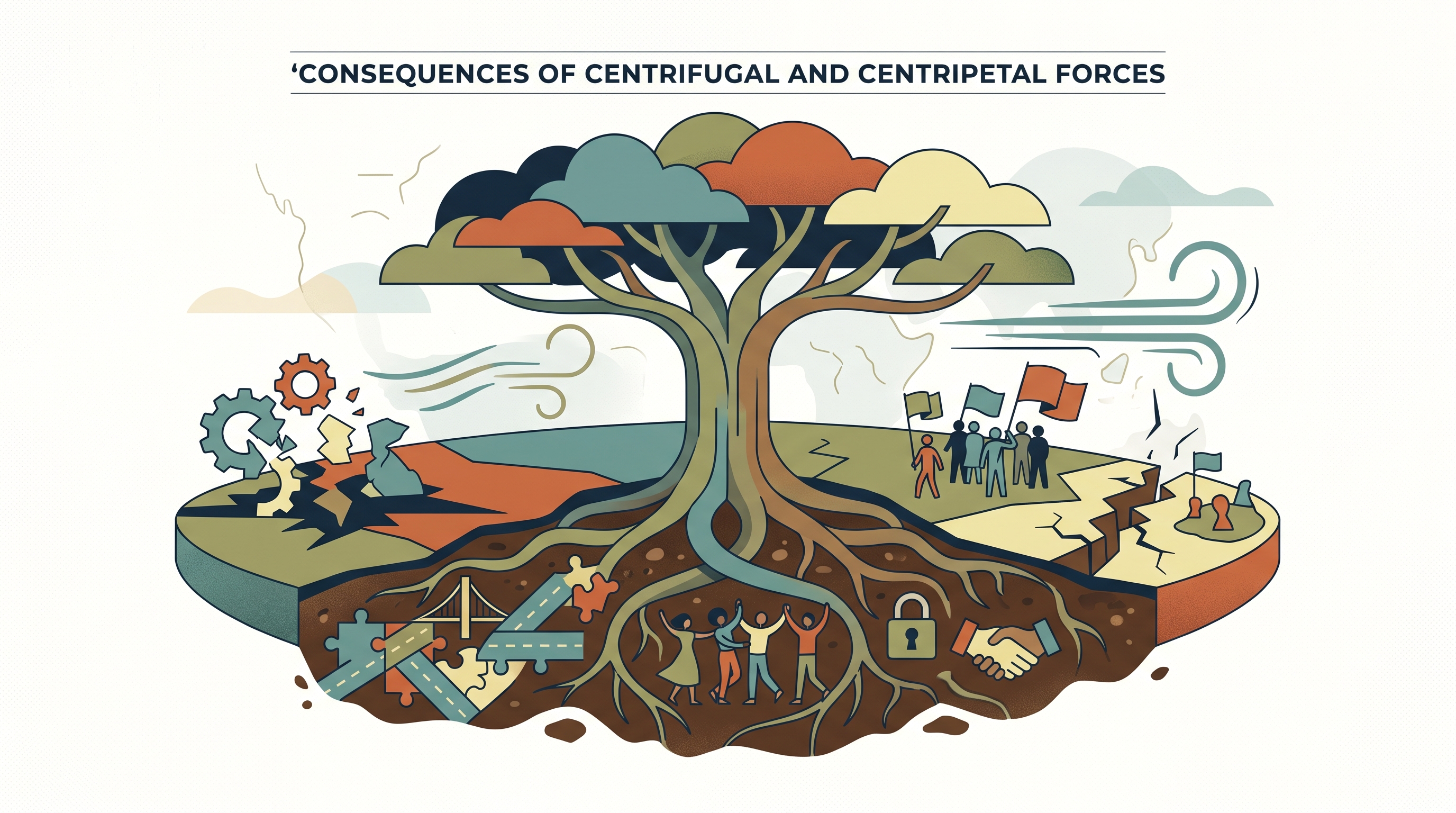
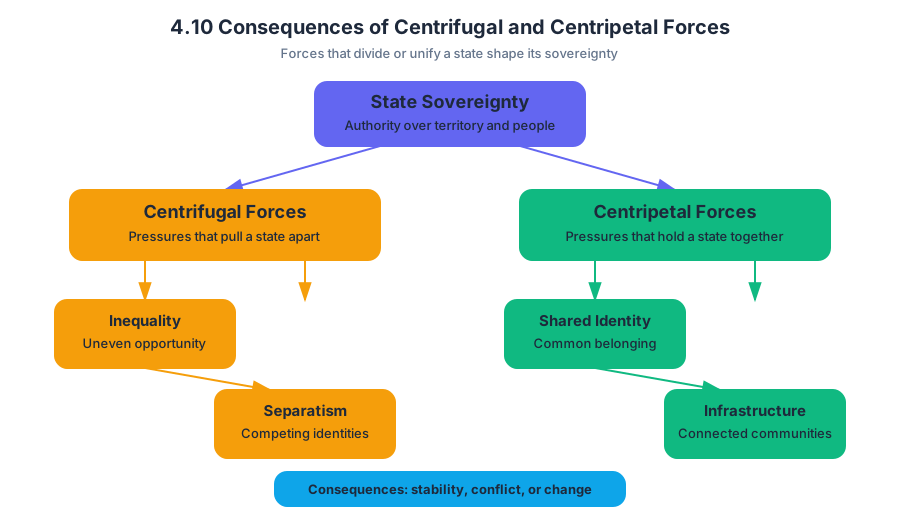
A state can be pulled together by shared identity and infrastructure—or pulled apart by inequality, separatism, and distrust. Centrifugal forces are pressures that divide a state, while centripetal forces are pressures that unify it.
4.10 Consequences of Centrifugal and Centripetal Forces
A state can be pulled together by shared identity and infrastructure—or pulled apart by inequality, separatism, and distrust. Centrifugal forces are pressures that divide a state, while centripetal forces are pressures that unify it. Their consequences are central to state sovereignty, the authority of a state to govern its territory and population.
Enduring Understanding [SPS-4]: Political, economic, cultural, or technological changes can challenge state sovereignty.
Learning Objective [SPS-4.C]: Explain how the concepts of centrifugal and centripetal forces apply at the state scale.
Two opposing forces at the state scale
The simplest way to visualize the relationship is as a tug-of-war over state stability. A state is not automatically stable because it has legal borders; stability depends on whether people accept, participate in, and benefit from the state’s authority.
| Force | Direction of pressure | Typical consequences |
|---|---|---|
| Centrifugal | Pulls groups and territories away from the state | Failed states, uneven development, stateless nations, ethnic nationalist movements |
| Centripetal | Pulls groups toward a shared state identity | Political unity, stronger state stability, cultural cohesion, more equitable infrastructure |
Centrifugal forces may be political, economic, cultural, or technological. Economic inequality can make one region feel exploited while another receives better roads, schools, jobs, or public services. Cultural differences can become politically divisive when an ethnic group believes the dominant group controls government and uses state power to suppress its identity. Separatist movements, ethnic cleansing, and terrorism are especially severe forms of internal division.
A stateless nation is a cultural group with a shared national identity that does not possess its own independent state. When a group believes that the existing state cannot protect its language, religion, territory, or political interests, ethnic nationalism may develop: the belief that a particular ethnic nation should control its own political territory. If separatists establish competing territorial control, the state’s sovereignty weakens because the central government can no longer exercise authority uniformly.
How centrifugal pressure produces instability
State failure occurs when a government loses the capacity to provide security, public services, or effective control over its territory. Centrifugal forces do not automatically cause state failure, but persistent regional inequality, armed conflict, terrorism, or competing ethnic authorities can erode state stability.
Worked example: Imagine a multinational state with three regions. Region A contains the capital and most industries; Region B has valuable minerals but receives little public investment; Region C speaks a different language and has historically experienced discrimination. If mineral revenues remain concentrated in Region A, residents of Region B may demand autonomy. If Region C’s language is banned, its political movement may become separatist. The government could respond with shared infrastructure and language recognition—centripetal strategies—or with strict military control. The first approach may preserve sovereignty by giving groups a reason to remain within the state; the second may suppress dissent temporarily while deepening centrifugal resentment.
Centripetal forces and the construction of unity
Centripetal forces promote political unity and strengthen state stability. Governments can use national symbols—flags, anthems, monuments, holidays, and public ceremonies—to present the state as a shared nation. These symbols help build national identity, especially in states containing several ethnic or linguistic groups.
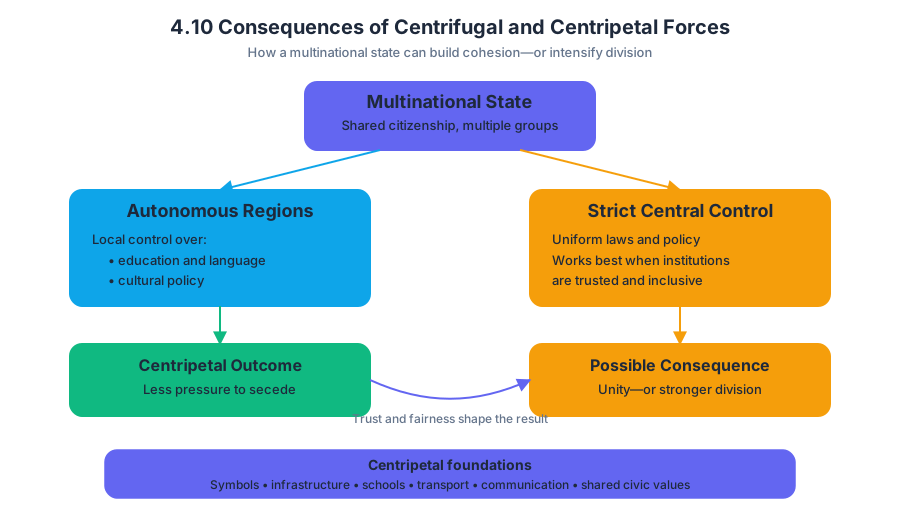
Centripetal forces can also be material rather than symbolic. Shared infrastructure connects regions physically and economically; national resources such as schools, hospitals, transportation systems, and communication networks distribute the benefits of citizenship; and cultural unity can grow through shared languages, traditions, or civic values. More equitable infrastructure development matters because people are more likely to support a state they experience as fair.
A multinational state facing ethnic tension has two broad strategies. It may create autonomous regions, allowing a minority territory to control selected local matters such as education, language, or cultural policy while remaining inside the state. This can reduce devolutionary pressure and preserve central sovereignty. Alternatively, the government may maintain strict central control, refusing territorial autonomy and enforcing uniform laws. That strategy can produce unity when institutions are trusted, but it can intensify centrifugal forces when groups view central authority as domination.
The same policy can unite or divide
A national language policy illustrates why consequences depend on context. Requiring one language in public administration may improve communication and create a common civic identity—a centripetal effect. If the policy suppresses minority languages, however, it may generate ethnic nationalism and separatism—a centrifugal effect. The geographic scale of analysis also matters: a policy that strengthens the state overall may weaken trust in a particular region.
Misconception check: Centripetal forces are not simply “good,” and centrifugal forces are not always “bad.”
A regional autonomy agreement may appear to weaken central control, yet it can preserve the state by reducing separatism. Conversely, forced uniformity may appear to strengthen the state while producing deeper instability.
Under Essential Knowledge [SPS-4.C.1], centrifugal forces may lead to failed states, uneven development, stateless nations, and ethnic nationalist movements. Under Essential Knowledge [SPS-4.C.2], centripetal forces can lead to ethnonationalism, more equitable infrastructure development, and increased cultural cohesion. The required reasoning is causal: identify the force, describe how it operates geographically, and connect it to a consequence for state stability.
Retrieval check: A government funds roads, schools, and hospitals equally across linguistic regions while recognizing each region’s cultural traditions. Is this primarily centrifugal or centripetal? Explain one mechanism and one likely consequence. A strong answer identifies a centripetal force, explains that equitable investment and cultural recognition build trust and cohesion, and connects those effects to stronger state stability.
Source Materials
- AP Human Geography Course and Exam Description
- AP Human Geography Course and Exam Description Clarifications and Corrections
- AP Human Geography Course Overview
- AP Human Geography Course at a Glance
- AP Human Geography Course at a Glance Poster
- AP Human Geography
- AP Human Geography
- AP Human Geography Sample Syllabus 1