From the free course AP Human Geography on Lykke
7.7 Changes as a Result of the World Economy
Key concepts: Outsourcing · Global economic interdependency · Free-trade zones · Special economic zones (SEZs) · Export-processing zones (EPZs) · Post-Fordist methods of production · Just-in-time delivery · Agglomeration and economies of scale · Deindustrialization · Supranational organizations and international trade
A smartphone may be designed in one country, assembled in another, and depend on minerals, chips, software, shipping, finance, and customers spread across dozens of countries.
7.7 Changes as a Result of the World Economy
A smartphone may be designed in one country, assembled in another, and depend on minerals, chips, software, shipping, finance, and customers spread across dozens of countries. Global economic interdependency is this mutual dependence among places through trade, production, finance, and supply chains. It makes production more flexible and geographically dispersed—but also means that a disruption in one place can affect employment and consumption far away.
Learning Objective PSO-7.A: Explain the causes and geographic consequences of recent economic changes, including increased international trade, outsourcing, deindustrialization, and growing interdependence in the world economy. The central required knowledge is PSO-7.A.5, PSO-7.A.6, and PSO-7.A.7.
From concentrated factories to global production networks
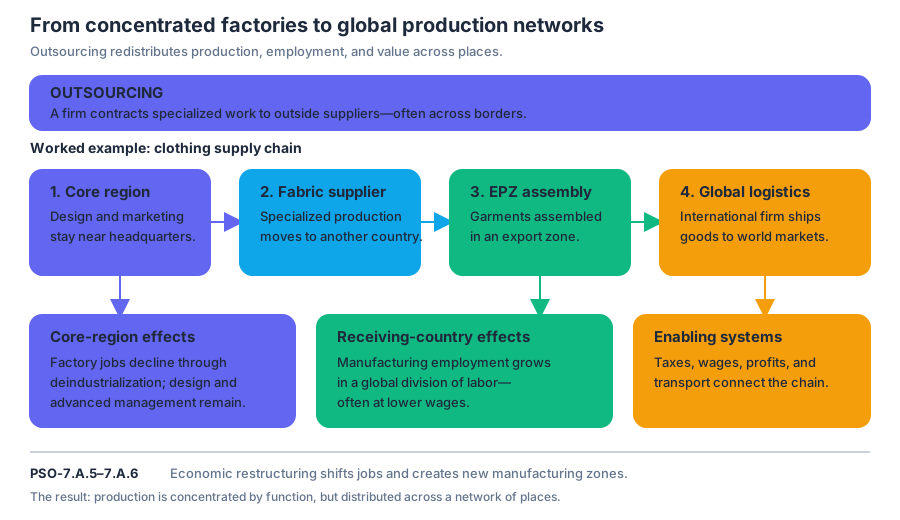
Outsourcing is the practice of contracting work to an outside company, often in another country. Firms outsource when a specialized supplier can perform a task more cheaply, quickly, or efficiently. This redistributes production and employment: headquarters, research, and advanced management may remain in a core region, while assembly, customer support, textiles, or routine data processing move to lower-cost locations.
Worked example — a clothing supply chain: A company based in a high-income country keeps design and marketing jobs at home, contracts fabric production to one country, garment assembly to an export-processing zone (EPZ) in another, and shipping to an international logistics firm. The core region may lose factory employment through deindustrialization, while the receiving country gains manufacturing jobs—often lower-paying positions in an international division of labor. The company’s profits, workers’ wages, government tax policies, and transportation systems connect all four places.
PSO-7.A.5: Outsourcing and economic restructuring have contributed to declining jobs in core regions and increasing employment in newly industrialized countries. PSO-7.A.6: Outside core regions, industrial growth has produced new manufacturing zones—including special economic zones (SEZs), free-trade zones, and EPZs—and a global division of labor in which developing countries often receive lower-paying jobs.
Zones that attract investment
A free-trade zone is an area where governments reduce or remove tariffs and other trade barriers on goods entering, leaving, or passing through the zone. An SEZ is a geographically defined area offering special rules—such as tax incentives, simplified regulations, improved infrastructure, or relaxed customs procedures—to attract foreign and domestic investment. An EPZ is an SEZ focused especially on export-oriented manufacturing, where imported inputs can be assembled and re-exported.
These zones can create jobs, roads, ports, factories, and supplier networks. They can also produce uneven development: investment may concentrate around one coastal industrial corridor while rural regions remain poorer, and workers may receive low wages or limited labor protections. A zone is therefore not automatically evidence that an entire country has developed equally.
Post-Fordist production and the new economic map
Fordist production used large factories, standardized products, and long production runs. Post-Fordist production is more flexible: firms use smaller production batches, rapid product changes, subcontracting, advanced technology, and globally distributed suppliers. Just-in-time delivery minimizes inventory by arranging for components to arrive shortly before they are needed.
Post-Fordist firms choose locations based not only on raw materials but also on reliable ports, digital networks, skilled labor, specialized suppliers, political stability, and access to markets. High-technology industries often cluster near research universities and skilled labor pools, while service-sector growth expands finance, information, health care, logistics, design, and communications in major metropolitan areas.
The spatial effects can reinforce one another. Agglomeration occurs when related firms and workers cluster together because proximity lowers costs and improves access to suppliers, labor, information, and infrastructure. Economies of scale occur when producing at a larger volume lowers the average cost per unit. A new factory can generate a multiplier effect by creating additional jobs in transportation, housing, retail, and services; a concentrated area of investment becomes a growth pole that attracts still more activity.
Interdependence, institutions, and uneven development
Global economic interdependency links places through several channels:
- Production: components cross borders before a final product is sold.
- Finance: loans, investment, currency exchange, and debt connect national economies.
- Supply chains: firms depend on transport routes, energy, software, suppliers, and labor in multiple regions.
- Rules: trade agreements and international institutions shape where firms invest and which markets they can enter.
Supranational organizations help states coordinate these connections. The European Union (EU) integrates member economies through shared institutions and reduced barriers; Mercosur promotes economic cooperation and trade in parts of South America; ASEAN encourages regional cooperation in Southeast Asia; OPEC coordinates petroleum policies among member countries; and the World Trade Organization (WTO) establishes and administers rules for international trade. The International Monetary Fund (IMF) provides financial assistance and policy support to countries facing serious balance-of-payments or monetary problems.
Free-trade rules can make an SEZ more attractive by lowering the cost of importing components and exporting finished goods. International lending can finance ports, roads, electricity, or telecommunications that make outsourcing possible, but loan conditions and repayment pressures may also reshape government priorities and deepen dependence on export industries. Thus, international finance can promote development while distributing its benefits unevenly.
Key insight: Economic globalization does not make every place economically similar. It reorganizes relationships among places, often connecting high-value research and management in core regions to lower-cost manufacturing and resource extraction elsewhere.
Misconception check and retrieval
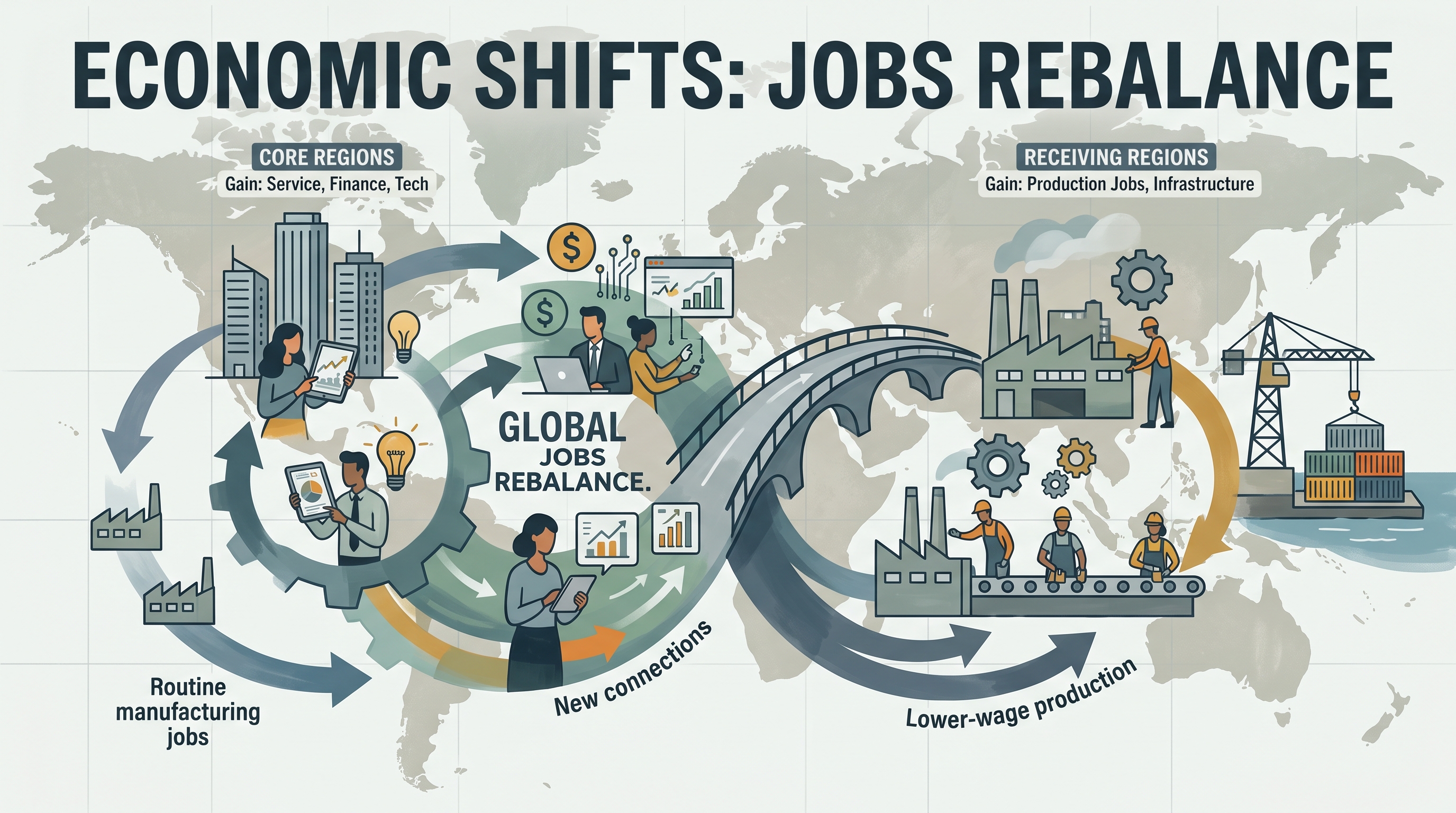
Named misconception — “Outsourcing means all economic activity leaves the core.” Outsourcing usually relocates selected tasks, not every function. Core regions may lose routine manufacturing jobs while gaining high-value service, finance, design, and technology employment; receiving regions may gain jobs and infrastructure but remain dependent on lower-wage production.
Retrieval check: A government offers tax breaks, streamlined customs procedures, and a new port to attract foreign electronics manufacturers. Identify the most likely zone type, explain one reason firms would locate there, and describe one possible effect on the host region. A strong response identifies an SEZ—possibly an EPZ if export manufacturing is its defining purpose—then connects the incentives and infrastructure to investment, employment, agglomeration, or uneven development.
Skill connection — 4.F, “Explain how maps, images and landscapes illustrate or relate to” geographic concepts, processes, and patterns: When examining a map of factory locations, ports, or technology clusters, connect the visible pattern to outsourcing, agglomeration, growth poles, or deindustrialization. Do not merely describe where activity appears; explain why that spatial arrangement exists and what consequences it produces at local, national, and global scales.
Source Materials
- AP Human Geography Course and Exam Description
- AP Human Geography Course and Exam Description Clarifications and Corrections
- AP Human Geography Course Overview
- AP Human Geography Course at a Glance
- AP Human Geography Course at a Glance Poster
- AP Human Geography
- AP Human Geography
- AP Human Geography Sample Syllabus 1