From the free course AP Human Geography on Lykke
7.3 Factors Driving Industrialization
Key concepts: Urbanization · Migration to cities · Population growth in urban areas · Economic growth · Trade · Industrialization · Economic development · Transportation infrastructure expansion · Communication infrastructure expansion · Governance
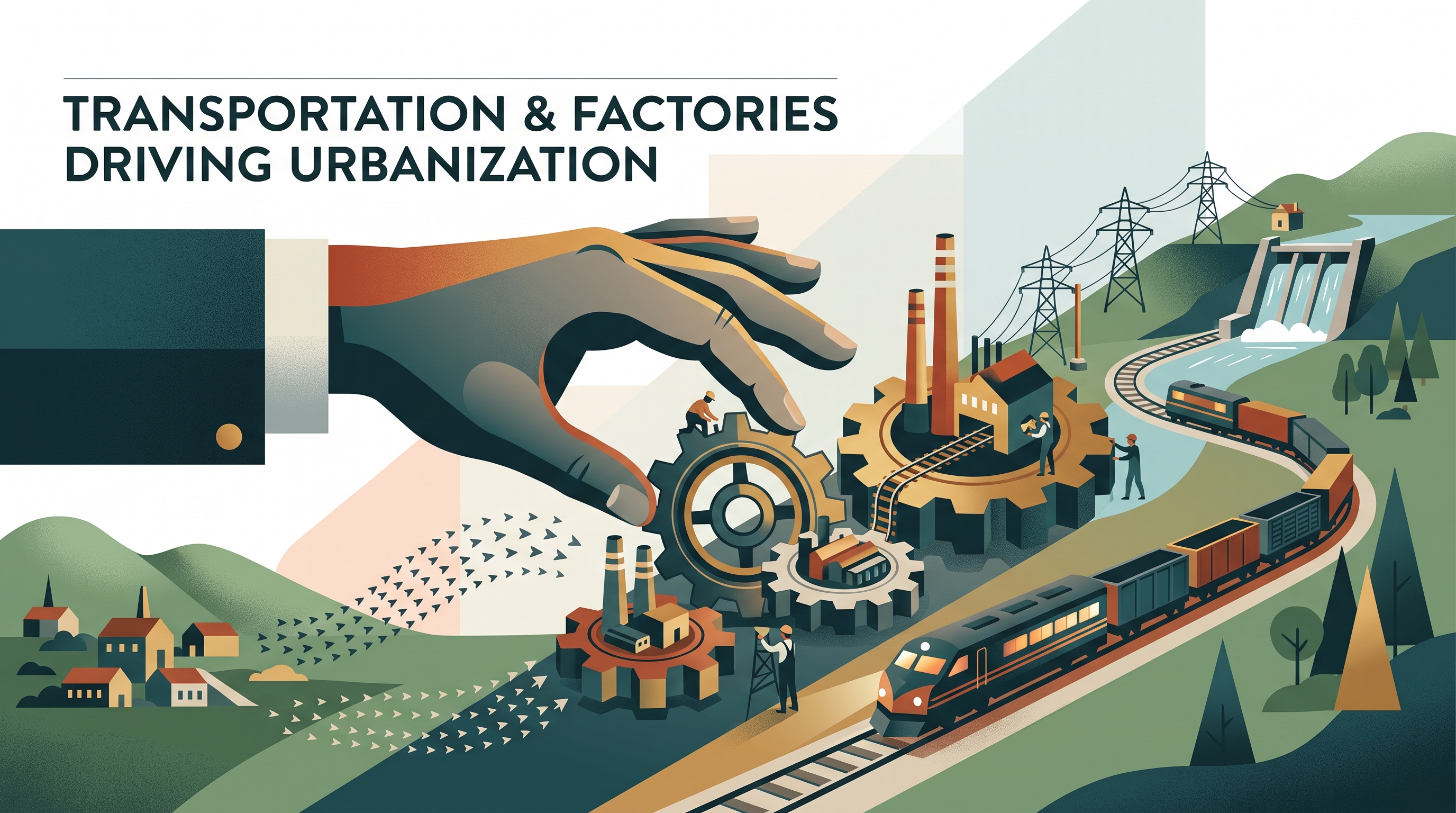
Industrialization reshapes places by concentrating jobs, investment, infrastructure, and people in connected urban areas. A factory may begin as a single workplace, but its demand for labor, transport, housing, markets, and communication can transform an entire city.
7.3 Factors Driving Industrialization
Industrialization reshapes places by concentrating jobs, investment, infrastructure, and people in connected urban areas. A factory may begin as a single workplace, but its demand for labor, transport, housing, markets, and communication can transform an entire city.
Urbanization is the growth in the proportion and number of people living in urban areas. Industrialization is the expansion of machine-based manufacturing and related economic activity. Industrialization often drives urbanization, but urbanization can also be accelerated by population growth, migration, trade, infrastructure, governance, and broader economic development.
CED alignment: Learning Objective 7.3.A — Explain the factors that drive industrialization and urbanization. The relevant Essential Knowledge is commonly represented as 7.3.A.1, identifying economic, demographic, infrastructural, technological, governmental, and locational forces that shape urban growth.
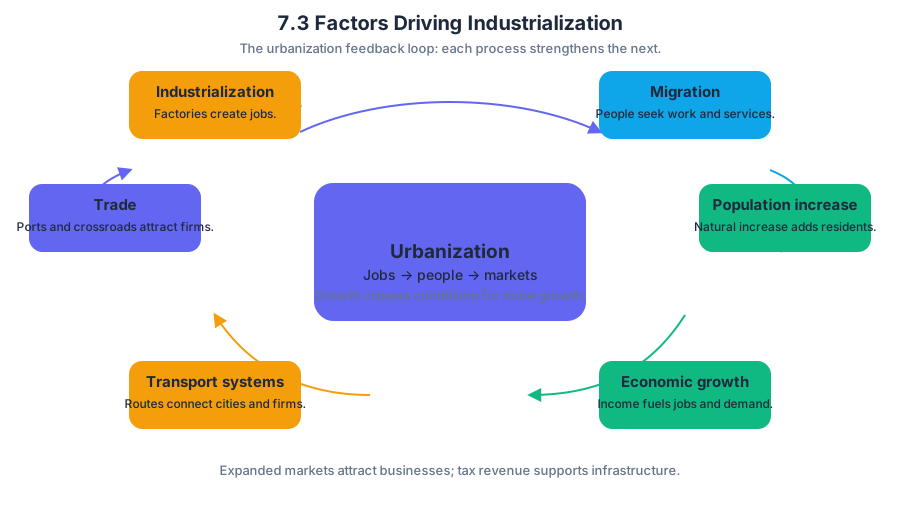
The urbanization feedback loop
Urban growth rarely has one cause. Instead, several processes reinforce one another: industries attract workers; workers increase the urban population; a larger population creates markets; expanding markets attract more businesses; and tax revenue supports additional infrastructure.
| Driving factor | Mechanism of urban growth |
|---|---|
| Migration to cities | People relocate from rural areas or other countries to seek employment, education, services, or safety. |
| Population increase | Natural increase adds residents, even without migration. |
| Economic growth | Rising incomes and expanding businesses create jobs and demand for services. |
| Trade | Ports, crossroads, logistics centers, and commercial regions attract firms and workers. |
| Industrialization | Factories and processing facilities concentrate employment and investment. |
| Transportation systems | Roads, railways, ports, and airports improve accessibility and connect cities to markets. |
| Communication systems | Telecommunications and digital networks coordinate production, finance, services, and migration. |
| Governance | Development policies, zoning, and urban planning direct investment and control land use. |
| Situation | A city’s relationships with other places influence its function and growth. |
How the factors work together
Migration and population growth
Migration to cities directly increases urbanization because people move from rural, pastoral, farming, mining, fishing, or forest-based communities into metropolitan areas. Migrants may be responding to economic opportunities, while cities gain labor, consumers, cultural connections, and new demand for housing and services.
Population can also rise through natural increase, meaning births exceed deaths. Thus, an urban area may grow because existing residents have children, because migrants arrive, or because both processes occur simultaneously. A city’s population increase is therefore not automatically evidence of industrial growth.
Economic growth, trade, and industrialization
Economic growth expands the production of goods and services. Trade strengthens urbanization when a city occupies a favorable position in networks connecting producers, consumers, ports, suppliers, or neighboring regions. A coastal port, for example, may grow because warehouses, shipping firms, manufacturers, retailers, and financial services cluster around its trade connections.
Industrialization intensifies this process by concentrating factories and related activities. Manufacturing requires workers, energy, raw materials, transportation, finance, and markets. The resulting employment can attract migrants, while the growing workforce encourages construction, retail, education, health care, and public administration.
Infrastructure, technology, and governance
The expansion of transportation systems lowers the effective distance between a city and other places. Railways can connect mines to factories; highways can link suburbs to employment centers; ports can connect producers to global markets. Communication systems perform a similar coordinating function by allowing firms, governments, and households to exchange information rapidly across distance.
Governance also drives urbanization. Governments may use development policies, zoning, and urban planning to locate industries, build housing, extend utilities, establish special economic zones, or designate transport corridors. These decisions do not merely respond to urban growth; they can actively produce it.
Worked example: explaining urban growth
Suppose a previously small coastal settlement becomes a major urban area. A strong explanation would connect several mechanisms: the settlement’s situation near international shipping routes encourages trade; a new port and railway improve transportation; factories locate nearby to reduce shipping costs; jobs attract rural-to-urban migrants; population growth expands the labor force and consumer market; and government zoning directs additional investment into industrial and residential districts.
The key is causation. “The city grew because it became important” is too vague. “The port connected the city to external markets, attracting factories that created jobs and encouraged migration” identifies a factor and explains how it produced urban growth.
Misconception check
Misconception: Urbanization always means industrialization. Urban areas can grow through government investment, trade, services, migration, natural increase, or administrative reclassification even when manufacturing is limited. Conversely, industrialization may cause environmental problems, housing shortages, or uneven development rather than universally improving living conditions.
Retrieval check
A city gains a railway, attracts factories, receives rural migrants, and expands its housing supply. Identify two factors driving urbanization and explain the causal link for each. A strong answer should name the factor—such as transportation expansion or industrialization—and state how it increases jobs, accessibility, investment, or population.
Source Materials
- AP Human Geography Course and Exam Description
- AP Human Geography Course and Exam Description Clarifications and Corrections
- AP Human Geography Course Overview
- AP Human Geography Course at a Glance
- AP Human Geography Course at a Glance Poster
- AP Human Geography
- AP Human Geography
- AP Human Geography Sample Syllabus 1