From the free course AP Human Geography on Lykke
6.1 The Origin and Influences of Urbanization
Key concepts: Urbanization · Population growth · Economic growth and industrialization · Infrastructure · Quality of life · Transportation and communication systems · Government development policies · Zoning and urban planning · Informal settlements · Urban governance
Urbanization is the increasing share of a population living in urban areas, together with the physical expansion and growing importance of cities. A city rarely grows for just one reason: people, jobs, infrastructure, government decisions, and connections to other places reinforce one another.
6.1 The Origin and Influences of Urbanization
Urbanization is the increasing share of a population living in urban areas, together with the physical expansion and growing importance of cities. A city rarely grows for just one reason: people, jobs, infrastructure, government decisions, and connections to other places reinforce one another.
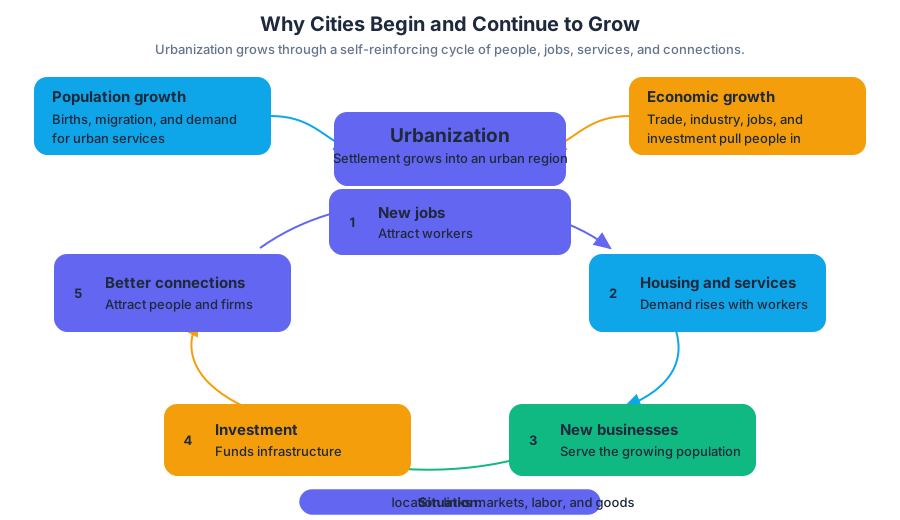
Why cities begin and continue to grow
Population growth can drive urbanization because a larger population creates greater demand for housing, schools, healthcare, utilities, shops, transportation, and other urban services. Growth may come from natural increase—births exceeding deaths—or from migration into cities. When rural residents move to cities for employment, education, or services, the urban population can increase even if the country’s total population grows slowly.
Economic growth, trade, and industrialization also pull people and investment toward cities. Factories, offices, ports, financial institutions, universities, and commercial districts tend to cluster because businesses benefit from access to workers, customers, suppliers, transportation, and information. As employment expands, metropolitan areas—large urban regions made up of a central city and connected surrounding communities—often grow beyond the original city boundary.
The process is therefore circular:
- New jobs attract workers.
- More workers increase demand for housing and services.
- New businesses serve the growing population.
- Tax revenue and investment support additional infrastructure.
- Better connections and services attract still more people and firms.
This feedback loop explains why a small settlement near a productive port, factory zone, or transportation junction can become a major urban center. Its situation—its location relative to other places—can influence its function and growth by connecting it to markets, resources, labor, and flows of goods.
Transportation, communication, and access
Transportation and communication systems make urban growth possible across distance. Roads, railways, ports, airports, electricity networks, internet connections, and mobile communications connect people to jobs, goods, education, healthcare, and government services. A new railway station, for example, can make a previously peripheral area attractive for factories, warehouses, housing, and retail.
These systems do not simply respond to urbanization; they also shape its pattern. Highways may encourage outward expansion and suburban development, while rail stations may concentrate dense growth around transit corridors. Digital communication can connect firms and workers across regions, but it does not eliminate the importance of physical infrastructure such as power, water, roads, and sanitation.
Government, planning, and the geography of growth
Government development policies, zoning, and urban planning influence where and how cities expand. Zoning divides land into permitted uses—such as residential, commercial, industrial, agricultural, or protected open space. Planning decisions can encourage compact development near transit, preserve green space, separate hazardous industries from homes, or direct investment toward neglected districts.
Planning can also produce unequal outcomes. If authorities extend utilities and roads to one district while leaving another without reliable water or public transportation, the location of infrastructure affects who can reach opportunity. Urban growth is not automatically orderly or equitable; it reflects political choices about land, investment, and access.
Infrastructure and quality of life
Infrastructure is the basic physical and organizational system that supports daily life, including roads, water pipes, sewers, electrical grids, schools, hospitals, commercial buildings, and waste-management systems. Its quality and location directly affect societal development and quality of life, meaning people’s access to conditions that support health, safety, education, employment, and well-being.
High-quality schools improve educational opportunity. Healthcare facilities and clean-water systems promote public health and sanitation. Commercial buildings, reliable utilities, and transportation allow residents to reach jobs, goods, and services. Infrastructure is therefore more than construction: it determines whether urban residents can participate fully in economic and social life.
When urban growth outruns urban capacity
Rapid urbanization occurs when urban populations or built-up areas grow faster than institutions and infrastructure can adapt. The result may include shortages of food, water, and energy; loss of green space; traffic congestion; pollution; inadequate sanitation; and informal settlements such as slums. Aging pipes, unreliable electricity, limited housing, and ineffective governance can turn ordinary urban growth into serious health and maintenance problems.
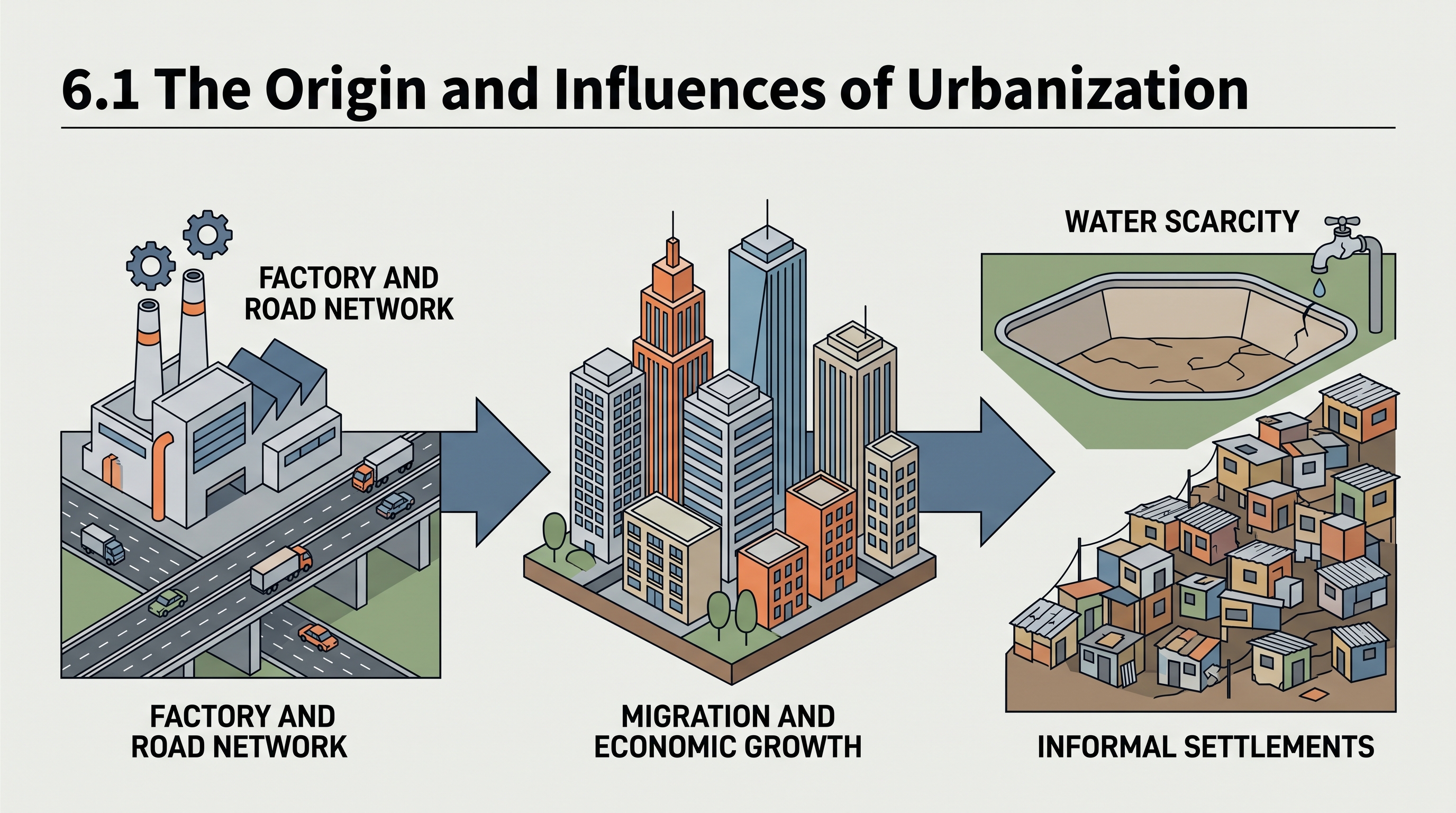
For example, imagine a metropolitan area whose population rises sharply after a new industrial zone opens. If jobs expand but water treatment, housing construction, and public transportation do not, workers may settle in informal neighborhoods near employment. The city has experienced economic growth, but inadequate infrastructure prevents that growth from producing equal improvements in quality of life.
Worked geographic reasoning
Suppose City A’s population increases by $30%$ after factories and a rail terminal are built, while City B grows by only $5%$ because it has fewer new jobs and weaker transportation links. A strong explanation connects the variables rather than merely naming them: industrialization creates employment; rail access connects workers and goods; population growth increases demand for housing and services; and government planning determines whether infrastructure keeps pace.
This explanation applies PSO-6.A.2 by linking the spatial organization of urban growth to transportation, infrastructure, policy, and situation. It also uses Skill 2.C (Spatial Relationships) to explain how places and systems are connected, and Skill 3.D (Data Analysis) when evidence from a table or graph is used to support a claim. SPS-6.B.1 becomes visible when rapid growth produces societal changes such as informal settlements, resource shortages, or unequal access.
Misconception check
Misconception: “Urbanization means only that a city’s population increases.” Population growth is one driver, but urbanization also involves changing land use, expanding metropolitan influence, increasing economic activity, and transforming transportation and service networks. A city can grow through migration and industrialization, while a rapidly growing population can still experience declining quality of life if infrastructure and governance fail to keep pace.
Retrieval check
A city gains factories and a highway, attracts migrants, and then develops water shortages and informal settlements. Identify one driver of urbanization, one system that supported its growth, and one consequence of growth exceeding infrastructure capacity. A complete answer should connect each factor through cause and effect rather than listing three unrelated terms.
Source Materials
- AP Human Geography Course and Exam Description
- AP Human Geography Course and Exam Description Clarifications and Corrections
- AP Human Geography Course Overview
- AP Human Geography Course at a Glance
- AP Human Geography Course at a Glance Poster
- AP Human Geography
- AP Human Geography
- AP Human Geography Sample Syllabus 1
- In part G students were asked to use the data from the table to explain the relationship between a city’s level of economic development and the city’s percent population growth over time.
- AP Human Geography-AP Students-College board
- AP Human Geography Units: Complete Breakdown
- AP Human Geography-National Council for Geographic Foundation