From the free course AP Human Geography on Lykke
3.1 Introduction to Culture
Culture is the shared system of practices, technologies, attitudes, and behaviors that a society passes from one generation to another. It helps explain why people in different places eat different foods, organize family life differently, attach different meanings to clothing, or respond differently to the same…
3.1 Introduction to Culture
Culture is the shared system of practices, technologies, attitudes, and behaviors that a society passes from one generation to another. It helps explain why people in different places eat different foods, organize family life differently, attach different meanings to clothing, or respond differently to the same landscape.
A useful analogy is a society’s “operating system.” Individuals still make choices, but culture supplies familiar settings, expectations, and rules for interpreting the world. Unlike computer software, culture is not fixed: people adapt it, contest it, borrow from other societies, and combine it with new influences.
CED Learning Objective 3.A: Explain how culture is expressed in landscapes and how it influences the characteristics of places.
CED Essential Knowledge 3.A.1: Culture comprises the shared practices, technologies, attitudes, and behaviors transmitted by a society.
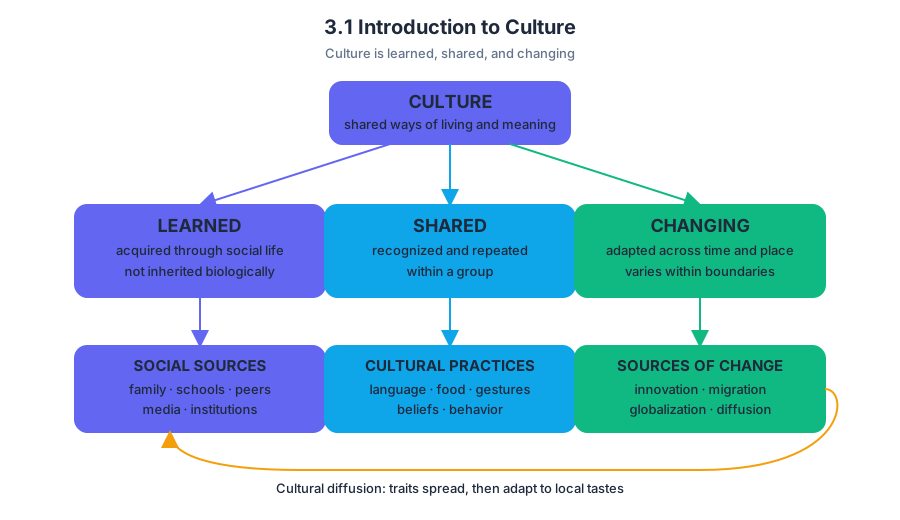
Culture is learned, shared, and changing
Culture is learned, rather than inherited biologically. A child learns a language, food preferences, religious practices, gestures, and ideas about appropriate behavior through family, schools, peers, media, and institutions. Culture is also shared: a practice becomes culturally meaningful when it is recognized and repeated by members of a group, even though individuals may participate in it with different levels of commitment.
Culture changes through innovation, migration, globalization, and cultural diffusion, the spread of cultural traits from one place or group to another. A food, technology, or fashion may enter a society from elsewhere and then be modified to fit local tastes. This means that cultures are neither perfectly isolated nor identical within their boundaries.
Cultural traits and cultural complexes
A cultural trait is a single element of culture. Examples include speaking Spanish, eating rice as a dietary staple, observing Ramadan, using a particular greeting, or wearing a religious symbol. Traits can be material, such as tools and clothing, or nonmaterial, such as beliefs, values, and language.
A cultural complex is a related group of cultural traits. For example, a religious cultural complex may include a belief system, a sacred calendar, dietary rules, architecture, forms of worship, and prescribed clothing. Looking at a complex prevents geographers from treating one isolated trait as if it explains an entire society.
CED Essential Knowledge 3.A.2: Cultural traits are the visible and measurable elements of culture, including artifacts, sociofacts, and mentifacts.
Artifacts are the material objects a culture creates or uses, such as houses, tools, clothing, and foods. Sociofacts are the structures and institutions that organize social life, such as family systems, schools, governments, and religious organizations. Mentifacts are the ideas and beliefs that shape behavior, including language, values, and religious principles.
Worked example: reading one everyday meal
Suppose a student eats a meal of rice, lentils, and vegetables with family members. The rice and cooking utensils are artifacts. The rule that everyone eats together, or that elders are served first, is a sociofact. The belief that certain foods are sacred, forbidden, or appropriate for a festival is a mentifact. The meal therefore represents a connected cultural system, not merely a personal preference.
Cultural differences and attitudes toward difference
Geographers compare cultures without assuming that one culture is the universal standard. Cultural relativism means evaluating a cultural practice within the context of the society that created it. Ethnocentrism is the tendency to judge another culture by the standards of one’s own culture, often treating one’s own practices as normal or superior.
CED Essential Knowledge 3.A.3: Cultural relativism and ethnocentrism influence how people view cultural differences.
These perspectives matter because cultural judgments can influence migration policy, political conflict, economic decisions, and the treatment of minority groups. Cultural relativism does not require approving every practice; it requires understanding its social context before evaluating it.
Named misconception — “Culture equals nationality.” A political boundary does not contain one uniform culture. A single state may include many ethnicities, languages, religions, and regional traditions, while the same cultural group may live across several states. Culture is spatial, but it does not automatically match country borders.
AP skill connection
This topic develops Skill 4.A: Identify and explain cultural patterns and processes. On a map, photograph, or written source, identify the cultural trait or pattern first; then explain the process producing it, such as migration, environmental adaptation, interaction, or diffusion. A strong explanation connects the evidence to a specific cultural practice rather than merely naming a group.
Retrieval check: A city contains multilingual signs, mosques, churches, restaurants serving foods from several regions, and schools teaching multiple languages. Name one artifact, one sociofact, and one mentifact that could be present. Then explain why the city should not be described as having only one culture.
Source Materials
- AP Human Geography Course and Exam Description
- AP Human Geography Course and Exam Description Clarifications and Corrections
- AP Human Geography Course Overview
- AP Human Geography Course at a Glance
- AP Human Geography Course at a Glance Poster
- AP Human Geography
- AP Human Geography
- AP Human Geography Sample Syllabus 1
- AP Human Geography-AP Students-College board
- AP Human Geography Units: Complete Breakdown
- AP Human Geography-National Council for Geographic Foundation
- Free AP Human Geography Resources for 2026-Knowt