From the free course AP Human Geography on Lykke
5.11 Challenges of Contemporary Agriculture
Key concepts: Contemporary agriculture · Agricultural production patterns · Agricultural consumption patterns · Environmental opportunities and challenges · Social opportunities and challenges · Economic opportunities and challenges · Cultural opportunities and challenges · Variation by location · Agricultural practices · IMP-5 enduring understanding
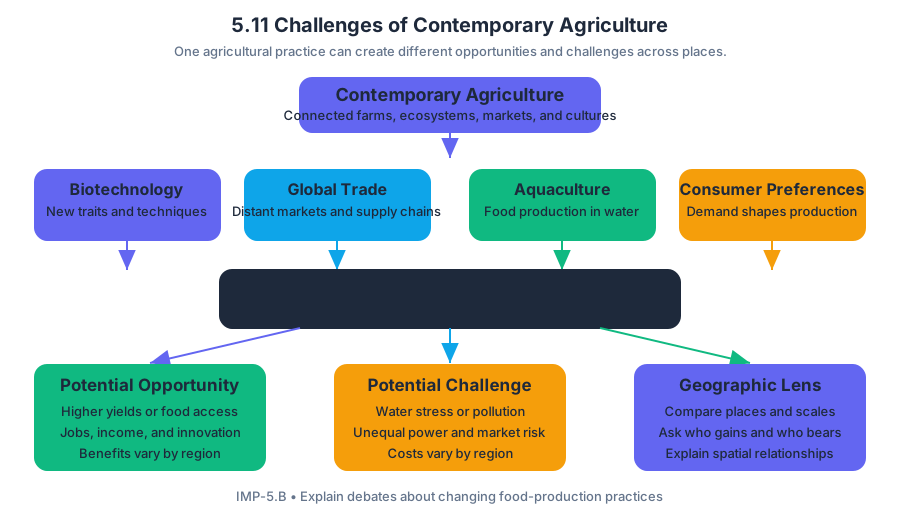
Agriculture is no longer shaped only by soil, climate, and traditional farming methods: biotechnology, global trade, aquaculture, and changing consumer preferences now connect farms, ecosystems, markets, and cultures across great distances.
5.11 Challenges of Contemporary Agriculture
Agriculture is no longer shaped only by soil, climate, and traditional farming methods: biotechnology, global trade, aquaculture, and changing consumer preferences now connect farms, ecosystems, markets, and cultures across great distances. The central geographic question is therefore: How can the same agricultural practice create an opportunity in one location and a challenge in another?
Enduring Understanding [IMP-5]: “Agricultural production and consumption patterns vary in different locations, presenting different environmental, social, economic, and cultural opportunities and challenges.”
The learning target for this topic is [IMP-5.B]: “Explain challenges and debates related to the changing nature of contemporary agriculture and food-production practices.” The suggested skill is 2.E Spatial Relationships, which asks students to explain how effectively a geographic concept, process, model, or theory explains effects in different contexts and regions of the world.
Production and consumption vary by location
Agricultural production patterns describe where and how food is produced. They vary because places differ in climate, water availability, land quality, labor costs, technology, infrastructure, government policy, and access to markets. Agricultural consumption patterns describe what people eat and how much they consume; these are influenced by income, culture, religion, prices, urbanization, advertising, and food availability.
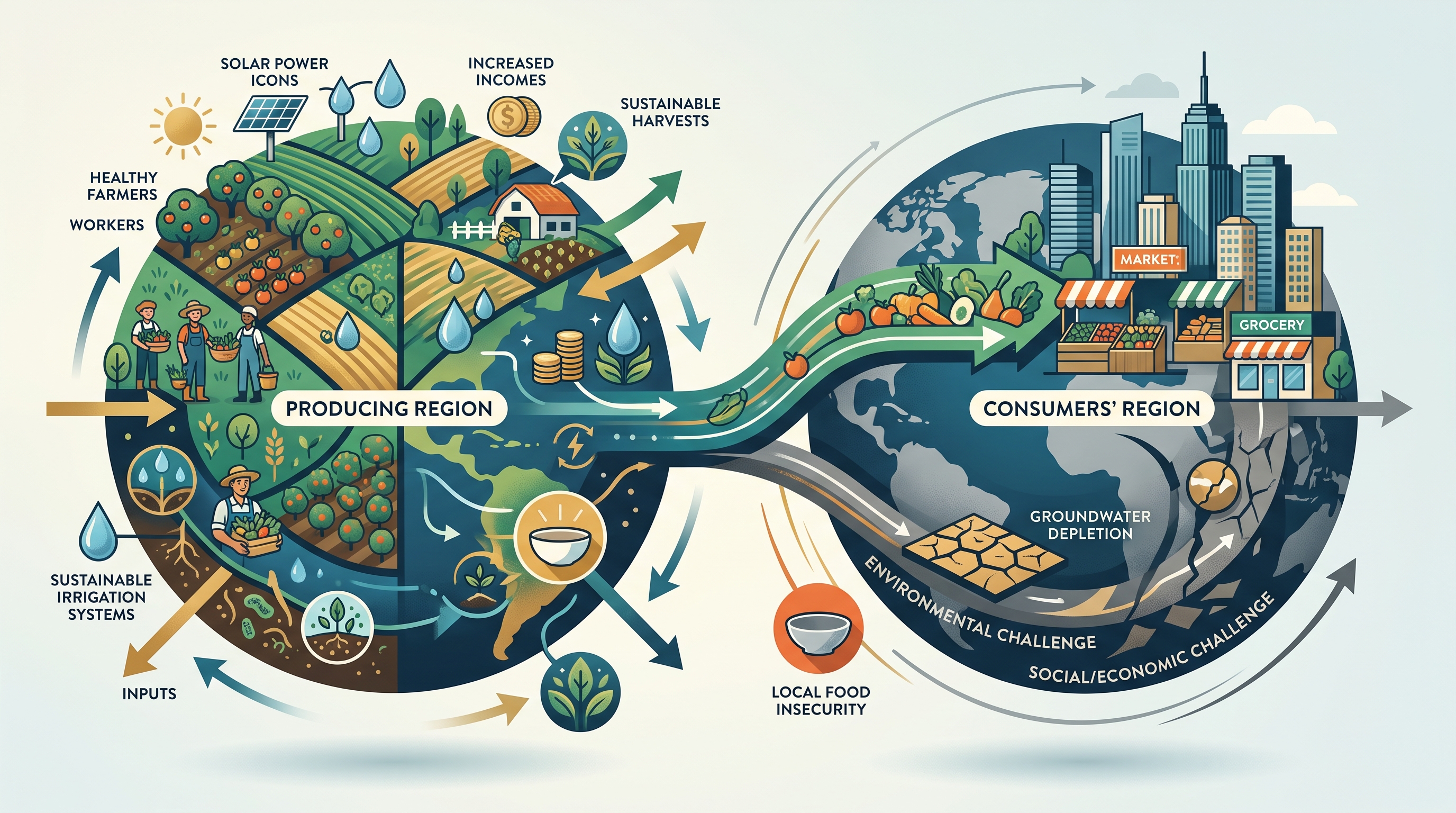
For example, a coastal region may produce farmed shrimp because warm water, investment capital, and export ports make aquaculture—the commercial raising of aquatic organisms—profitable. Consumers in distant cities may purchase the shrimp because refrigerated transport and global trade make it available year-round. The same production system can create jobs and export income while also generating debates about water pollution, habitat conversion, labor conditions, and dependence on external markets.
A production map and a consumption map may therefore look very different. A country can produce large quantities of a crop for export while importing much of the food its population eats. This reflects agricultural interdependence: places rely on one another for food, inputs, technology, labor, or markets.
Contemporary innovations and environmental debates
[IMP-5.B.1] Agricultural innovations such as biotechnology, genetically modified organisms, and aquaculture can increase yields, improve resistance to pests or drought, and expand food production in locations with physical limitations. However, these innovations have generated debates over sustainability, soil and water usage, reductions in biodiversity, and extensive fertilizer use.
A genetically modified crop engineered to resist insects may reduce crop losses and lower the need for some insecticides. Yet if farmers plant one dominant variety across a large area, biodiversity may decline, and pests may eventually adapt. The geographic effect depends on scale and context: a practice that improves food security for a farm or region may create ecological vulnerability across a larger landscape.
Key distinction: “More food” is not automatically the same as “more sustainable food.” Sustainability requires considering long-term environmental effects alongside immediate production gains.
Social and cultural opportunities and challenges
Agriculture creates social opportunities through employment, rural services, food access, and community stability. It can also produce social challenges when land consolidation displaces small farmers, when agricultural labor is poorly protected, or when unequal access to land, irrigation, machinery, seeds, and credit prevents some groups from benefiting from innovation.
Agriculture also has cultural consequences. Food preferences, religious restrictions, livestock traditions, and regional cuisines influence what farmers produce and what consumers demand. Global food systems can broaden choices and spread crops, cooking styles, and technologies, but they may also weaken local food traditions or replace culturally important crops with profitable export commodities.
Economic opportunities and trade-offs
Agricultural specialization can generate export earnings, attract processing industries, and connect rural producers to global markets. It can also expose producers to price swings, trade restrictions, transportation costs, and unequal bargaining power between farmers, corporations, and retailers.
Consider a region that shifts from subsistence grains to an export fruit. Higher-value exports may increase household income and foreign exchange earnings. However, local residents may then face higher food prices or shortages if land and water are redirected toward exports. The economic benefit is real, but its distribution—and its effect on local consumption—must be analyzed.
A spatial-analysis method
To apply 2.E Spatial Relationships, connect the practice to its geographic effects rather than listing advantages and disadvantages:
- Identify the practice: for example, aquaculture, biotechnology, or export-oriented farming.
- Locate its production and consumption: ask where inputs, products, workers, and consumers are situated.
- Compare contexts: examine how the effects differ between local, regional, national, and global scales.
- Explain the relationship: connect the practice to environmental, social, economic, and cultural outcomes.
Named misconception check — “One practice has one universal effect.” Agricultural practices do not produce identical outcomes everywhere. Irrigation may support food production in a dry region, but excessive withdrawal can deplete groundwater; export farming may raise incomes, but it can also increase local food insecurity. Strong geographic explanations specify where, for whom, and at what scale an effect occurs.
Retrieval check: A region adopts high-yield seeds and expands fertilizer use to increase food exports. Name one environmental opportunity, one environmental challenge, and one economic or social challenge. Then explain why the balance of effects might differ between the producing region and the consumers’ region.
Source Materials
- AP Human Geography Course and Exam Description
- AP Human Geography Course and Exam Description Clarifications and Corrections
- AP Human Geography Course Overview
- AP Human Geography Course at a Glance
- AP Human Geography Course at a Glance Poster
- AP Human Geography
- AP Human Geography
- AP Human Geography Sample Syllabus 1