From the free course AP Human Geography on Lykke
AP Practice 6
A strong free-response question (FRQ) answer does more than name a geographic term: it connects a concept to a place, explains a spatial relationship, interprets evidence, and follows the question’s command precisely.
AP Practice 6
A strong free-response question (FRQ) answer does more than name a geographic term: it connects a concept to a place, explains a spatial relationship, interprets evidence, and follows the question’s command precisely. This practice targets the FRQ task type through an original, unofficial scenario about agricultural change and urban growth.
Exam conditions: Set aside approximately $25$ minutes for one three-part FRQ. Budget about $3$ minutes to read, $17$ minutes to write, and $5$ minutes to check that every requested part contains a complete geographic explanation.
Original Practice FRQ: Food, Cities, and Regional Change
The fictional country of Lunara has experienced rapid urban growth. Between $2005$ and $2025$, the share of Lunara’s population living in urban areas increased from $42%$ to $68%$. During the same period, farms near the capital city increasingly shifted from staple grains to vegetables, eggs, and fresh milk. These products are sold in the capital’s expanding supermarkets and restaurants.
The government also invested in refrigerated trucks, paved roads, and irrigation systems. However, many small family farms were replaced by larger commercial farms, and some rural workers moved to the capital in search of employment.
A. Describe one reason agricultural land near the capital is being used for products such as vegetables, eggs, and fresh milk rather than staple grains.
B. Explain one way improved transportation or storage infrastructure could affect the spatial organization of agriculture in Lunara.
C. Explain one consequence of the shift toward commercial agriculture for either rural communities or the urban population.
How to Decode the Prompt
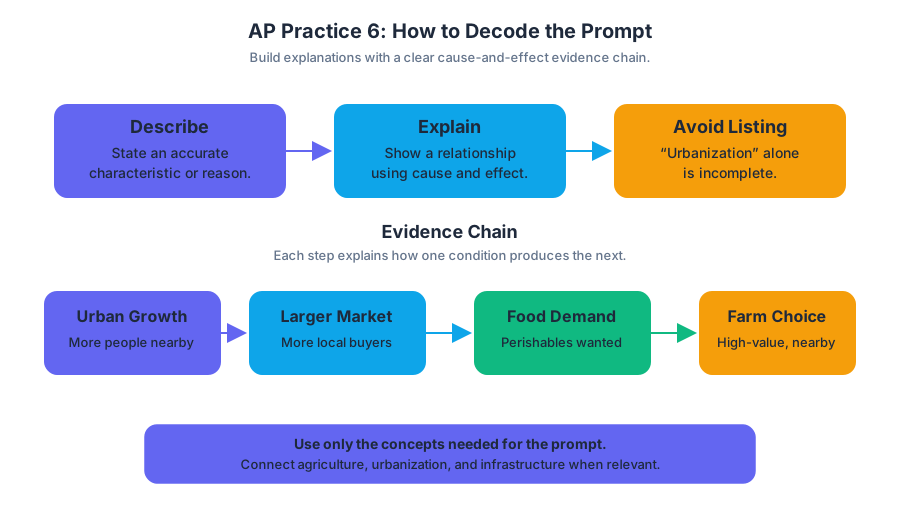
The command describe requires an accurate characteristic or reason. The command explain requires a relationship written as cause and effect. A response that merely identifies “urbanization” or “commercial farming” without showing how one condition produces another is incomplete.
A useful evidence chain is:
Urban growth $\rightarrow$ larger nearby market $\rightarrow$ greater demand for perishable foods $\rightarrow$ high-value, market-oriented farming near the city.
The scenario also connects several course ideas: 5.7 Spatial Organization of Agriculture, 5.8 Von Thünen Model, 5.9 The Global System of Agriculture, 5.10 Consequences of Agricultural Practices, 6.1 The Origin and Influences of Urbanization, and 6.7 Infrastructure. The strongest answers use only the concepts needed for the specific part rather than listing every related topic.
Worked Response and Rubric Logic
Part A: Describe
Sample response: Agricultural land near the capital is increasingly devoted to vegetables, eggs, and fresh milk because the nearby urban population creates strong demand for fresh food. These products are often perishable, so producing them close to the market reduces the time and cost required to move them to consumers.
Why this earns the point: The response gives a valid reason—urban demand—and adds a geographic mechanism—shorter transport distance for perishable goods. This applies the logic of the Von Thünen Model, in which land uses near a market are influenced by transportation costs, crop value, and perishability.
Part B: Explain
Sample response: Refrigerated trucks and paved roads allow perishable agricultural products to travel farther without spoiling. As a result, vegetables, eggs, and milk do not have to be produced only in the immediate area around the capital, so commercial farms may expand into more distant rural areas while still serving the urban market.
Why this earns the point: The answer identifies an infrastructure improvement and explains its spatial effect. Refrigeration lowers the risk of spoilage, while roads reduce travel time and transportation costs. Together, they can enlarge the agricultural market area and weaken the strict distance pattern predicted by a simplified Von Thünen Model.
Part C: Explain
Sample response: The replacement of family farms by larger commercial farms may cause rural workers to migrate to the capital. Commercial farms can use economies of scale—lower average costs when production is organized on a larger scale—but may require fewer workers per unit of output. This can reduce rural employment while increasing the supply of agricultural labor in the city.
Why this earns the point: The response identifies a consequence, names a relevant process, and connects the process to an outcome. It does not assume that commercial agriculture has only negative effects: larger farms may increase production efficiency, but the transition can also disrupt rural livelihoods and accelerate rural-to-urban migration.
Common Misconceptions Examiners See
Misconception 1: “Perishable crops are always grown in the city.” Urban proximity matters, but farms are generally located outside dense urban areas because land is expensive and agricultural production requires space. The geographic relationship is near the market, not necessarily inside the city.
Misconception 2: “Better roads make transportation free.” Infrastructure usually reduces travel time, spoilage, or cost; it does not eliminate them. A precise answer explains which transportation constraint changes.
Misconception 3: “Commercial agriculture means food is exported.” Commercial agriculture means production primarily for sale, not necessarily for international export. Lunara’s farms can be commercial while supplying domestic supermarkets.
Misconception 4: “Explain means define.” Defining economies of scale is not enough for Part C. The response must show the chain: larger farms $\rightarrow$ lower average costs or increased efficiency $\rightarrow$ possible displacement of family farms or rural workers.
Skill Alignment and Self-Check
This FRQ primarily assesses Skill Category 1: Concepts and Processes, because responses apply the Von Thünen Model, economies of scale, and urbanization. It also assesses Skill Category 2: Spatial Relationships, because each answer must connect distance, market access, infrastructure, and land use. Skill Category 5: Scale Analysis becomes relevant when explaining how changes at the farm or rural-community scale affect the national urban system.
Before moving on, cover the sample responses and answer from memory: Why do perishable goods often locate near markets? How can infrastructure expand a market area? What is one beneficial and one disruptive consequence of commercial agriculture? If each answer contains a clear cause-and-effect chain, the geographic reasoning is doing the work—not vocabulary alone.

Source Materials
- AP Human Geography Course and Exam Description
- AP Human Geography Course and Exam Description Clarifications and Corrections
- AP Human Geography Course Overview
- AP Human Geography Course at a Glance
- AP Human Geography Course at a Glance Poster
- AP Human Geography
- AP Human Geography
- AP Human Geography Sample Syllabus 1
- AP Human Geography-AP Students-College board
- AP Human Geography Units: Complete Breakdown
- AP Human Geography-National Council for Geographic Foundation
- Free AP Human Geography Resources for 2026-Knowt