From the free course AP Human Geography on Lykke
3.5 Historical Causes of Diffusion
Key concepts: Spatial diffusion · Hearths of domestication · Columbian Exchange · Crop diffusion · Colonialism · Indigenous languages · Immigration · Types of diffusion · Historical causes of diffusion · Spatial relationships
A potato domesticated in the Andes became a staple in Ireland, while maize from the Americas transformed diets in Africa and Europe. These changes were not random: historical spatial diffusion is the spread of a cultural trait, crop, language, or practice through time because of migration, trade, conquest,…
3.5 Historical Causes of Diffusion
A potato domesticated in the Andes became a staple in Ireland, while maize from the Americas transformed diets in Africa and Europe. These changes were not random: historical spatial diffusion is the spread of a cultural trait, crop, language, or practice through time because of migration, trade, conquest, colonization, or other connections between places.
SPS-3.A.1 — Historical causes of diffusion: Cultural traits and agricultural products often diffuse from their original hearths because historical processes connect distant places.
From hearths of domestication to global crops
A hearth of domestication is a place where humans first developed the sustained cultivation of a plant or the controlled breeding of an animal. From that hearth, the crop may spread outward through relocation diffusion, trade, conquest, colonization, changing food preferences, or changing agricultural practices.
Historical diffusion often follows a sequence:
- A crop is domesticated in a particular environmental and cultural setting.
- People carry, trade, or impose the crop elsewhere.
- Farmers adapt the crop to new environments and production systems.
- Consumers adopt it because of taste, cost, policy, necessity, or cultural change.
- The crop becomes part of a new agricultural landscape and may later diffuse again.
Worked example: the Columbian Exchange
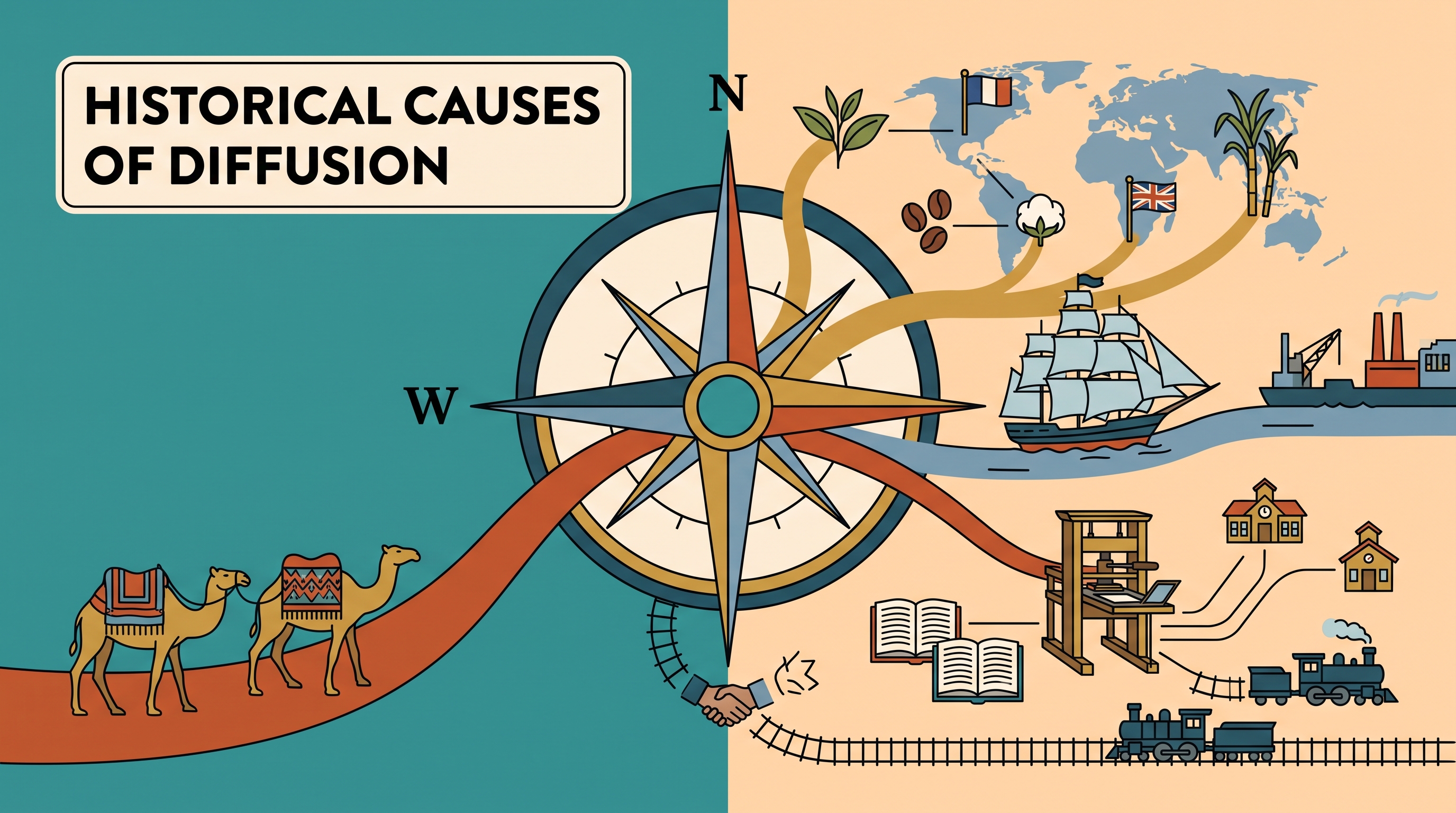
The Columbian Exchange was the large-scale transfer of plants, animals, people, diseases, and cultural practices between the Americas and Afro-Eurasia after sustained contact began in the late fifteenth century. It is a classic example of historical spatial diffusion because ships, colonial networks, conquest, and trade connected previously separated regions.
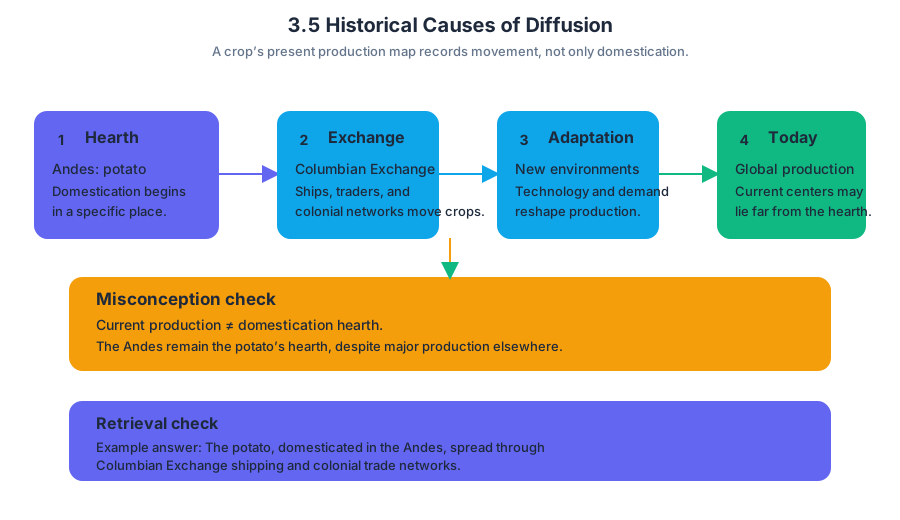
Consider the potato. Its hearth of domestication was in the Andes of South America. European colonial and trade networks transported it across the Atlantic; farmers then cultivated it in European environments, and changing agricultural practices and food preferences encouraged wider adoption. The potato therefore diffused far beyond its original hearth.
A strong geographic explanation identifies both the process and the outcome: the Columbian Exchange moved crops through colonization and trade, while new agricultural practices and changing diets allowed those crops to become established in distant regions.
Crop movement could also be accidental. Seeds might travel as “stow-aways” in soil, cargo, animal feed, or shipping containers. Thus, diffusion does not always require a government or farmer to intentionally introduce a crop.
Historical mechanisms that move culture
The major diffusion types provide a useful vocabulary for explaining historical outcomes. The definition must match the mechanism, not merely the fact that something spread.
| Type of diffusion | What spreads and how | Historical example |
|---|---|---|
| Relocation diffusion | People physically move and carry a cultural trait | Immigrants establish restaurants, religious practices, or language communities in a new country |
| Expansion diffusion | A trait spreads outward while remaining strong in its hearth | A crop spreads from a domestication hearth as neighboring farmers adopt it |
| Hierarchical diffusion | A trait moves from influential people or places to others | A colonial capital introduces an administrative language to surrounding territories |
| Contagious diffusion | A trait spreads through direct contact across nearby populations | A food crop passes from one farming community to adjacent communities |
| Stimulus diffusion | The underlying idea spreads but is modified locally | A colonized society adopts an introduced crop but prepares it using local techniques |
For Skill 4.C: 1D Describe a relevant geographic concept, process, model, or theory in a specified context, name the type of diffusion and then connect it to a concrete historical mechanism. “The crop spread” is incomplete; “the crop spread through relocation diffusion as colonial ships transported it from its hearth” explains both the concept and the context.
Colonialism and Indigenous languages
Colonialism is the control of a territory and its people by an external power. Colonial governments frequently imposed their languages through schools, courts, religious institutions, administration, and economic systems. As a result, an Indigenous language might lose speakers, become restricted to private or local settings, or be replaced in government and education by the colonizer’s language.
This pattern must be analyzed at more than one scale. At the local scale, families may continue using an Indigenous language at home. At the national or regional scale, the language may decline if schooling and employment reward use of the colonial language. This connection between scale and language change is central to Skill 5.D: Scale Analysis.
Important distinction: Language change under colonialism is not simply “natural cultural mixing.” It can reflect unequal political power, forced schooling, land dispossession, religious conversion, and economic pressure.
Immigrants, however, may make different choices after relocation. Some adopt the dominant language or cultural patterns to gain access to education, employment, or social acceptance. Others preserve their heritage language, create ethnic institutions, or use both languages. Adoption, maintenance, and blending are possible outcomes; none should be assumed automatically.
Reading a diffusion pattern as evidence
For Skill 2.C: Spatial Relationships, connect the observed pattern to relationships among places. If a crop appears in former colonies linked by one empire, colonial trade routes are a plausible cause. If an Indigenous language declines most sharply near colonial schools and administrative centers, political and economic institutions may explain the spatial pattern.
For Skill 4.B: Source Analysis, examine what a map, passage, or dataset actually shows before explaining it. Identify the geographic pattern, locate the likely hearth, compare connected regions, and then infer the historical process. A map of present-day distribution alone cannot prove whether diffusion occurred through trade, migration, conquest, or accidental transport; additional historical evidence is needed.
Misconception check
Misconception: “A crop’s current center of production must be its hearth of domestication.” Modern production reflects later diffusion, market demand, colonial history, technology, and environmental adaptation. The Andes remain the potato’s domestication hearth even though major potato production also occurs far beyond South America.
Retrieval check: A map shows a crop concentrated in several regions formerly connected by European colonial trade. Explain, in one sentence, how the Columbian Exchange could account for the pattern, naming the crop’s hearth of domestication and one intentional or accidental diffusion mechanism.
Source Materials
- AP Human Geography Course and Exam Description
- AP Human Geography Course and Exam Description Clarifications and Corrections
- AP Human Geography Course Overview
- AP Human Geography Course at a Glance
- AP Human Geography Course at a Glance Poster
- AP Human Geography
- AP Human Geography
- AP Human Geography Sample Syllabus 1