From the free course AP Human Geography on Lykke
4.9 Challenges to Sovereignty
Key concepts: state sovereignty · territoriality · devolution · supranationalism · democratization · communication technologies · Scottish independence · Brexit and sovereignty · unitary and federal states · electoral district redistricting
State sovereignty is the authority of an independent government to control its territory, make and enforce its laws, and conduct its affairs without being controlled by an external power.
4.9 Challenges to Sovereignty
State sovereignty is the authority of an independent government to control its territory, make and enforce its laws, and conduct its affairs without being controlled by an external power. That authority is strengthened when other states recognize the government as legitimate; sovereignty is therefore both internal control and external recognition.
Sovereignty = autonomous government + control over territory and laws + recognition by other states
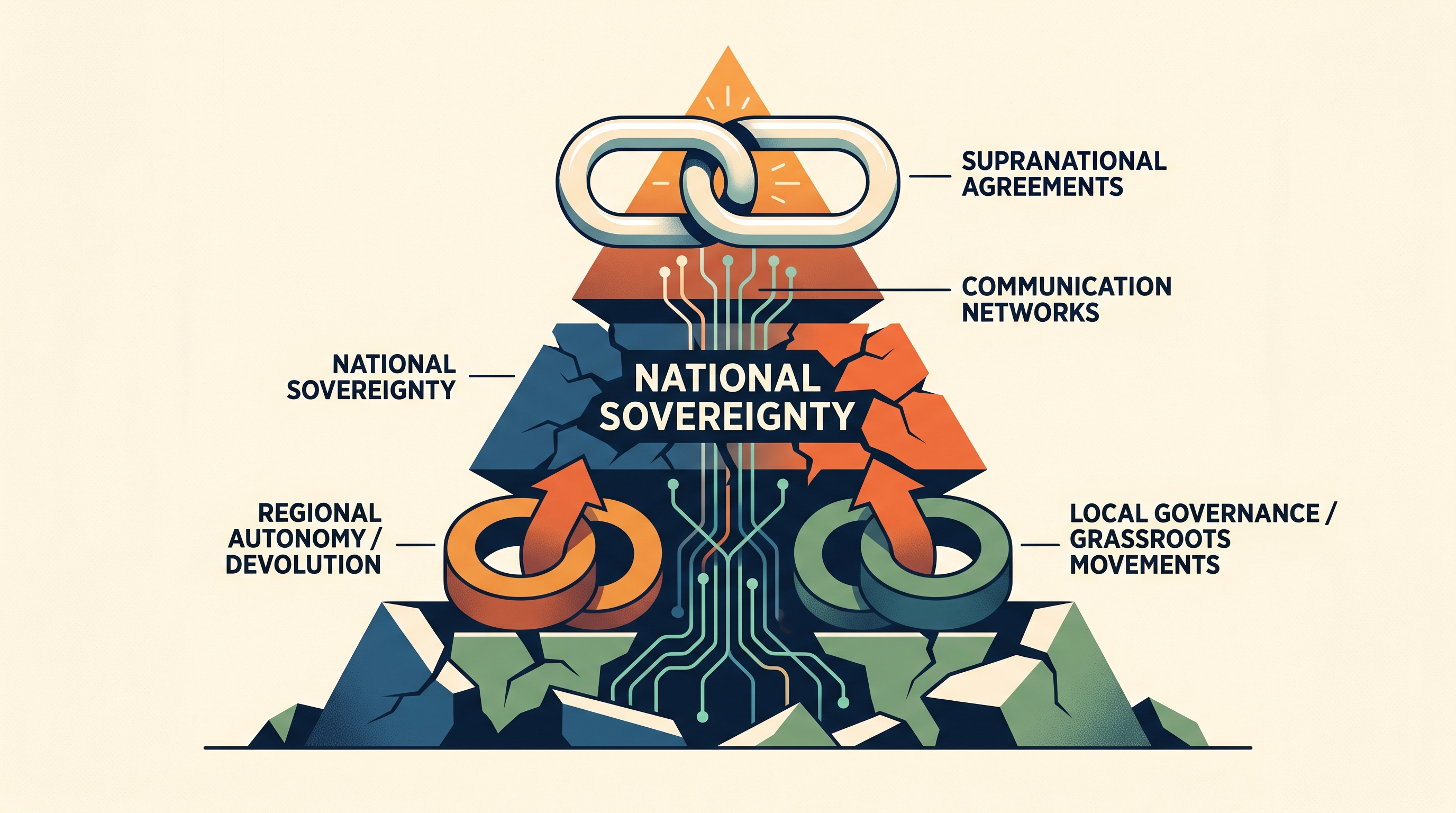
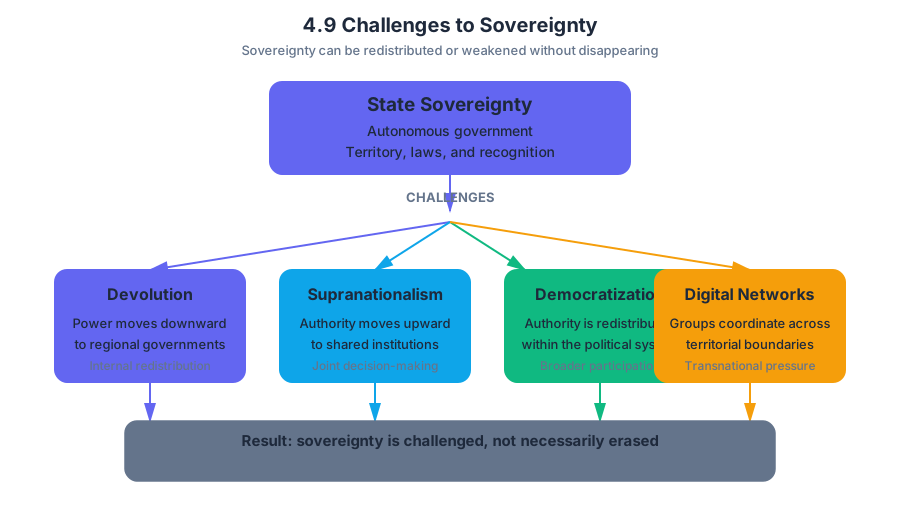
A state’s sovereignty can be challenged without immediately disappearing. Authority may be transferred downward to regional governments, shared upward with supranational organizations, redistributed through democratization, or weakened when communication technologies allow political groups to coordinate across boundaries.
Four pathways that challenge state sovereignty
1. Devolution: authority moves within the state
Devolution is the transfer of some powers from a national government to regional or local authorities. The state remains formally sovereign, but its central government no longer makes every decision uniformly across its territory.
A geographically distinct region may demand control over education, taxation, language policy, policing, or natural resources. In Scotland, proposals for independence from the United Kingdom illustrate a challenge to the United Kingdom’s sovereignty. Strictly speaking, devolution itself grants regional authority while keeping the region inside the existing state; full independence would create a separate sovereign state. A devolutionary demand can therefore be an alternative to independence or a step toward it.
Territoriality—the attempt to control a specific geographic area—helps explain why devolutionary movements are often regional. A region with a clear boundary, distinctive cultural identity, separate historical institutions, or concentrated resources may argue that its residents should exercise greater authority over the territory they inhabit.
Named misconception: Devolution does not automatically mean secession. Devolution redistributes authority inside an existing state; secession creates a new state claiming complete sovereignty.
2. Supranationalism: authority is shared above the state
Supranationalism occurs when states cooperate through an organization whose decisions or agreements influence member states. By joining such an organization, a state may voluntarily limit some independent control over trade, laws, borders, currency, security, or environmental policy.
The United Kingdom’s decision to withdraw from the European Union can be interpreted through sovereignty. Supporters of withdrawal opposed external influence over British laws and governance and argued that decision-making should return to the national government. The issue was not simply geographic separation; it was a debate over who should possess final authority.
3. Democratization: authority is redistributed politically
Democratization expands popular participation and accountability in governance. Elections, constitutional reforms, voting rights, and stronger local representation can challenge a centralized government when citizens demand that authority be exercised more directly by elected communities rather than by a distant national leadership.
Territorial organization affects how democratization works. Unitary states concentrate constitutional authority in a national government, which may delegate powers to local governments but can often revise that arrangement. Federal states constitutionally divide authority between national and regional governments, giving regions more protected power.
| Territorial organization | Where authority is concentrated | Geographic consequence |
|---|---|---|
| Unitary state | Primarily at the national level | Local powers are generally delegated |
| Federal state | Constitutionally divided between national and regional levels | Regional governments possess protected authority |
Redrawing internal electoral districts also changes how political power is distributed. If boundary lines divide a concentrated minority among several districts, that group may lose the ability to elect preferred representatives. If lines concentrate the group into one district, it may gain representation there but have less influence elsewhere. Thus, a seemingly local map can alter political outcomes at the city or state scale.
4. Communication technologies connect challengers across space
Advances in communication technology—such as social media, encrypted messaging, and rapid video sharing—allow people separated by distance to feel politically connected. Groups can publicize grievances, coordinate demonstrations, recruit supporters, and seek alliances beyond their immediate territory.
This connectivity can support devolution by helping a regional movement coordinate demands; supranationalism by linking organizations across countries; and democratization by allowing citizens to circulate information outside state-controlled channels. Communication technology does not itself create sovereignty, but it can change the structure of a state or its system of governance by making challenges easier to organize.
Scale analysis: locating the challenge
Skill 5.B: Scale Analysis asks how a political process changes when examined at different geographic levels. A district-boundary dispute operates locally, a Scottish autonomy movement operates regionally and nationally, and the European Union operates supranationally. Communication networks can connect all of these scales, allowing a local grievance to attract national or international support.
Retrieval check: A region receives control over schools and taxation but remains part of its country. Is this devolution or independence, and what role does territoriality play? Answer: It is devolution because authority has moved to a regional government within the existing state. Territoriality matters because the region seeks control over a specific, geographically distinct area.
Source Materials
- AP Human Geography Course and Exam Description
- AP Human Geography Course and Exam Description Clarifications and Corrections
- AP Human Geography Course Overview
- AP Human Geography Course at a Glance
- AP Human Geography Course at a Glance Poster
- AP Human Geography
- AP Human Geography
- AP Human Geography Sample Syllabus 1